
Polycarbonate is the material people reach for when PETG softens and ABS is not quite tough enough. It takes more heat than any other everyday filament, survives knocks that crack other plastics, and comes in a translucent natural colour. It also asks more of the printer than anything else most hobbyists print. This guide sets out what each maker publishes, what PC is good for, and the hardware you need.
PC in numbers
These figures are live from our catalog: every plain PC line we track, with the maker's settings and the lowest current price per kg. Carbon-fibre PC is listed separately as PC-CF.
- Filaments we track
- 3 from 3 brands
- Nozzle, makers' range
- 250-285 °C
- typical middle 270 °C
- Bed, makers' range
- 90-120 °C
- Heat deflection (0.45 MPa)
- 111-113 °C
- median 112 °C, 3 data sheets
- Drying, makers' range
- 75-85 °C
- stated for 3 of 3 lines
- Density
- 1.19-1.22 g/cm³
- Length of 1 kg (1.75 mm)
- 345-350 m
- from makers' density
- Price per kg
- $23.99 to $47.31
- median $29.99, as of Nov 14, 2026
- Colours across these lines
- 10
- up to 5 in one line
- Printers in our catalog it fits
- 50 of 123 FDM printers
- enclosure needed
PrintStock catalog data for PC: makers' published values and in-stock US prices, updated with the catalog.
The PC lines we track today are Bambu Lab PC, Polymaker PolyLite PC and Prusament PC Blend, plus Prusament PC Blend Carbon Fiber under PC-CF. We add more as we verify makers' data.
Why PC: heat and toughness together
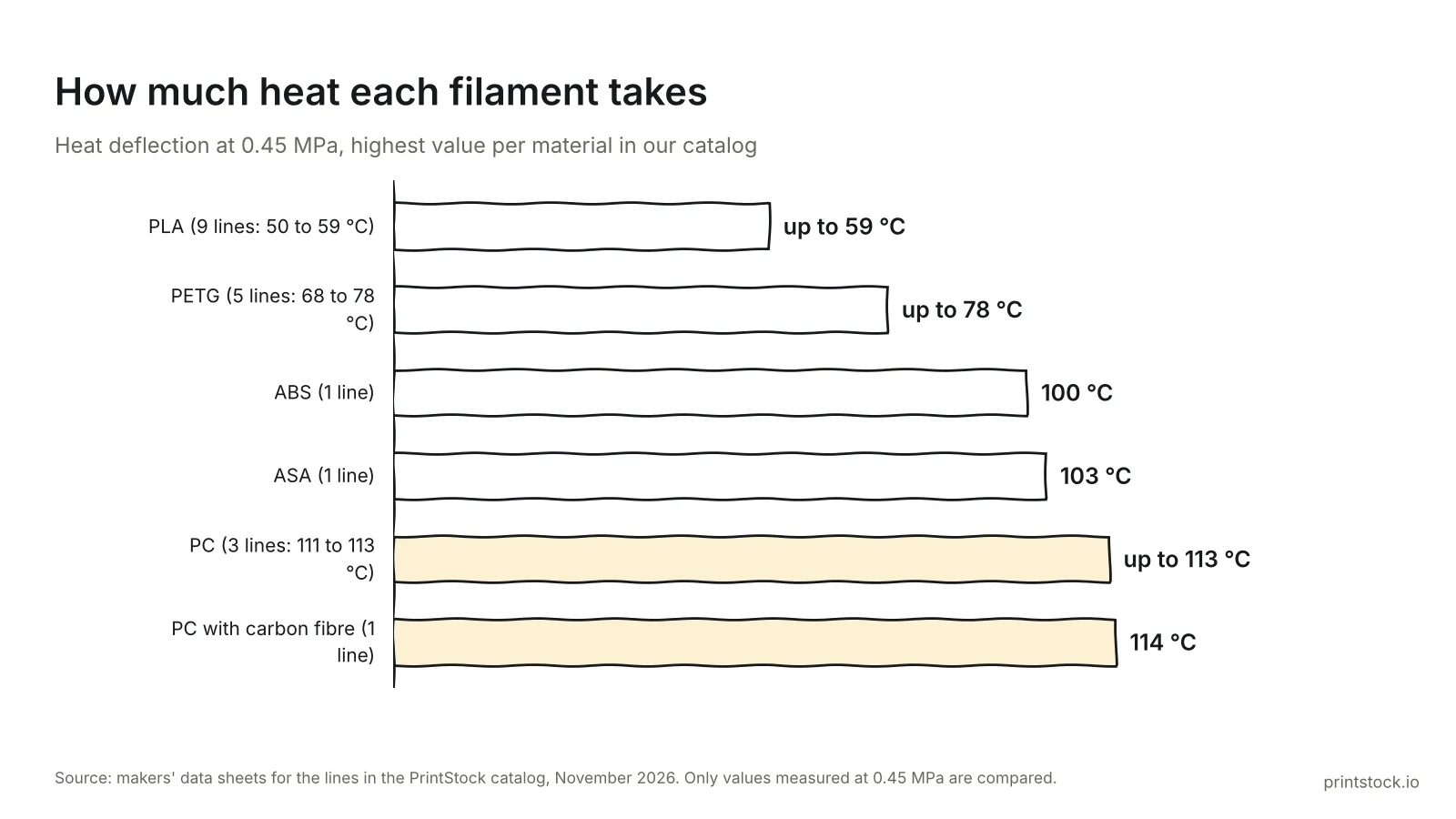
PC keeps its shape at temperatures that soften PLA, PETG and most ABS. Comparing like with like (heat deflection measured at 0.45 MPa), the PC lines in our catalog list 111 to 113 °C, and the carbon-fibre blend 114 °C. PETG lines list 68 to 78 °C and PLA lines 50 to 59 °C.
That makes PC a good fit for:
- brackets and housings next to motors, lamps or electronics that run warm;
- car interior parts that sit in a hot cabin;
- jigs, fixtures and tool holders that get knocked about;
- translucent light covers and diffusers.
It is not the answer for everything. PC is harder to print than PETG or ASA, needs more energy and an enclosure, and costs more. For parts that only need to survive a warm room, PETG is usually enough; for outdoor parts in the sun, ASA is the easier choice. See the PETG and ASA guides.
PC settings by brand
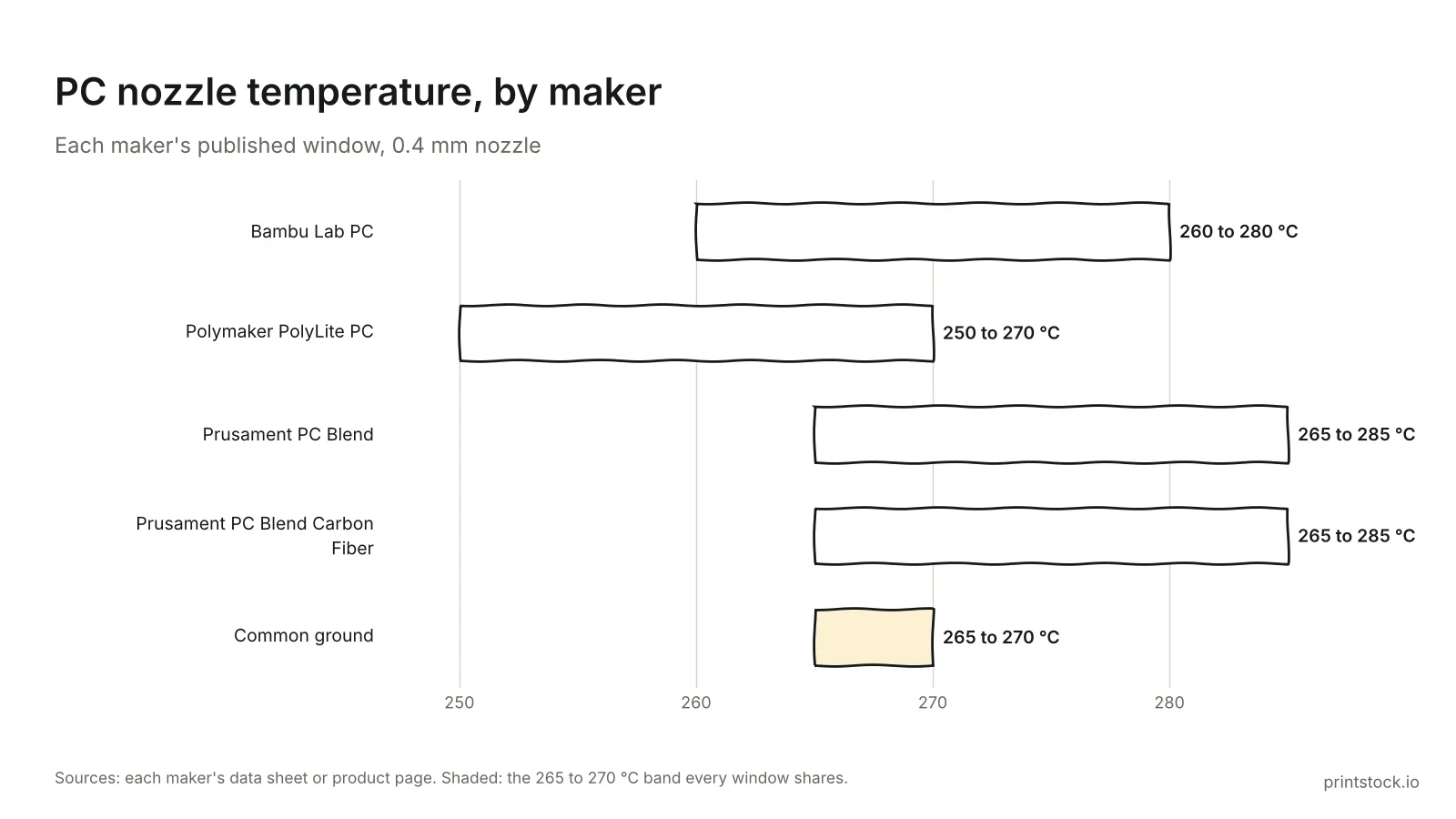
Makers' nozzle windows run from 250 to 285 °C, and every one includes 265 to 270 °C. Beds run from 90 to 120 °C. This table comes from our catalog, with each maker's numbers as published; it includes the carbon-fibre blend.
| Filament | Nozzle (maker) | Bed (maker) | Drying (maker) | Heat deflection | Length per spool | From, per kg |
|---|---|---|---|---|---|---|
| Bambu Lab PCBambu Lab | 260 to 280 °C | 90 to 110 °C | 80 °C, 8 h | 112 °C at 0.45 MPa | ≈ 345 m | $23.99as of Nov 14, 2026 |
| Polymaker PolyLite PCPolymaker | 250 to 270 °C | 90 to 105 °C | 75 °C, 6 h | 111 °C at 0.45 MPa | ≈ 350 m | $29.99as of Nov 14, 2026 |
| Prusament PC BlendPrusa Research | 265 to 285 °C | 100 to 120 °C | 85 °C, 5 h | 113 °C at 0.45 MPa | ≈ 305 m | $47.31as of Nov 14, 2026 |
| Prusament PC Blend Carbon FiberPrusa Research | 265 to 285 °C | 100 to 120 °C | Not stated | 114 °C at 0.45 MPa | ≈ 275 m | $77.09as of Nov 11, 2026 |
Live from our catalog: settings, drying and heat deflection as each maker publishes them (heat deflection is comparable only at the same load); length is calculated by PrintStock. Open a filament for every offer.
A few practical notes from the makers' own guidance:
- Bed adhesion. Bambu Lab recommends glue on an engineering or PEI plate; Polymaker recommends a dedicated PC adhesive and a brim or raft; Prusa recommends its satin sheet and, on some sheets, glue as a separating layer so the part does not bond too strongly.
- Cooling. Little or none. Polymaker says fan off; Prusa suggests about 20%.
- Annealing. Polymaker says PolyLite PC can be annealed after printing (its page gives 90 °C for 2 hours); Bambu Lab's data sheets also give annealing temperatures. Annealing relieves internal stress; expect the part to shrink slightly.
What your printer needs
Three things: a hot enough nozzle, a hot enough bed, and an enclosure.
- Nozzle. At least 270 °C to use the middle of most makers' windows, and 285 °C for the full Prusament range. An all-metal hotend is a must.
- Bed. 100 °C or more; Prusa asks for 110 °C.
- Enclosure. PC shrinks as it cools. In open air, corners lift and layers split. Bambu Lab lists PC for enclosed printers only, and Polymaker says an enclosure that traps heat is required, with a heated chamber of 60 °C or more highly recommended for large parts. See 3D printer enclosures.
- Hardened nozzle for carbon-fibre PC. Prusament PC Blend Carbon Fiber is abrasive; brass nozzles wear out. See hardened steel nozzles.
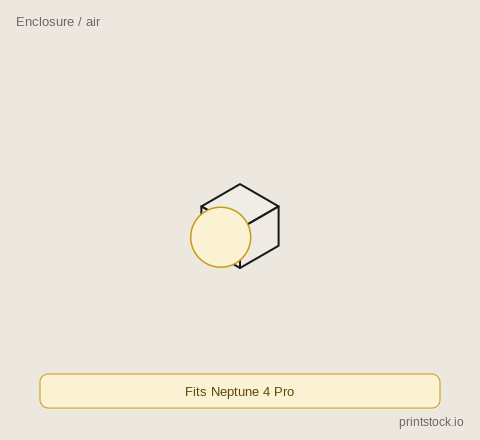
Each PC page in our catalog lists the printers it fits, worked out from each printer's published maximum nozzle and bed temperatures and whether it is enclosed.
Drying and storage
Dry PC before you print it, and keep it dry while it prints. Polycarbonate absorbs moisture from the air. Wet filament crackles at the nozzle, leaves bubbles and stringing, and prints weak layers.
- Bambu Lab: 80 °C for 8 hours in a drying oven, and store below 20% humidity with desiccant.
- Polymaker: 75 °C for 6 hours.
- Prusa says its PC Blend absorbs much less moisture than ordinary polycarbonate, and lists 0.13% absorption in 24 hours on its data sheet.
Feed PC straight from a dry box during long prints. Our filament drying guide covers dryers and ovens.
Pure PC, PC blends and PC with carbon fibre
Nearly all desktop PC is a blend or a modified grade, because pure polycarbonate is very hard to print. Prusa says pure PC is not suitable for 3D printing because of bad surface adhesion and significant thermal expansion, which is why its PC Blend contains additives that improve adhesion and reduce warping and cracking.
- PC blends trade a little of pure PC's heat resistance for far easier printing. Pure polycarbonate softens at around 147 °C; the blends in our catalog are rated for heat deflection around 111 to 113 °C at 0.45 MPa.
- PC-ABS is a common blend that prints more like ABS, with less heat resistance than PC.
- PC with carbon fibre (PC-CF) is stiffer and has a matte finish, and it needs a hardened nozzle. In our catalog that is Prusament PC Blend Carbon Fiber, with heat deflection of 114 °C at 0.45 MPa.
Common mistakes with PC
- Printing it on an open-frame printer. Small parts may survive; anything larger warps or splits.
- Skipping drying. The single most common cause of rough, weak PC prints.
- Running the part fan as for PLA. Cooling causes warping and poor layer bonding.
- Using a brass nozzle with carbon-fibre PC. It wears the nozzle quickly.
- Expecting glass-clear prints. Transparent PC prints translucent; clarity takes thin walls, slow printing or polishing.
Where to go from here
- PLA vs PETG vs ABS: the everyday materials compared.
- ABS and ASA: the next step down in heat resistance, and easier to print.
- Dry filament: drying times and temperatures.
- Browse all PC filament in our catalog, with prices as of the date shown.