
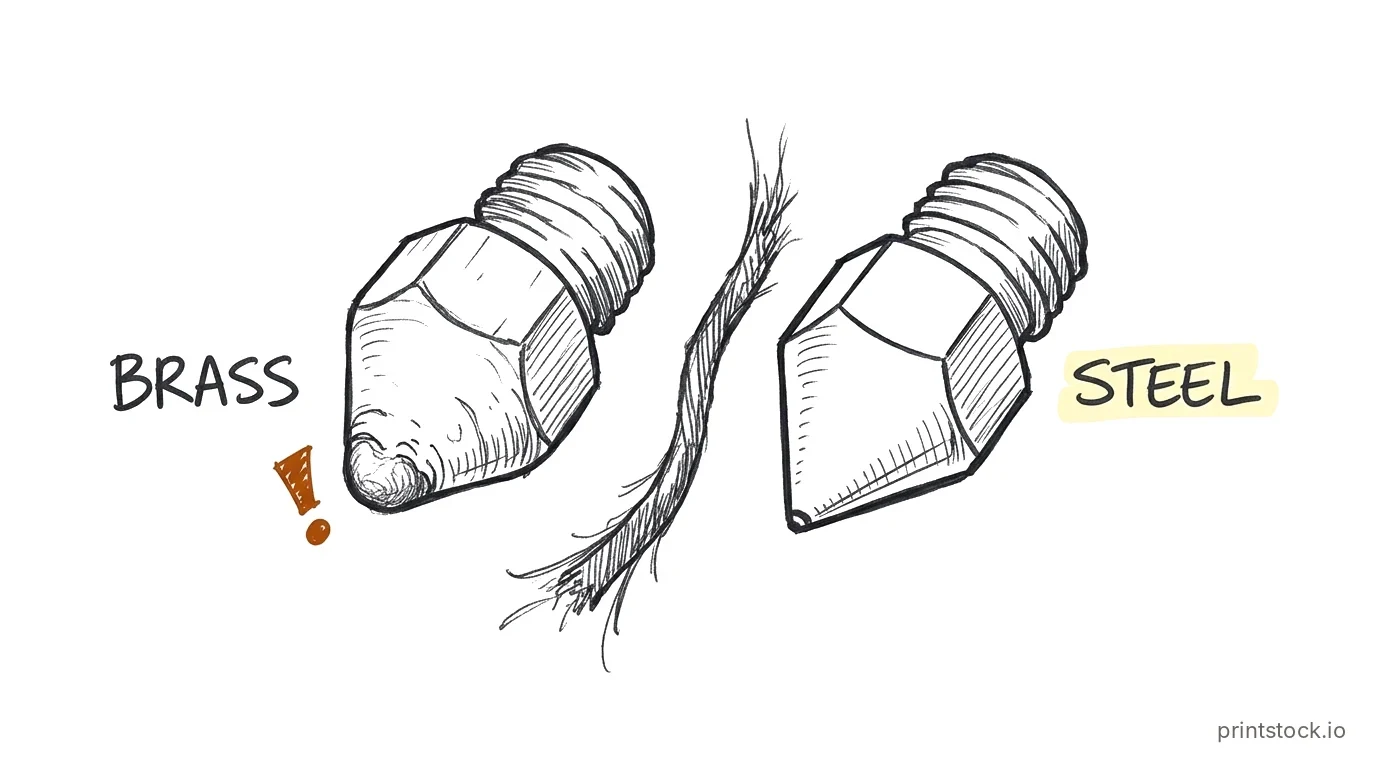
The nozzle is the cheapest part of a filament printer and one of the most important. Choose the wrong material for it and you either wear a nozzle out in a few spools or accept slower, hotter printing for no reason. The rule is simple: the material of the nozzle should match how abrasive your filament is. This guide explains each option and what changes when you switch.
Do you need a hardened steel nozzle?
You need a hardened steel nozzle only if you print abrasive filaments: carbon fibre, glass fibre, metal-filled, wood-filled or glow-in-the-dark blends. For everything else, a brass or stainless steel nozzle is the better choice.
Abrasive filaments contain hard particles, like chopped carbon or glass fibres or metal powder, that act like sandpaper as they pass through the nozzle. In a soft nozzle they widen the hole and round off the tip, which causes under-extrusion, poor detail and inconsistent first layers. Ordinary PLA, PETG, ABS, ASA, TPU and plain nylon do not contain such particles and do not wear a nozzle noticeably.
How nozzle materials compare
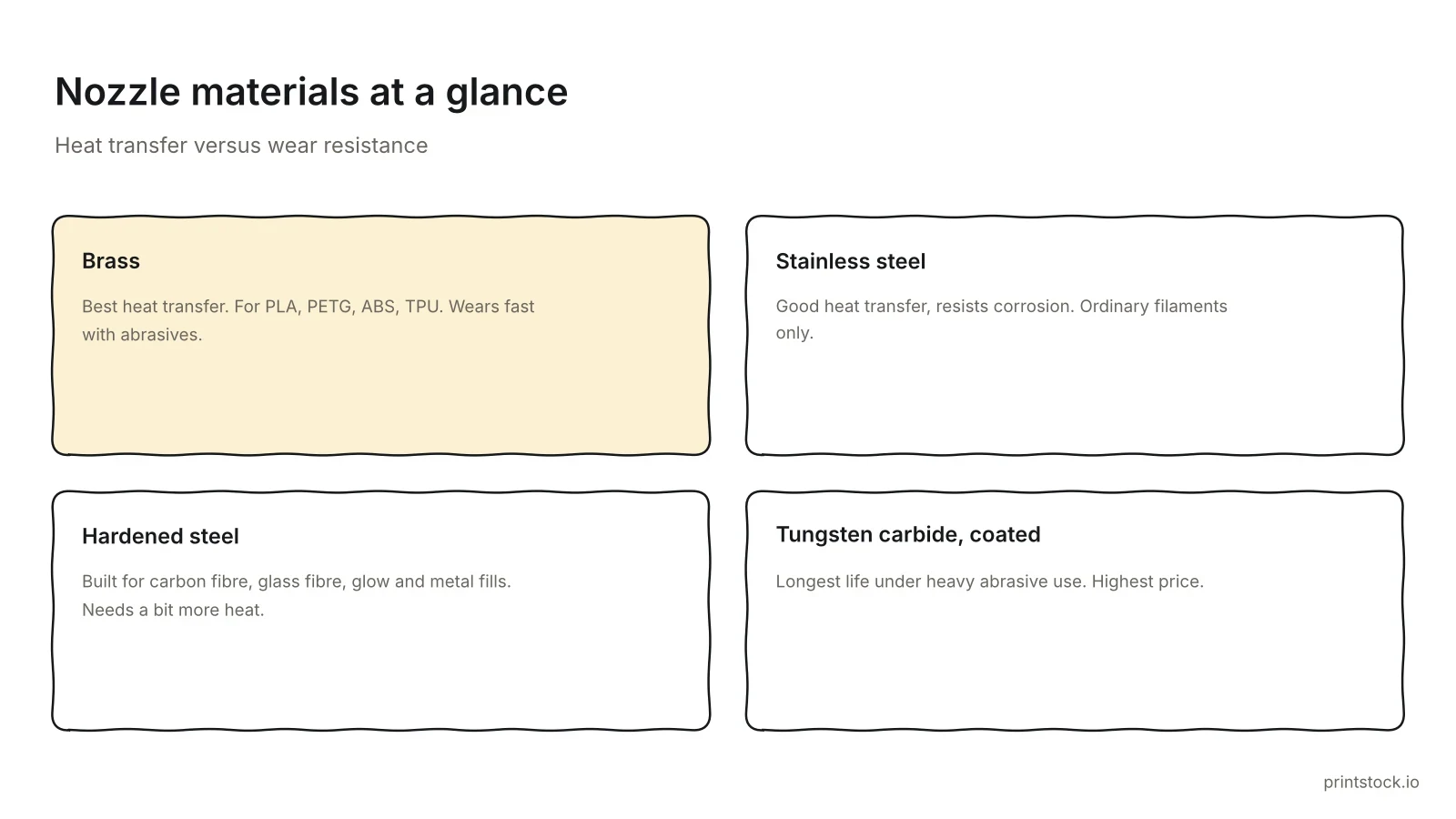
Brass transfers heat best; hardened steel and harder materials resist wear best. Every nozzle material sits somewhere between those two qualities.
| Brass | Stainless steel | Hardened steel | Tungsten carbide or coated |
|---|---|---|---|---|
Heat transfer | Excellent | Good | Lower | Good to very good |
Wear resistance | Low | Medium | High | Very high |
Ordinary filaments | Ideal | Ideal | Fine, may need more heat | Fine |
Abrasive filaments | Wears fast | Not recommended | Designed for them | Designed for heavy use |
Price | Lowest | Low | Medium | Highest |
Brass is the classic nozzle material. Prusa's support guide describes it as having excellent heat conductivity and being tough enough for most common filaments, but wearing too quickly with abrasives. Stainless steel is used as the standard nozzle on several Bambu Lab printers; it resists corrosion and wears a little better than brass, but Bambu Lab's wiki makes clear it is meant for non-abrasive filaments. Hardened steel is heat-treated to resist abrasion and is the standard choice for fibre-filled materials. Tungsten carbide and coated hardened steel nozzles, such as the hardened steel nozzles with a wear-resistant coating that Prusa sells for abrasive materials, last longest under heavy use and often conduct heat better than plain hardened steel, at a higher price.
Which nozzle does your printer come with?
Printers ship with different nozzles, so check before you buy abrasive filament. Bambu Lab's wiki, for example, states that the P1S comes with a stainless steel hotend and extruder, suited to PLA, PETG, ABS, nylon and TPU, while the X1C ships with a hardened steel nozzle. The A1 also ships with stainless steel.
Check your printer's specifications or manual for its stock nozzle. If yours came with brass or stainless steel and you want to print carbon-fibre PETG or similar, plan the upgrade before the first spool rather than after the nozzle starts under-extruding. Here are the nozzles and hotends in our catalog, matched to the printers they fit:
| Part | Fits | From |
|---|---|---|
| AOSEED X-MAKER JOY Nozzle ModuleAoseed | Aoseed X-Maker Joy | $19.99as of Nov 12, 2026 |
| 0.4 mm Hotend Kit for Centauri 2 Series/Centauri Carbon 2 Series (2pcs)Elegoo | Elegoo Centauri Carbon 2 | $29.99as of Nov 11, 2026 |
| Creality × Phaetus Silicon Carbide Nozzle 0.4/0.6 mmCreality | Creality K2, Creality K2 Pro, Creality K2 Plus | $27.71as of Nov 11, 2026 |
| Artillery M1 Ceramic Heater and ThermistorArtillery | Artillery M1 Pro, Artillery M1 Pro S1 | $16.99as of Nov 12, 2026 |
| Flashforge AD5X Nozzle AssemblyFlashforge | Flashforge AD5X | $25as of Nov 12, 2026 |
| Bambu High Flow Hotend - Bambu Lab H3CBambu Lab | Bambu Lab H3C | $59.99as of Nov 11, 2026 |
| FLSUN S1 Pro Hardened Steel Nozzles (5 pcs)FLSUN | FLSUN S1 Pro | $36.99as of Nov 12, 2026 |
| Ender-5 Max Ceramic Heating Block KitCreality | Creality Ender-5 Max | $24.99as of Nov 11, 2026 |
| Hardened Steel Nozzle Kit for Neptune 4/4 ProElegoo | Elegoo Neptune 4 Pro | $11.99as of Nov 11, 2026 |
| Flashforge AD5X Heat SinkFlashforge | Flashforge AD5X | $29as of Nov 12, 2026 |
| Longer LK5 Pro Nozzle KitLonger | Longer LK5 Pro | $21.99as of Nov 12, 2026 |
| FLSUN S1 Pro Hotend KitFLSUN | FLSUN S1 Pro | $60.27as of Nov 12, 2026 |
Live from our catalog. Open a part for every compatible printer and all prices.
What changes when you switch to hardened steel
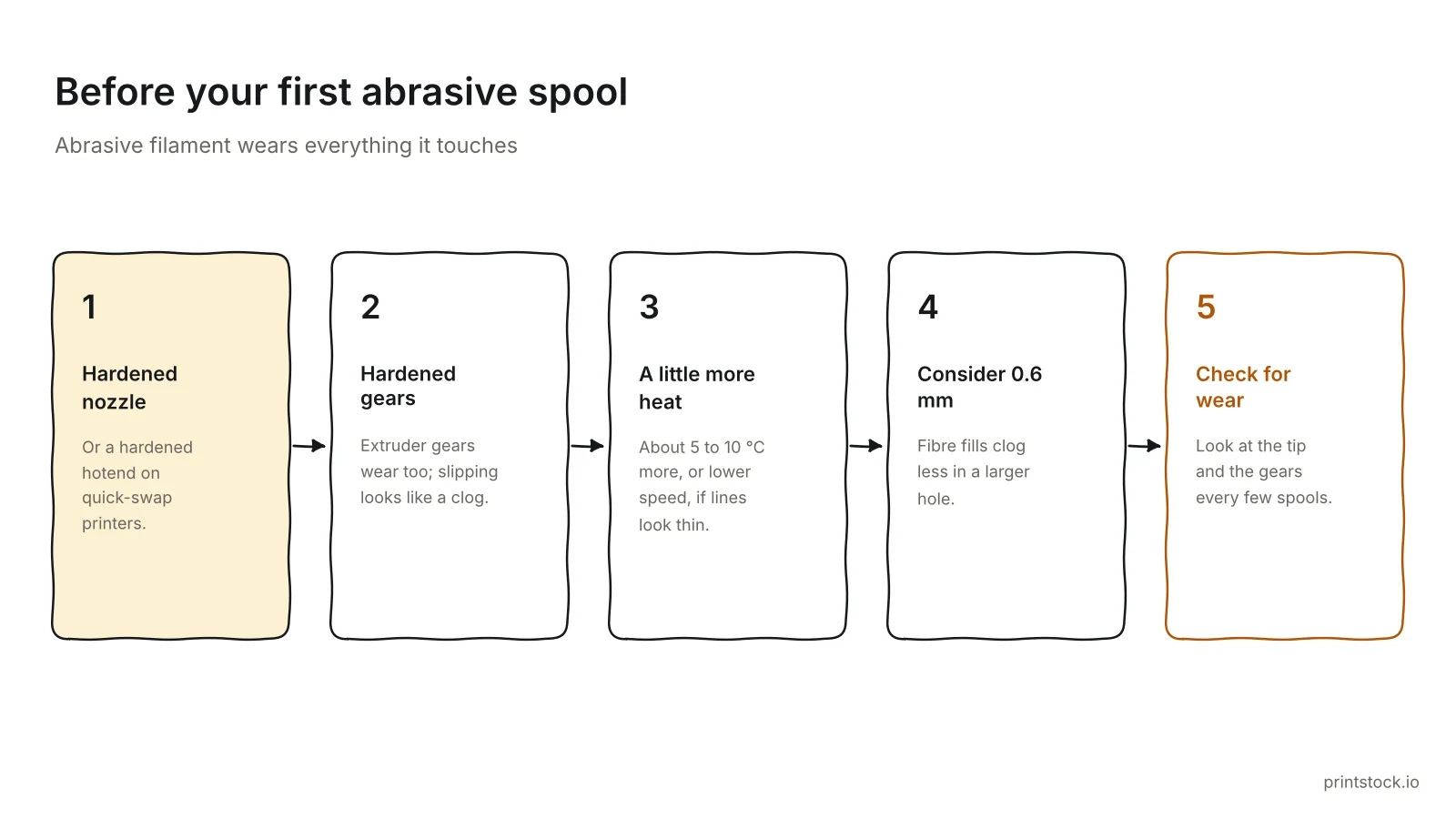
Hardened steel heats the filament less efficiently, so you may need a slightly higher temperature or a lower speed. This is the one real downside, and it matters most on fast printers.
Because steel conducts heat less well than brass, plastic leaving a hardened nozzle can be a little cooler at the same set temperature, especially at high flow rates. If you see under-extrusion or weak layers after switching, raise the nozzle temperature by about 5 to 10 °C or reduce the maximum flow or speed. Printer makers' profiles for their own hardened nozzles usually account for this already.
Do you also need hardened extruder gears?
Yes, for regular abrasive printing. The same particles that wear the nozzle also wear the extruder gears that grip the filament, and worn gears slip and under-extrude.
Bambu Lab's wiki recommends upgrading both the hotend and the extruder to hardened steel on the P1S for carbon fibre, glass fibre, metal-filled and glow-in-the-dark filaments. If you print abrasives only occasionally, a hardened nozzle alone is a reasonable first step, but check the extruder gears for wear and keep a spare.
These are the abrasive filaments we currently track and the lowest price per kilogram we have found:
| Material | Filaments we track | Nozzle range from makers | From, per kg |
|---|---|---|---|
| PLA-CF | 3 | 190 to 240 °C | $25.78as of Nov 17, 2026 |
| PETG-CF | 3 | 240 to 275 °C | $25.49as of Nov 11, 2026 |
Live from our catalog: nozzle ranges span the settings filament makers publish; prices are in-stock offers in US dollars.
Signs your nozzle is worn
A worn nozzle prints like a partly clogged one: thin, gappy lines and a first layer that will not behave. If cleaning and cold pulls do not fix it, look at the nozzle itself.
- The tip looks flattened, rounded or shiny on the end.
- The hole is visibly larger than when new.
- Under-extrusion or inconsistent lines that cleaning does not fix.
- Detail gets softer over time with the same settings.
- You printed abrasive filament with a brass or stainless nozzle.
Our guide to a clogged 3D printer nozzle covers how to rule out a clog before replacing the nozzle.
Common mistakes
The most common mistake is printing a spool of carbon-fibre filament on a stock brass or stainless nozzle "just once". One spool can be enough to change how the nozzle prints.
- Fitting a hardened nozzle for plain PLA. It works, but brass or stainless prints it more efficiently.
- Forgetting the extruder. Worn gears cause slipping that looks like a clog.
- Not adjusting temperature. Under-extrusion after switching to hardened steel is usually a few degrees.
- Buying by thread size alone. Nozzle length and seat must match your hotend; buy the type listed for your printer.
Where to go from here
Browse nozzles and hotends for your printer in our catalog, each matched to specific models with prices we check. For the filament side, read PLA vs PETG vs ABS, and if you are fighting a nozzle that will not extrude, start with how to unclog a nozzle.