
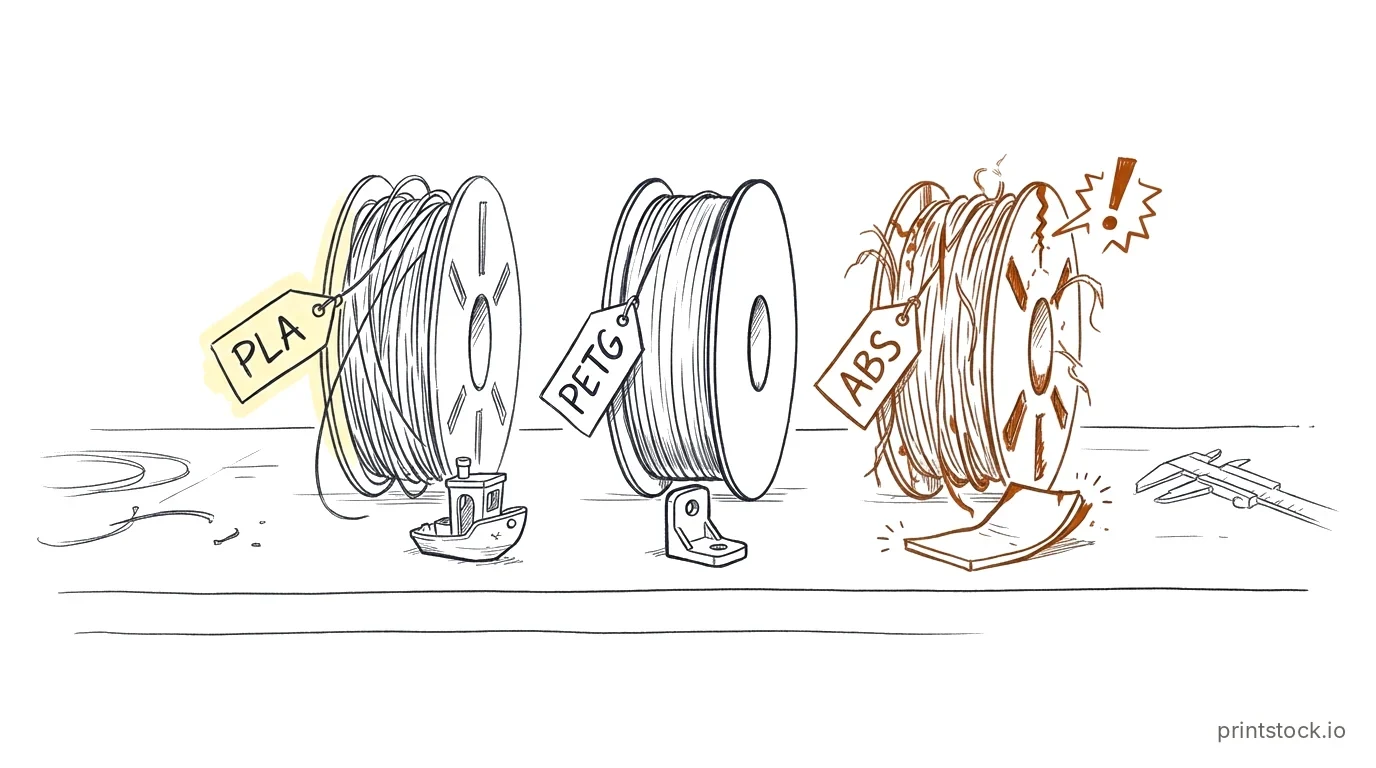
Walk into any 3D printing forum and you will find the same question every day: PLA, PETG or ABS? The good news is that the answer is rarely complicated. Each of the three has one clear strength and one clear weakness, and once you know them, the choice follows from what the part has to do.
PLA, PETG or ABS: the short answer
PLA is the right choice for most prints, PETG for tough practical parts, and ABS (or ASA) only for parts that must survive heat. If you are new to 3D printing, start with PLA, then add PETG when a part needs to take knocks or sit somewhere warm.
| PLA | PETG | ABS |
|---|---|---|---|
Ease of printing | Easiest | Easy, strings more | Hard without an enclosure |
Nozzle temperature (example data sheet) | 210 °C, plus or minus 10 | 250 °C, plus or minus 10 | 240 to 270 °C |
Bed temperature | 40 to 60 °C | 80 °C, plus or minus 10 | 80 to 100 °C |
Part cooling fan | Full | About half | Off or low |
Enclosure | Not needed | Not needed | Needed |
Behaviour under load | Stiff but brittle | Tough, bends first | Tough, impact resistant |
Smell and fumes | Mild | Mild | Strong, more particles |
Typical uses | Models, prototypes, toys, decor | Brackets, holders, enclosures, outdoor shade | Car parts, housings near heat, tools |
The PLA and PETG settings are from Prusa's data sheets for its own filaments, and the ABS settings from Bambu Lab's ABS data sheet. Every brand publishes its own ranges, and they differ by a few degrees, so always start from the numbers on your spool or in your slicer profile.
Here is what our catalog currently shows for these materials, side by side: how many filaments we track, the ranges their makers publish, heat deflection from their data sheets, and prices per kilogram.
| From our catalog | PLA | PETG | ABS | ASA |
|---|---|---|---|---|
| Filaments we track | 41 (10 brands) | 16 (10 brands) | 6 (6 brands) | 4 (4 brands) |
| Nozzle, makers' range | 180-260 °C | 220-270 °C | 230-280 °C | 200-275 °C |
| Bed, makers' range | 0-70 °C | 60-90 °C | 75-110 °C | 40-115 °C |
| Heat deflection, median (0.45 MPa) | 55 °C (9 sheets) | 69 °C (5 sheets) | 100 °C (1 sheets) | 103 °C (1 sheets) |
| Drying, makers' range | 45-65 °C | 55-65 °C | 70-85 °C | 60-80 °C |
| Density | 1.17-1.37 g/cm³ | 1.22-1.3 g/cm³ | 1.02-1.05 g/cm³ | 1.04-1.13 g/cm³ |
| Length of 1 kg | 305-355 m | 320-340 m | 395-410 m | 370-400 m |
| Median price per kg | $18.22 | $14.95 | $17.28 | $28.97 |
| Cheapest per kg | $9.34 | $9.71 | $13.45 | $20.56 |
| FDM printers it fits | 97 of 123 | 88 of 123 | 52 of 123 | 51 of 123 |
| Needs an enclosure | No | No | Yes | Yes |
PrintStock catalog data: makers' published values and in-stock US prices as of Nov 13, 2026.
For just the two most common choices, see PLA vs PETG. Each material also has its own page: PLA, PETG, ABS and ASA.
PLA: the easy default
PLA (polylactic acid) is the easiest filament to print and the one most printers are tuned for out of the box. It prints at low temperatures, barely warps, needs no enclosure and gives sharp detail with clean overhangs.
That ease comes from its chemistry. PLA shrinks very little as it cools, so corners stay down on the plate, and it hardens quickly under a fan, which keeps bridges and overhangs neat. It is also the cheapest of the three and comes in the widest choice of colours and effects, from matte and silk to wood-filled and glow-in-the-dark.
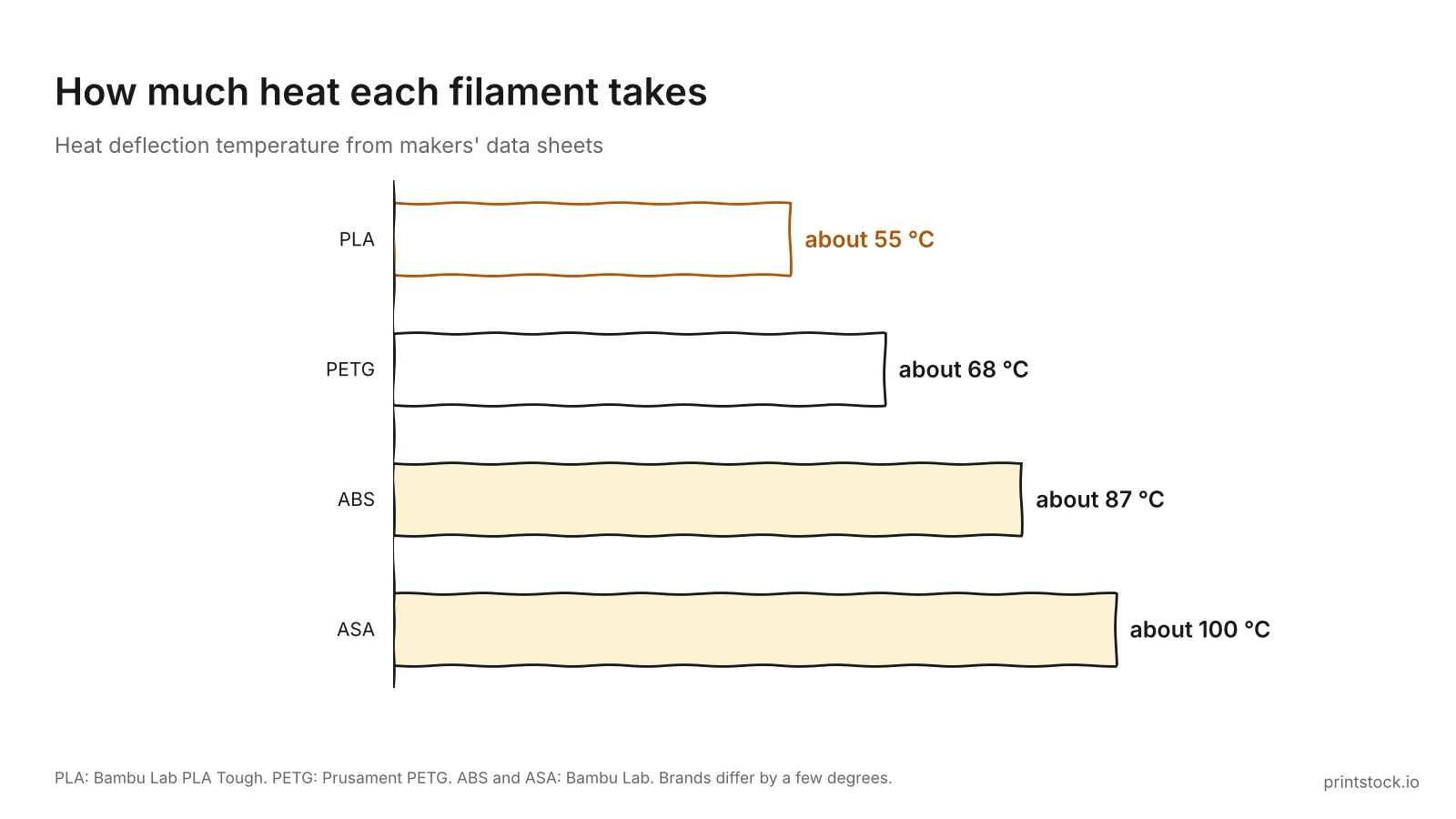
The weak point is heat. PLA starts to soften at around 55 °C; Bambu Lab's data sheet for its tough PLA gives a heat deflection temperature of 55 °C, and Prusa's figures are similar. That is warmer than a room but well below the inside of a parked car in summer or the area next to a motor. PLA is also brittle: a PLA hook holds a lot of weight until it suddenly snaps instead of bending.
Choose PLA for: display models, miniatures and figures, prototypes, organisers, cosplay pieces, toys kept indoors, and anything where looks matter more than toughness.
PETG: tough and forgiving with heat
PETG is the step up for practical parts: tougher than PLA, more heat resistant, and still easy to print without an enclosure. It is the same family of plastic as drink bottles, modified with glycol so it prints well.
Prusa's data sheet gives PETG a heat deflection temperature of 68 °C, roughly 13 °C better than PLA, and describes it as tougher and less brittle. In practice a PETG part bends and absorbs an impact where a PLA part would crack, and layers bond strongly, so it suits clips, brackets, holders, fittings and anything that gets handled. It also copes with water and some chemicals better than PLA.
The trade-offs are small but real. PETG prints hotter, around 250 °C at the nozzle and 80 °C on the bed, and with less cooling, so bridges and steep overhangs are a little rougher. It strings more than PLA, especially if the spool has absorbed moisture. And it sticks very well, sometimes too well: Prusa advises against printing PETG directly on a smooth PEI sheet because the bond can tear the coating, and recommends a textured or satin sheet, or glue as a release layer.
Choose PETG for: functional parts, mounts and brackets, tool holders, parts near warm electronics, outdoor parts in shade, and anything that needs to flex or survive a drop.
ABS and ASA: for heat and harsh conditions
ABS is the choice when a part has to survive real heat, but it is the hardest of the three to print well. It is the plastic of LEGO bricks and many car interior parts, and it handles temperatures that would deform PLA and PETG.
Bambu Lab's data sheet gives its ABS a heat deflection temperature of about 87 °C and lists a chamber temperature of 45 to 60 °C for printing. That second number explains the difficulty. ABS shrinks noticeably as it cools, so in open air the corners curl up from the plate and tall parts crack between layers. A heated enclosure keeps the whole part warm while it prints and solves most of that. ABS can also be smoothed to a glossy finish with acetone vapour, which is popular for display parts and prototypes.
ASA is the outdoor cousin of ABS. It prints the same way, needs the same enclosure, but resists UV light and weather much better, and Bambu Lab rates it even higher for heat, at 100 °C. For anything that lives outside in the sun, from garden fittings to car exterior parts, ASA is usually the better choice of the two.
The other cost of ABS and ASA is air quality. Research by UL Chemical Safety and Georgia Tech found that ABS tends to produce more ultrafine particles than PLA and gives off a noticeable smell. Print these materials in an enclosure with a filter or a vent to the outside, and not in a bedroom.
Choose ABS or ASA for: parts in cars, housings near motors or lamps, tools, parts that will be acetone-smoothed, and (ASA) anything outdoors in sunlight.
Which filament for which job?
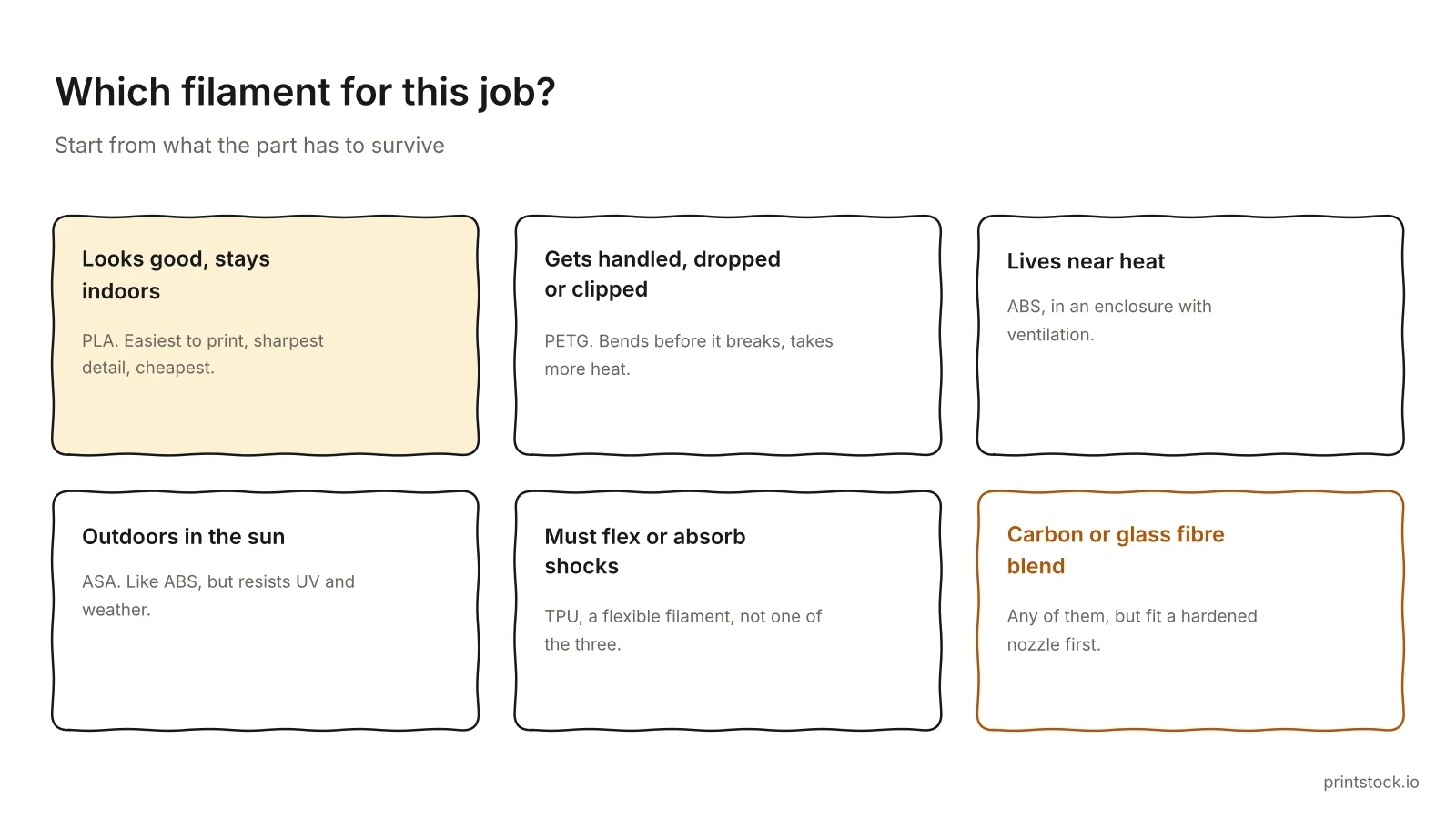
Choose by what the part has to survive, not by what sounds strongest. Strength figures on data sheets are measured on perfectly printed test bars; in a real part, the right material printed well beats the "strongest" material printed badly.
A few practical rules make the choice quick. If the part only has to look good and stays indoors, use PLA. If someone will lean on it, drop it, clip it or screw into it, use PETG. If it will get hot, use ABS; if it will get hot in the sun, use ASA. If it must bend or absorb shocks like a phone case or a seal, look at flexible TPU instead of any of the three. And if you want the stiffness of a carbon-fibre or glass-fibre filled version of any of these, budget for a hardened nozzle, because those blends wear brass quickly.
Is it hard to switch from PLA to PETG or ABS?
Switching from PLA to PETG is easy; switching to ABS mostly depends on whether your printer has an enclosure. The fear many people have, that a new material will clog the nozzle or wreck the plate, is mostly about a few settings.
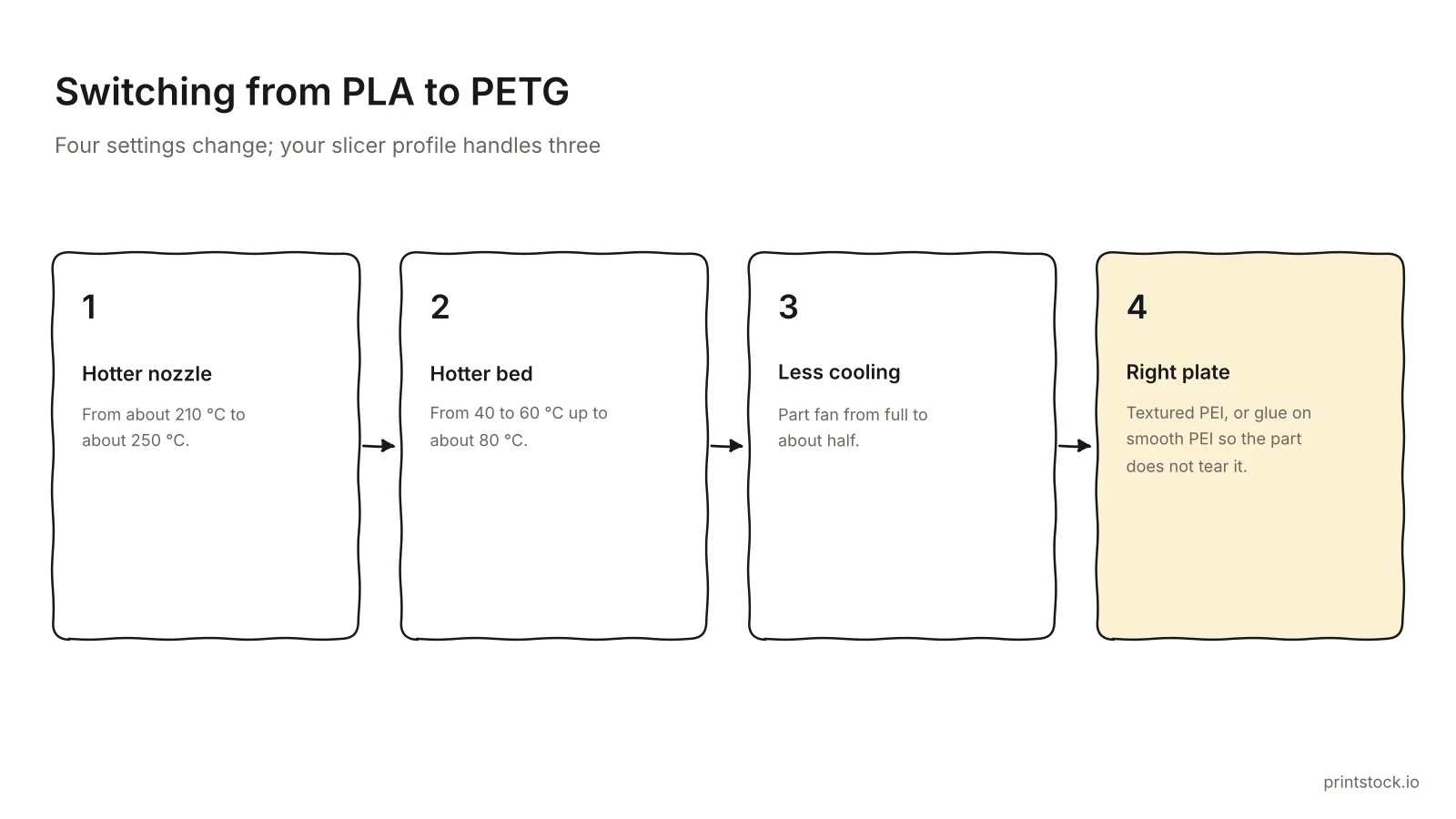
Going from PLA to PETG means four changes: a hotter nozzle, a hotter bed, less part cooling, and the right build surface. Your slicer's PETG profile sets the first three for you. The fourth is up to you: use a textured PEI plate or put a thin layer of glue on a smooth one. When you go back to PLA, purge the hotter PETG out at PETG temperature first, then drop to PLA temperature, so nothing cooks inside the nozzle.
ABS is a bigger step. On an open printer you will fight warping and cracking, and no setting fully replaces an enclosure. If your printer is open, either add one or choose PETG unless the part truly needs ABS-level heat resistance. These are the enclosures, dryers and filters from our catalog, matched to specific printers:
Common mistakes when choosing filament
The most common mistake is choosing ABS for strength when PETG would do the job with far less trouble. ABS earns its place only when heat resistance or acetone smoothing matters.
Other mistakes come up again and again:
- Leaving PETG and ABS spools open to the air. Both absorb moisture, which shows up as stringing, popping and weak layers. Store them sealed with desiccant and dry them when they act up.
- Printing PETG on smooth PEI without glue. It can bond so strongly that it tears the coating when you remove the part.
- Using PLA for anything in a car. It may look fine in spring and sag in summer.
- Printing ABS in a bedroom or a small closed room. The smell is a warning; ventilate or filter.
- Treating data sheet strength as a guarantee. Wall count, infill and print orientation change a part's strength more than switching between PLA and PETG.
Where to go from here
Browse filaments by material to compare brands with the print settings their makers publish and the prices we last checked. If you are still choosing a machine, the printer catalog shows which models come with an enclosure, which matters most if you plan to print ABS or ASA. For the basics of how a printer turns a spool into a part, read how a 3D printer works.
Settled on PETG? See the PETG settings by brand. Going for ABS or ASA? Read about enclosures, fumes and filters first.