
PLA is the filament most people start with and many never leave. It prints on almost any machine, it is the cheapest per kilogram, and it gives sharp, accurate parts. This page puts numbers on it: the settings each maker in our catalog publishes, its heat limit from their data sheets, and what it costs today.
PLA at a glance
PLA is easy and accurate, and its limit is heat. These figures come live from our catalog: every PLA line we track, the values its maker publishes, and current in-stock prices.
- Filaments we track
- 41 from 10 brands
- Nozzle, makers' range
- 180-260 °C
- typical middle 210 °C
- Bed, makers' range
- 0-70 °C
- Heat deflection (0.45 MPa)
- 50-59.3 °C
- median 55 °C, 9 data sheets
- Drying, makers' range
- 45-65 °C
- stated for 24 of 41 lines
- Density
- 1.17-1.37 g/cm³
- Length of 1 kg (1.75 mm)
- 305-355 m
- from makers' density
- Price per kg
- $9.34 to $56.05
- median $18.22, as of Nov 11, 2026
- Colours across these lines
- 833
- up to 49 in one line
- Printers in our catalog it fits
- 97 of 123 FDM printers
PrintStock catalog data for PLA: makers' published values and in-stock US prices, updated with the catalog.
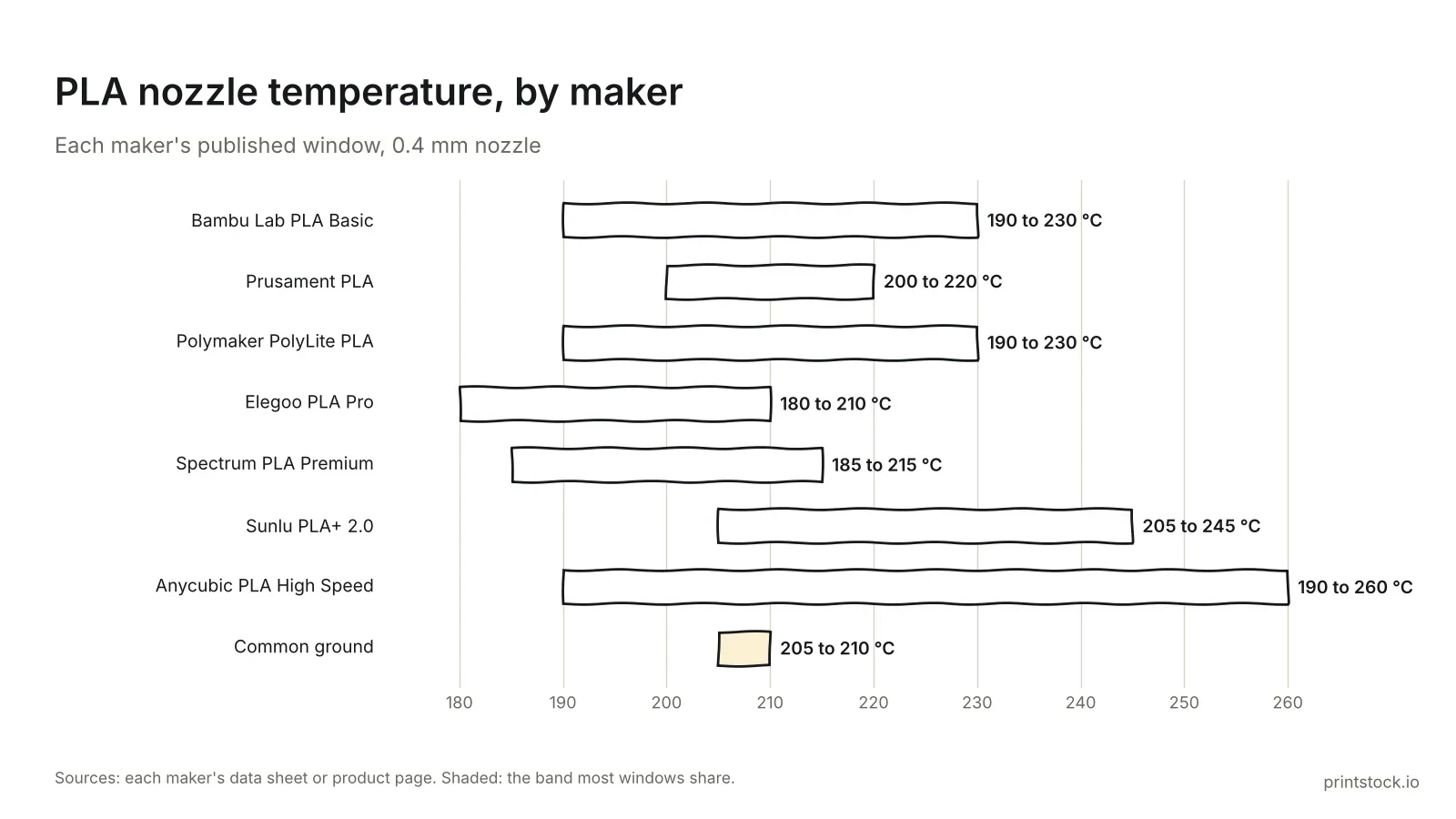
The spread matters. A "PLA" spool from one brand can want 20 °C more at the nozzle than another, and densities differ enough that a kilogram of one brand gives noticeably more metres of filament than another. Always start from the numbers for your spool.
PLA print settings by brand
Use your spool's own range, then tune within it. The table lists every PLA line in our catalog with the settings its maker publishes, the drying recommendation and heat deflection where the data sheet states them, and the cheapest price per kilogram we have found.
| Filament | Nozzle (maker) | Bed (maker) | Drying (maker) | Heat deflection | Length per spool | From, per kg |
|---|---|---|---|---|---|---|
| Anycubic PLA+Anycubic | 190 to 230 °C | 55 to 65 °C | 45-50 °C, 6-8 h | 50 °C at 0.45 MPa | ≈ 345 m | $11.95as of Nov 11, 2026 |
| Anycubic PLA BasicAnycubic | 190 to 230 °C | 55 to 65 °C | 50-60 °C, 6-8 h | 55 °C at 0.45 MPa | ≈ 335 m | $11.20as of Nov 11, 2026 |
| Anycubic PLA High SpeedAnycubic | 190 to 260 °C | 55 to 65 °C | 45-50 °C, 6-8 h | 52 °C at 0.45 MPa | ≈ 350 m | $11.95as of Nov 11, 2026 |
| Anycubic PLA SilkAnycubic | 210 to 240 °C | 55 to 65 °C | 55-65 °C, 6-8 h | 53 °C at 0.45 MPa | ≈ 340 m | $13.45as of Nov 11, 2026 |
| Bambu Lab PLA BasicBambu Lab | 190 to 230 °C | 35 to 45 °C | 55 °C, 8 h | 57 °C at 0.45 MPa | ≈ 335 m | $18.68as of Nov 11, 2026 |
| Bambu Lab PLA MatteBambu Lab | 190 to 230 °C | 35 to 45 °C | 55 °C, 8 h | 52 °C at 1.8 MPa | ≈ 315 m | $15.88as of Nov 11, 2026 |
| Bambu Lab PLA Silk+Bambu Lab | 210 to 240 °C | 35 to 45 °C | 55 °C, 8 h | Not stated | ≈ 350 m | $18.68as of Nov 11, 2026 |
| Bambu Lab PLA TranslucentBambu Lab | 200 to 240 °C | 35 to 65 °C | 50 °C, 8 h | Not stated | ≈ 335 mestimate | $18.68as of Nov 11, 2026 |
| Creality Hyper PLACreality | 190 to 230 °C | 25 to 60 °C | Not stated | Not stated | ≈ 335 m | $22.42as of Nov 11, 2026 |
| Creality Hyper PLA RFIDCreality | 190 to 230 °C | 25 to 60 °C | Not stated | Not stated | ≈ 335 m | $25.22as of Nov 11, 2026 |
| Elegoo PLAElegoo | 190 to 230 °C | See spool label | 50-60 °C, 6 h | Not stated | ≈ 335 mestimate | $9.71as of Nov 11, 2026 |
| Elegoo PLA BasicElegoo | 190 to 230 °C | 35 to 65 °C | 50-60 °C, 6 h | Not stated | ≈ 335 mestimate | $9.34as of Nov 11, 2026 |
| Elegoo PLA MatteElegoo | 190 to 230 °C | 50 to 65 °C | Not stated | Not stated | ≈ 335 mestimate | $13.45as of Nov 11, 2026 |
| Elegoo PLA ProElegoo | 180 to 210 °C | 50 to 65 °C | 50-60 °C, 6 h | Not stated | ≈ 335 mestimate | $12.71as of Nov 11, 2026 |
| Elegoo PLA SilkElegoo | 190 to 220 °C | 50 to 65 °C | 50-60 °C, 6 h | Not stated | ≈ 335 mestimate | $14.20as of Nov 11, 2026 |
| eSUN PLA+eSUN | 210 to 230 °C | 45 to 60 °C | Not stated | 52 °C at 0.45 MPa | ≈ 335 m | $17.75as of Nov 11, 2026 |
| eSUN PLA BasiceSUN | 210 to 230 °C | 45 to 60 °C | Not stated | Not stated | ≈ 335 m | $11.67as of Nov 11, 2026 |
| eSUN PLA+HSeSUN | 210 to 230 °C | 45 to 60 °C | Not stated | Not stated | ≈ 335 mestimate | $17.75as of Nov 11, 2026 |
| eSUN PLA-MatteeSUN | 190 to 230 °C | 45 to 60 °C | Not stated | Not stated | ≈ 335 mestimate | $16.35as of Nov 11, 2026 |
| eSUN PLA-Silk RainboweSUN | 190 to 230 °C | 45 to 60 °C | Not stated | Not stated | ≈ 335 mestimate | $27.09as of Nov 11, 2026 |
| Overture Easy PLAOverture 3D | 190 to 220 °C | 25 to 60 °C | Not stated | Not stated | ≈ 335 mestimate | n/a |
| Overture Matte PLA Dual ColorsOverture 3D | 190 to 230 °C | 50 to 70 °C | Not stated | Not stated | ≈ 335 mestimate | $24.99as of Nov 11, 2026 |
| Overture PLA+Overture 3D | 190 to 230 °C | 50 to 60 °C | 55 °C, 6 h | Not stated | ≈ 340 m | $16.99as of Nov 11, 2026 |
| Overture Silk PLA GradientOverture 3D | 200 to 220 °C | 50 to 60 °C | Not stated | Not stated | ≈ 335 mestimate | $19.99as of Nov 11, 2026 |
| Polymaker Panchroma PLAPolymaker | 190 to 230 °C | 25 to 60 °C | 55 °C, 6 h | Not stated | ≈ 320 m | $18.68as of Nov 11, 2026 |
| Polymaker Panchroma PLA MattePolymaker | 190 to 230 °C | 25 to 60 °C | 55 °C, 6 h | Not stated | ≈ 305 m | $18.68as of Nov 11, 2026 |
| Polymaker Panchroma PLA SilkPolymaker | 190 to 230 °C | 25 to 60 °C | 55 °C, 6 h | Not stated | ≈ 345 m | $23.36as of Nov 11, 2026 |
| Polymaker PLA ProPolymaker | 210 to 230 °C | 30 to 60 °C | Not stated | Not stated | ≈ 335 mestimate | $21.52as of Nov 11, 2026 |
| Polymaker PolyLite PLAPolymaker | 190 to 230 °C | 25 to 60 °C | Not stated | 58 °C at 1.8 MPa | ≈ 355 m | $28.02as of Nov 11, 2026 |
| Polymaker PolyLite PLA ProPolymaker | 190 to 220 °C | 30 to 60 °C | Not stated | 59.3 °C at 0.45 MPa | ≈ 1,020 m | $29.90as of Nov 11, 2026 |
| Polymaker PolyLite Silk PLAPolymaker | 190 to 230 °C | 25 to 60 °C | Not stated | Not stated | ≈ 335 mestimate | $28.02as of Nov 11, 2026 |
| Polymaker PolyMax PLAPolymaker | 190 to 230 °C | 25 to 60 °C | Not stated | 52 °C at 1.8 MPa | ≈ 250 mestimate | $56.05as of Nov 11, 2026 |
| Polymaker PolyTerra PLAPolymaker | 190 to 230 °C | 25 to 60 °C | 55 °C, 6 h | 58 °C at 0.45 MPa | ≈ 335 mestimate | $14.01as of Nov 11, 2026 |
| Prusament PLAPrusa Research | 200 to 220 °C | 40 to 60 °C | 45 °C, 6 h | 55 °C at 0.45 MPa | ≈ 335 m | $30.83as of Nov 11, 2026 |
| Spectrum Huracan PLASpectrum Filaments | 200 to 250 °C | 30 to 60 °C | 45 °C, 4 h | Not stated | ≈ 335 mestimate | $26.16as of Nov 11, 2026 |
| Spectrum PLASpectrum Filaments | 185 to 215 °C | See spool label | 45 °C, 4 h | 55 °C (load not stated) | ≈ 335 m | $17.75as of Nov 11, 2026 |
| Spectrum PLA ProSpectrum Filaments | 185 to 230 °C | 0 to 45 °C | 50 °C, 5 h | Not stated | ≈ 335 mestimate | $27.09as of Nov 11, 2026 |
| Spectrum Premium PLA High SpeedSpectrum Filaments | 190 to 250 °C | 0 to 45 °C | Not stated | Not stated | ≈ 335 mestimate | $18.68as of Nov 11, 2026 |
| SUNLU High-Speed PLASUNLU | 210 to 230 °C | 50 to 60 °C | 50-55 °C, 6-8 h | 57 °C (load not stated) | ≈ 325 m | $16.81as of Nov 11, 2026 |
| SUNLU PLA+ 2.0SUNLU | 205 to 245 °C | 50 to 60 °C | 50-55 °C, 6-8 h | 56 °C (load not stated) | ≈ 345 m | $16.81as of Nov 11, 2026 |
| SUNLU Silk PLA+ 2.0SUNLU | 210 to 230 °C | 50 to 60 °C | 50-55 °C, 6-8 h | 57 °C (load not stated) | ≈ 335 m | $17.75as of Nov 11, 2026 |
Live from our catalog: settings, drying and heat deflection as each maker publishes them (heat deflection is comparable only at the same load); length is calculated by PrintStock. Open a filament for every offer.
Heat deflection is only comparable at the same test load. Most PLA data sheets use 0.45 MPa; a few quote 1.8 MPa, which gives a lower number for the same plastic.
How much heat can PLA take?
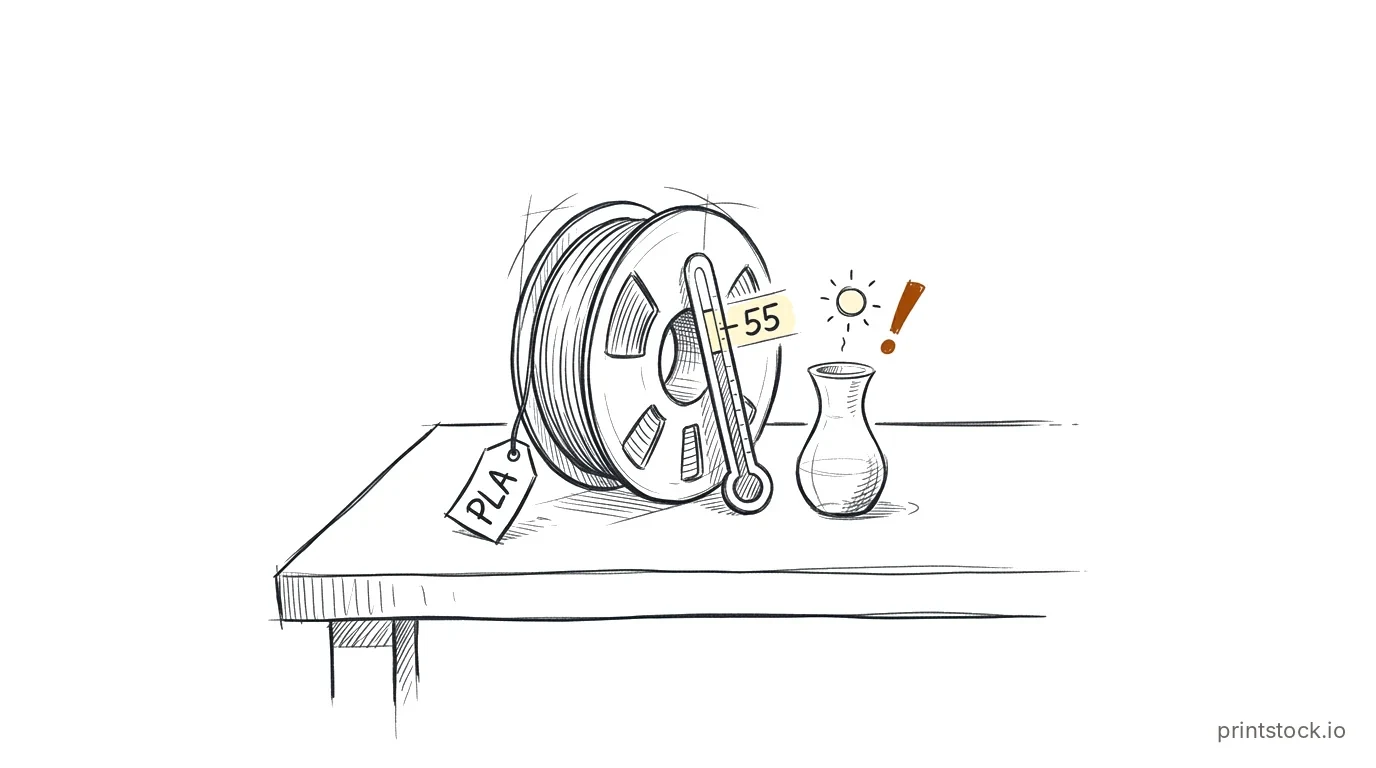
Plan on PLA parts softening above about 55 °C. That is the glass transition temperature, and the heat deflection figures in makers' data sheets sit right around it. A closed car in summer, a windowsill in direct sun, or a part next to a motor can go past it.
If a part has to live somewhere warm, move up a material: PETG handles roughly 70 °C and ABS or ASA closer to 90 to 100 °C. Our PLA vs PETG vs ABS comparison walks through that choice.
Does PLA need drying?
Less than most filaments, but an opened spool still benefits from it. PLA absorbs moisture slowly. A spool left out for weeks can start to string, pop or print with a rough surface. Makers that publish a drying setting for PLA give between 45 and 65 °C, most often 55 °C, for 6 to 8 hours. Stay inside your maker's range: PLA softens around 60 °C, and a dryer that runs too hot can fuse the windings on the spool.
Our filament drying guide covers dryers, ovens and storage.
PLA, PLA+, matte, silk and high speed: what changes
The base polymer is the same; additives change how it prints and looks. "PLA+" lines add modifiers for toughness, matte and silk lines change the surface finish, and high-speed lines are tuned to melt faster for printers that move quickly. They print at similar temperatures, but check the maker's range: some silk lines list a hotter nozzle range than the same brand's basic PLA.
Carbon fibre filled PLA is the exception. It is abrasive and needs a hardened nozzle; see hardened steel nozzles.
Where to go from here
Compare every PLA spool with its colours, length per spool and current prices in the filament catalog. If your parts need to bend or survive heat, read the PLA vs PETG vs ABS comparison. If prints come out stringy, start with fixing stringing.