
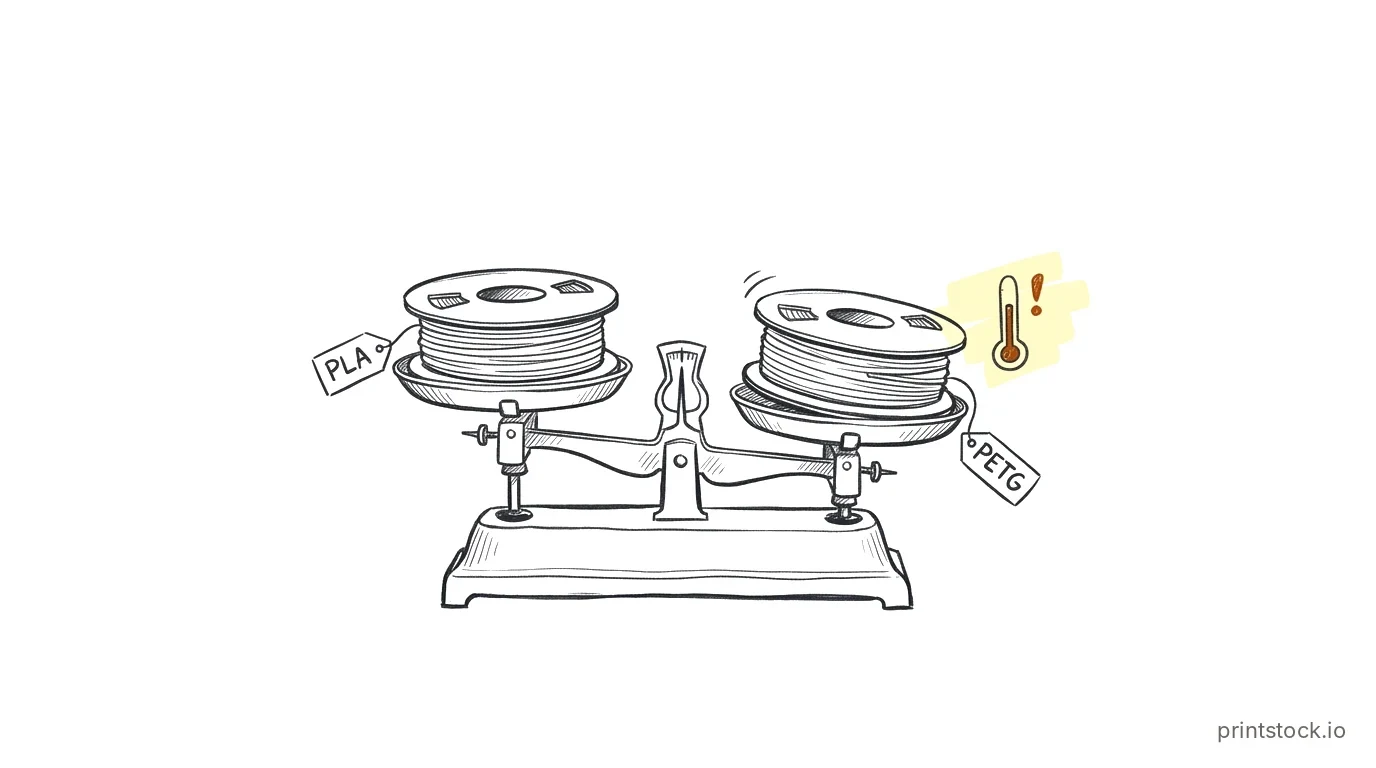
PLA or PETG is the first real material choice most people make. The two cover nine out of ten everyday prints between them, neither needs an enclosure, and both run on any common FDM printer. The difference comes down to what the part has to survive.
PLA vs PETG side by side
PETG gives up a little ease and detail for toughness and heat resistance. This comparison is built live from our catalog: every PLA and PETG line we track, what its maker publishes, and current in-stock prices.
| From our catalog | PLA | PETG |
|---|---|---|
| Filaments we track | 41 (10 brands) | 16 (10 brands) |
| Nozzle, makers' range | 180-260 °C | 220-270 °C |
| Bed, makers' range | 0-70 °C | 60-90 °C |
| Heat deflection, median (0.45 MPa) | 55 °C (9 sheets) | 69 °C (5 sheets) |
| Drying, makers' range | 45-65 °C | 55-65 °C |
| Density | 1.17-1.37 g/cm³ | 1.22-1.3 g/cm³ |
| Length of 1 kg | 305-355 m | 320-340 m |
| Median price per kg | $18.22 | $14.95 |
| Cheapest per kg | $9.34 | $9.71 |
| FDM printers it fits | 97 of 123 | 88 of 123 |
| Needs an enclosure | No | No |
PrintStock catalog data: makers' published values and in-stock US prices as of Nov 13, 2026.
Two things stand out. Heat: PETG's heat deflection sits roughly 15 °C above PLA's, which is the gap between a part that sags on a sunny dashboard and one that does not. Price: the old rule that PETG costs more no longer holds in our catalog, where the two medians are within a few dollars of each other.
When to choose PLA
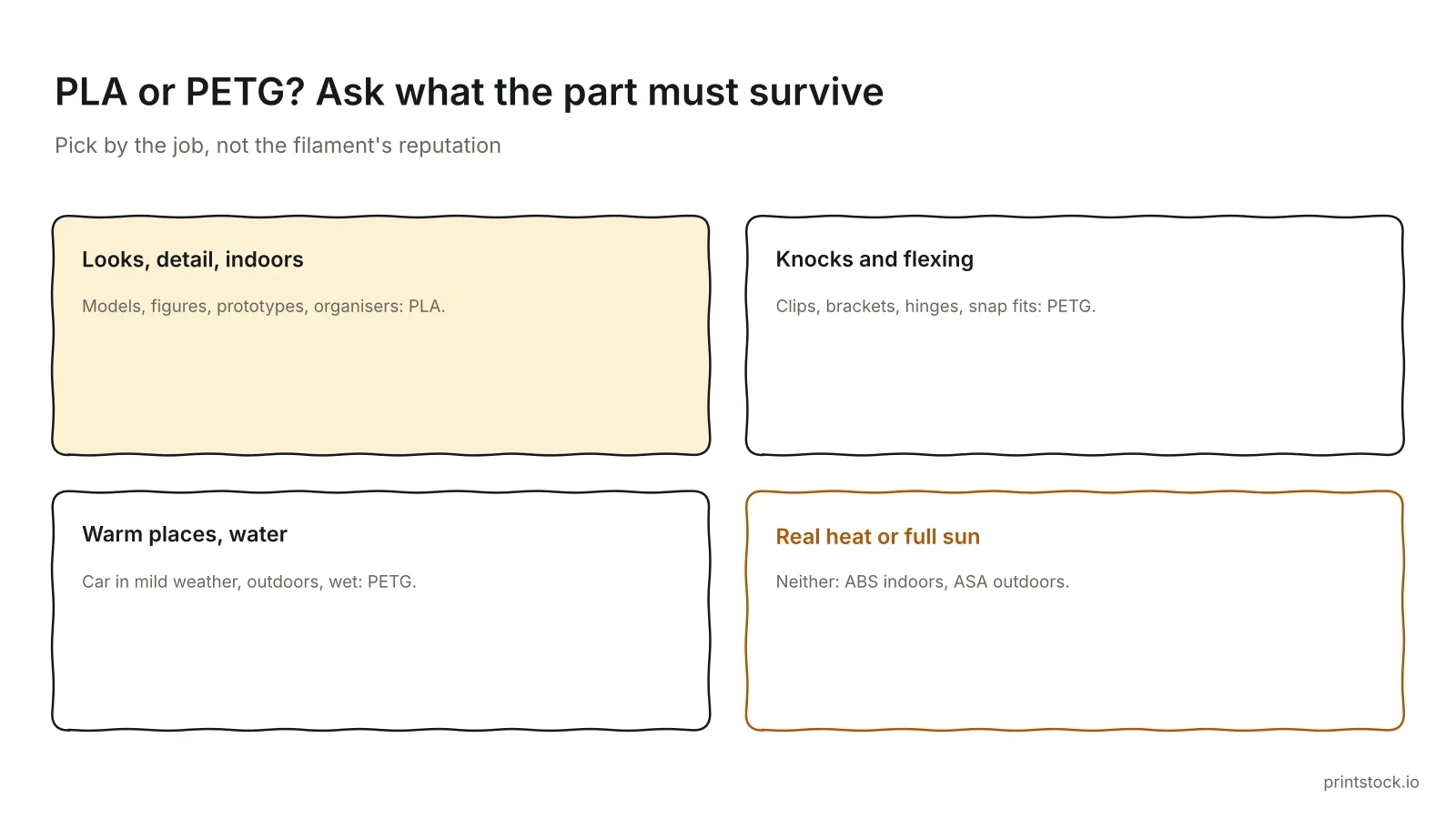
Choose PLA when appearance and accuracy matter more than toughness. It gives the sharpest corners and finest detail, prints fastest on most machines, and smells the least. It is right for models, figures, prototypes, cosplay props, organisers and anything that lives indoors at room temperature. See the PLA guide.
When to choose PETG
Choose PETG when the part has to work. Brackets, clips, holders, enclosures for electronics, parts that get wet, parts in a warm room or a car in mild weather. It bends before it breaks, so snap fits and hinges last longer. See the PETG guide for settings by brand.
Switching from one to the other
Change four things: nozzle, bed, cooling and build surface. Your slicer's PETG profile raises the nozzle by about 30 to 40 °C, the bed by about 20 °C, and lowers the part cooling fan. The build surface is up to you: textured PEI, or glue on smooth PEI. Dry PETG before printing if the spool has been open for a while; it takes up moisture faster than PLA. See how to dry filament.
Where to go from here
Need more heat resistance than PETG? Read the PLA vs PETG vs ABS comparison. Ready to buy? Compare spools in the filament catalog.