
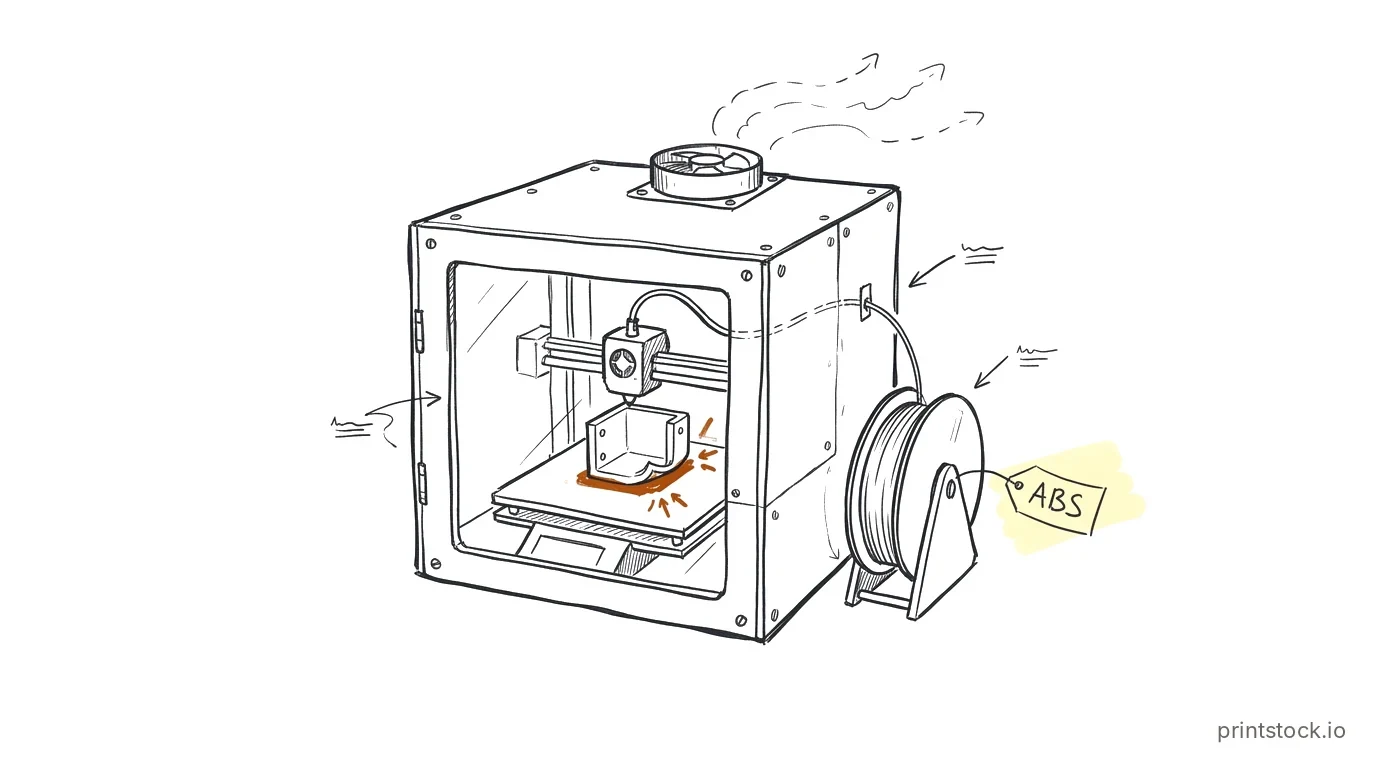
ABS is the material people reach for when PLA melts in the car. It handles real heat, it is tough, and it can be smoothed with acetone. The price is a harder print: it needs a warm enclosure and good ventilation. This page puts the makers' own numbers side by side.
ABS in numbers
ABS needs more heat at every step and returns more heat resistance. These figures come live from our catalog: every ABS line we track, what its maker publishes, and current in-stock prices.
- Filaments we track
- 6 from 6 brands
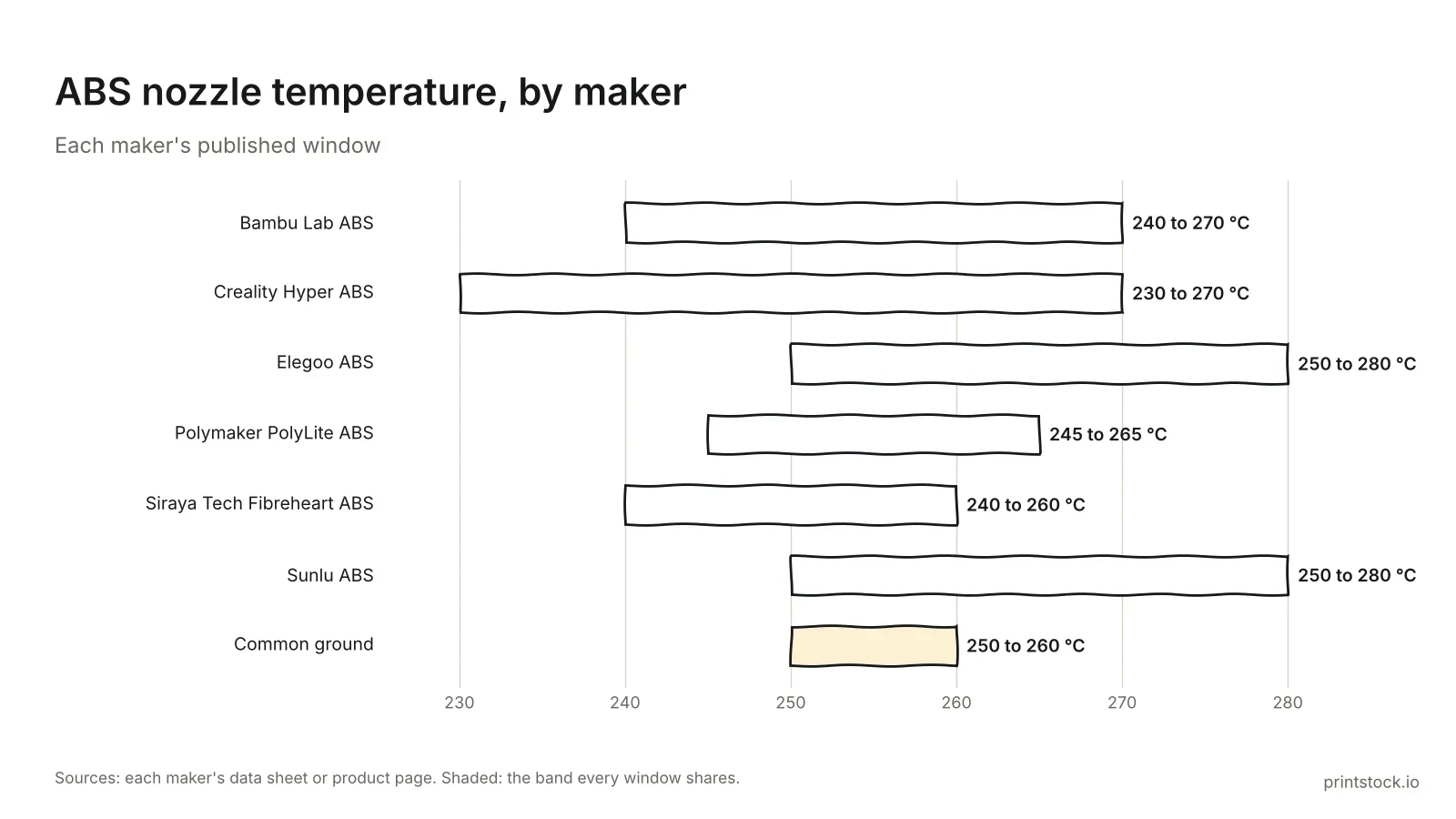
- Nozzle, makers' range
- 230-280 °C
- typical middle 255 °C
- Bed, makers' range
- 75-110 °C
- Heat deflection (0.45 MPa)
- 100 °C
- median 100 °C, 1 data sheet
- Drying, makers' range
- 70-85 °C
- stated for 3 of 6 lines
- Density
- 1.02-1.05 g/cm³
- Length of 1 kg (1.75 mm)
- 395-410 m
- from makers' density
- Price per kg
- $13.45 to $20.56
- median $17.28, as of Nov 11, 2026
- Colours across these lines
- 54
- up to 16 in one line
- Printers in our catalog it fits
- 52 of 123 FDM printers
- enclosure needed
PrintStock catalog data for ABS: makers' published values and in-stock US prices, updated with the catalog.
Only a few ABS data sheets state the load behind their heat deflection figure, which is why the 0.45 MPa value above rests on fewer sheets than the table below. Even the lowest figure we have is well above PLA and PETG.
ABS settings by brand
Start from your spool's range; ABS windows differ by up to 20 °C between brands. The table lists every ABS line in our catalog with its maker's nozzle and bed range, drying and heat deflection where published, and the cheapest price per kilogram we have found.
| Filament | Nozzle (maker) | Bed (maker) | Drying (maker) | Heat deflection | Length per spool | From, per kg |
|---|---|---|---|---|---|---|
| Bambu Lab ABSBambu Lab | 240 to 270 °C | 90 to 100 °C | 80 °C, 8 h | 87 °C (load not stated) | ≈ 395 m | $15.88as of Nov 11, 2026 |
| Creality Hyper ABSCreality | 230 to 270 °C | 75 to 95 °C | Not stated | Not stated | ≈ 400 m | $20.56as of Nov 11, 2026 |
| Elegoo ABSElegoo | 250 to 280 °C | 90 to 100 °C | Not stated | Not stated | ≈ 400 mestimate | $13.45as of Nov 11, 2026 |
| Polymaker PolyLite ABSPolymaker | 245 to 265 °C | 90 to 100 °C | 70 °C, 6 h | 100 °C at 0.45 MPa | ≈ 400 m | $18.68as of Nov 11, 2026 |
| Siraya Tech Fibreheart ABS HT HFSiraya Tech | 240 to 260 °C | 100 to 110 °C | Not stated | Not stated | ≈ 400 mestimate | $19.99as of Nov 11, 2026 |
| SUNLU ABSSUNLU | 250 to 280 °C | 80 to 100 °C | 75-85 °C, 6-8 h | 95 °C (load not stated) | ≈ 410 m | $14.01as of Nov 11, 2026 |
Live from our catalog: settings, drying and heat deflection as each maker publishes them (heat deflection is comparable only at the same load); length is calculated by PrintStock. Open a filament for every offer.
Keep the part cooling fan low or off for the first layers, and only add a little for overhangs. Leave the enclosure closed until the print has cooled down; opening it early is a common cause of a crack across a finished part.
Enclosure, fumes and filters
An enclosure solves warping; ventilation or a filter deals with the fumes. They are separate problems. A closed printer keeps the air at a steady temperature so the part shrinks evenly. It does not clean the air, so add a carbon and HEPA filter or vent the room. Our guide to enclosures, fumes and filters covers both, and these are the matching parts in our catalog:
ABS or ASA?
For anything outdoors, choose ASA. It prints almost exactly like ABS but resists UV light and weather, so it does not yellow and turn brittle in the sun. ABS stays the cheaper choice for indoor parts that need heat resistance. See the ASA guide.
Where to go from here
Compare every ABS spool and its current prices in the filament catalog. Not sure ABS is the right step? The PLA vs PETG vs ABS comparison helps you decide, and the warping guide helps when corners lift.