
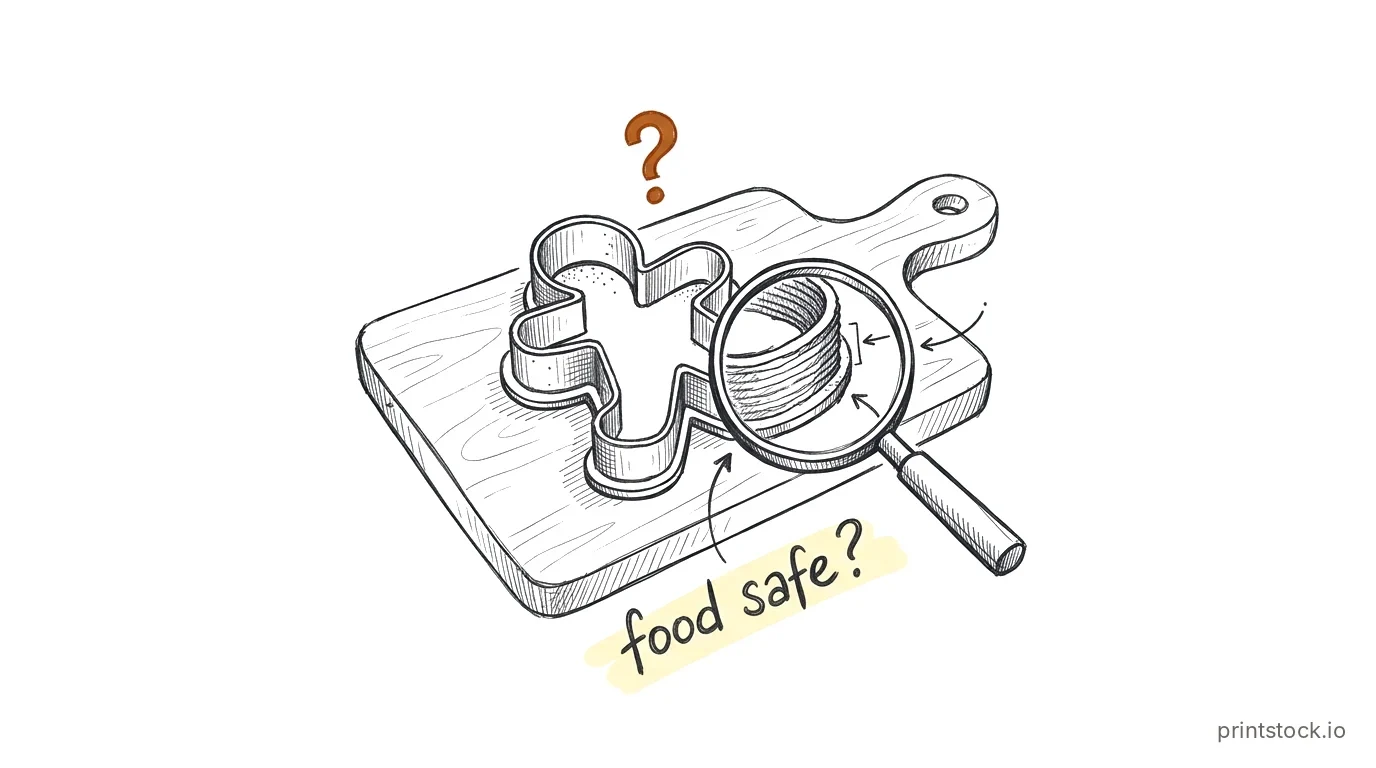
Search for "food safe filament" and you will find spools labelled food safe, forum posts saying nothing printed is, and very little in between. Both sides are partly right, because they are answering two different questions. One is about the plastic. The other is about the object you print from it.
What "food safe" actually means
"Food safe" on a filament is a claim that the material meets a food-contact regulation, backed by a document. It is not a quality rating and not a property you can see. In the EU, the rule is Regulation (EU) No 10/2011 on plastic materials in contact with food, which sets limits on how much of a substance may migrate from the plastic into food. In the US, the FDA clears specific substances for specific uses; it does not approve a filament as a product.
Two details matter in practice. First, clearance belongs to the substance in a described use, not to every object made from it. Second, a coloured filament is more than its base polymer: pigments, UV stabilisers and flow modifiers are added during manufacturing, and those additives may have no food-contact clearance of their own.
What the makers in our catalog declare
We found no food-contact declaration for any of the 83 filament and resin lines in our catalog. For 51 of them we reviewed the maker's technical data sheet; for the rest no data sheet was available to us, and the product listings we checked make no such claim. None of the documents mentions EU 10/2011, FDA food-contact rules or a declaration of compliance. That includes the main lines from Bambu Lab, Prusament, Polymaker, Anycubic and Sunlu.
That does not mean those plastics are dangerous. It means no maker has put its name to a food-contact claim for them, so you should not assume one. Some makers do sell separate lines with food-contact documentation; if you need one, ask the seller for the declaration of compliance and check the conditions it covers. We will list such lines here when we add them to the catalog.
Why a printed part is a different question
Even a certified filament becomes an uncertified object once you print it. The certification covers the material as tested. Printing adds things it does not cover.
Layer lines. FDM printing leaves grooves between layers that are far larger than bacteria. A 2021 study in Frontiers in Microbiology found biofilms building up preferentially between the layers. Hot water and a scrub remove a lot, but a printed surface is never as easy to clean as a moulded one. Finer layers make the grooves shallower.
The nozzle. Most stock nozzles are brass, and common free-cutting brass contains a small percentage of lead to make it easier to machine. How much, if any, ends up in the plastic is very likely small but has not been well measured. Stainless steel nozzles contain no lead, which is why they are the usual choice for food-contact printing.
The printer path. Extruder gears, tubes and leftover filament from earlier prints all touch the plastic on its way to the nozzle.
What you can do instead
Match the precaution to how the part meets food. The risk grows with contact time, temperature, fat content and liquids.
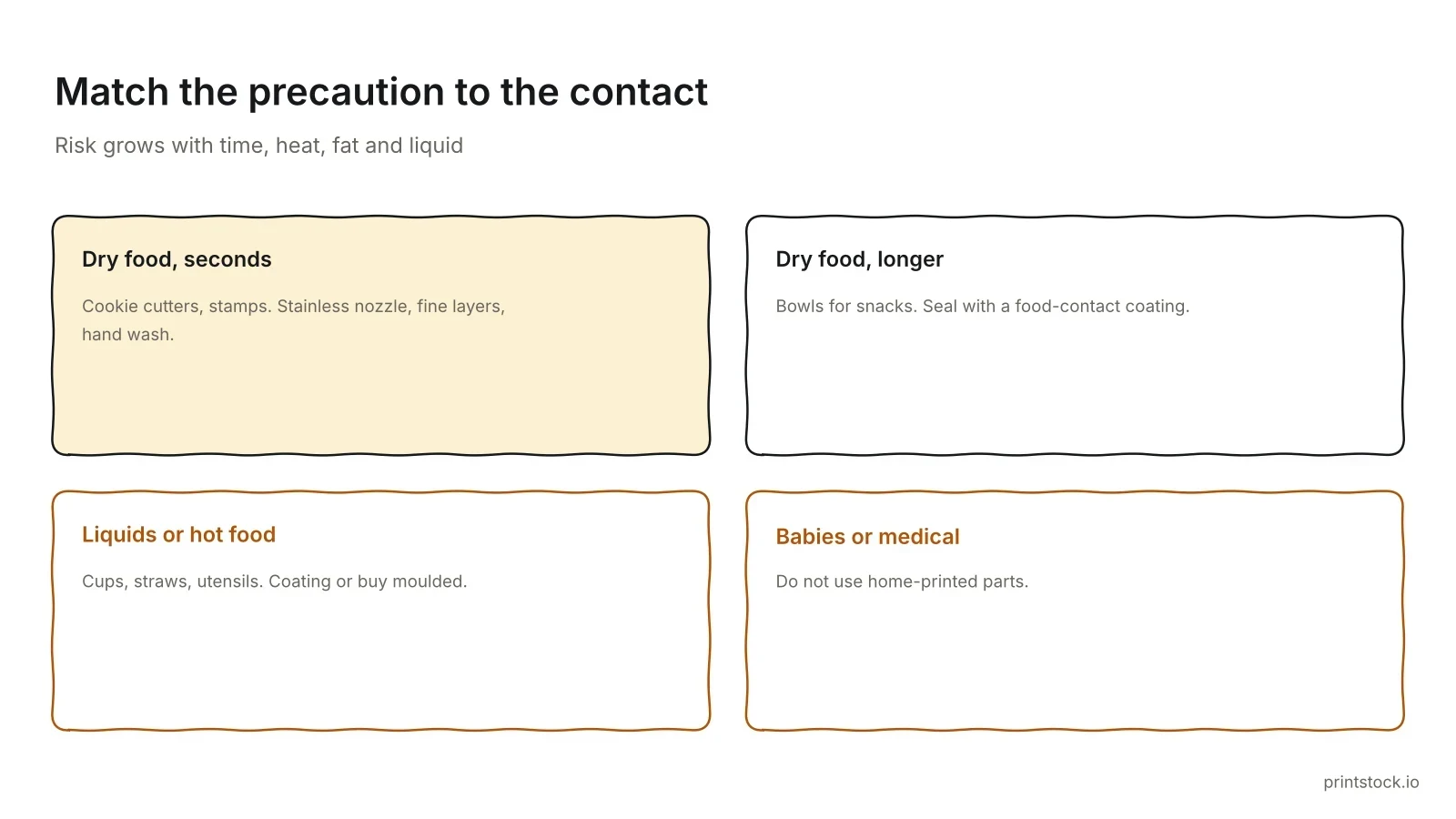
- Brief contact with dry food at room temperature (cookie cutters, dough stamps, a one-off chocolate mould): low risk. Use a stainless steel nozzle, fine layers and an uncoloured filament if you can, wash by hand, and replace the part when it wears.
- Longer contact, liquids, hot or fatty food (cups, bowls, bottles, straws, utensils): seal the surface with a coating rated for food contact, follow its curing instructions, and replace the part when the coating wears. Or buy a moulded product.
- Anything for babies, medical use or commercial food service: do not use a home-printed part.
Where to go from here
Printing kitchen tools anyway? A hardened or stainless steel nozzle is the first upgrade. For choosing a material for everything else, see the PLA guide, the PETG guide and PLA vs PETG.