$59.99 as of Nov 12, 2026Check price
QIDI Tech
QIDI Max4
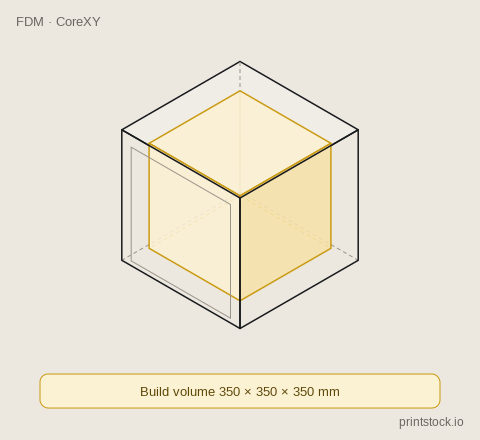
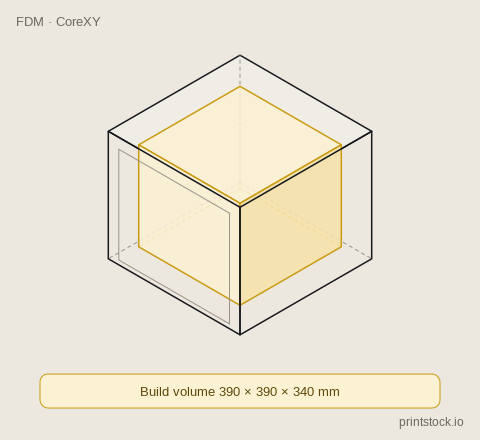
FDMCoreXYEnclosed390 × 390 × 340 mm
QIDI's large engineering printer (2026): enclosed CoreXY, 390 × 390 × 340 mm, 370 °C nozzle, 120 °C bed, 65 °C actively heated chamber, load-cell leveling, QIDI Box support for up to 16 colors.
- Hottest nozzle of the 73 FDM printers we list
Where to buy
Prices as of Nov 11, 2026Taxes, shipping and any import duties are worked out by the store at checkout and depend on your country; ask the store if in doubt.
Store links may be affiliate links: we may earn a commission, and it does not change your price. Affiliate disclosure
Price history, 90 days
Lowest: $980.29 · Highest: $1,120.47Overview
The QIDI Max4, launched in 2026, is QIDI's large-format machine for engineering parts. Its 390 × 390 × 340 mm volume prints big enclosures and functional parts in one piece, and the thermal package matches: a 370 °C nozzle, a 120 °C bed and a separate 500 W PTC heater that holds the whole chamber at up to 65 °C, so ABS, ASA, nylon, polycarbonate and carbon-filled filaments can print without warping.
QIDI added an active cooling air system that blows cold air on the extruder, aimed at the PLA heat-creep problem hot chambers cause, which it says reduces clogging by 90%. Leveling uses a load cell in the hotend, a 1080p camera records time-lapses, and the QIDI Box adds multi-color printing up to 16 colors. At our last check QIDI listed it at $1,049 on sale from $1,149.
It is heavy at 40 kg and big. The community is small, and Printer Hub notes firmware changes such as a release that cut maximum bed power to 70% while still reaching 120 °C, so read update notes before installing.
Best for
- Large functional parts in ABS, ASA, nylon and PC
- Engineering prints in one piece instead of glued sections
- Users wanting a big heated-chamber printer under $1,200
Look elsewhere if
- You print small PLA parts: a QIDI Q2 or Bambu P2S is cheaper
- You lack space for a 40 kg, 58 cm wide machine
Before you buy
- Plan a sturdy table and strong power circuit (chamber 500 W plus bed 700 W).
- Print PLA and TPU with the lid off unless the room is cold.
- Read firmware notes; OTA updates have changed behavior.
- Decide whether you need the Combo with QIDI Box.
Pros and cons
Pros
- Huge 390 × 390 × 340 mm volume
- 370 °C nozzle and 65 °C chamber
- Load-cell leveling
- Strong value for its size
Cons
- Heavy and large
- Small community
- Firmware changes between versions
What owners like
Delivers on speed, quality and size
Often praisedNikKTech gave it a Golden Award, finding it delivers as advertised on speed, print quality, size, enclosure and multicolor.
Large parts in one piece
Often praisedOwners print large enclosures and functional parts in one piece thanks to the huge build area and actively heated chamber.
Collected the same way as known issues: from independent reviews, owner reports and public discussions, merged and grouped.
Known issues
Last reviewed Nov 13, 2026Popular models have longer lists simply because more people own them and talk about them. Severity and status show how much each problem matters today.
PLA and PETG heat creep
Moderate (affects prints)Workaround availableChamber heat softens filament in the heatbreak; open the door for these materials.
QIDI Box feed, RFID and purge problems
Moderate (affects prints)Workaround availableKinked PTFE, false sensor triggers and a small default purge stop feeding and bleed colors.
Step loss and layer shifts
Moderate (affects prints)Workaround availableThe closed-loop motors do not correct position after step loss; firmware 01.01.06 reduced it.
Early-batch hardware defects
Moderate (affects prints)Still reportedSome units arrived with hotends that would not heat or faulty sensors and steppers.
Firmware regressions between versions
Minor (annoyance)Still reportedOwners track OTA problems and per-version regressions, including a release that reduced maximum bed power to 70% (120 °C still reachable). Check recent reports before updating.
Z offset does not persist
Minor (annoyance)Workaround availableThe offset resets between prints; set it per filament profile.
Loud Polar Cooler and hose kinks
Minor (annoyance)Still reportedThe cooler reaches about 60 to 65 dB and its hose rubs at far positions.
Hotend sock fails above 300 degrees C
Minor (annoyance)Still reportedThe silicone sock is rated to 300 degrees C while the nozzle reaches 370.
How we build this list: we collect independent reviews, owner reports and public discussions on forums and social networks, merge duplicates and group them by cause. Only serious or recurring problems make the list, so a single complaint will not appear here, and a listed problem does not mean every unit is affected.
Specs
Printing
- Type
- FDM
- Build volume
- 390 × 390 × 340 mm
- Kinematics
- CoreXY
- Max speed
- 800 mm/s
- Max acceleration
- 30,000 mm/s²
- Multi-color
- Yes
- Nozzles / toolheads
- 1
Extruder and bed
- Extruder
- Direct drive
- Stock nozzle
- 0.4 mm
- Nozzle / hotend
- Bimetal hardened steel nozzle
- Max nozzle temp
- 370 °C
- Filament
- 1.75 mm
- Build plate
- Double-sided magnetic PEI plate
- Max bed temp
- 120 °C
- Bed leveling
- Automatic
- Enclosure
- Yes
- Heated chamber
- Up to 65 °C
Control and sensors
- Screen
- Touchscreen, 5 in
- Features
- Filament runout sensorInput shapingPower-loss recoveryAI print failure detectionAir filter
Files and setup
- Files the slicer opens
- STL, OBJ, 3MF, STEP
- Arrives
- Ships assembled
- Variants
- Standard, Combo
Features
- Cooling
- Active cooling air control to reduce clogs in a hot chamber
- Camera
- Up to 1080p, time-lapse
Multi-color
- Multi-material
- QIDI Box, up to 16 colors
Electronics
- Storage
- 32 GB eMMC
From maker and store specifications, checked Nov 12, 2026. Power, size, network and warranty are in their own blocks below.
Power and setup
Electricity
- Rated power
- 1,350 W
- Note
- 150 W printer, 500 W chamber heater and 700 W heated bed as listed by QIDI
Network and cloud
- Works without internet
- Yes, fully (SD card / USB / LAN)
- Maker account
- Only for cloud / remote features
- Local control for other software
- Open (documented or open source)
- Note
- Runs QIDI's Klipper and Moonraker with a Fluidd web page; QIDI Studio connects by IP without an account, and LAN Only mode cuts the printer off from the QIDI cloud. Only the QIDI Link app needs an account.
Space and room
- Size (W × D × H)
- 558 × 578 × 612 mm
- Weight
- 40 kg
On a standard power circuit
- US 15 A / 120 V standard circuit: fine, and about 50 W stays free for other things on that circuit while it heats up
- EU/UK 16 A / 230 V standard circuit: fine, and about 1,550 W stays free for other things on that circuit while it heats up
Our calculation from the maker's rated power, keeping a circuit at 80% for long loads.
Safety and support
Safety
- Air filtration
- Pre-filter + HEPA filter + Activated carbon filter
Computer you need
- Runs on
- Windows, macOS (Apple silicon), Linux
Warranty and repair
- Warranty
- 12 months; 1 year for consumers worldwide, up to 2 years in the EU, Switzerland, Norway and Iceland; consumables not covered; no cross-region service
- Spare parts store
- Official page ↗
- Repair guides
- Official page ↗
Running costs
| PLA filament, per kg | Cheapest in our catalog: Elegoo PLA Basic | $9.34 |
|---|---|---|
| Spare nozzle or hotend | QIDI Max4 Bimetal Nozzles (2 pcs) | $29.99 |
| Spare build plate | QIDI Max4 Dual-sided PEI Plate | $49.99 |
Starter budget: about $1,020 for the printer at its best listed price, 1 kg of PLA and a spare nozzle.
Cheapest compatible items in our catalog, USD prices as last checked. Prices change; see each item for the date.
Software and firmware
- Slicer / control software
- QIDI Studio (official), OrcaSlicer
- Firmware
- QIDI Klipper-based firmware, OTA updates
- Connectivity
- Wi-Fi, Ethernet, USB
Official firmware and downloads ↗ We never host firmware files.
Questions people ask
QIDI Max4 or Plus4?
The Max4 is larger (390 × 390 × 340 mm versus 305 × 305 × 280 mm) with a third-gen chamber heater and active extruder cooling; the Plus4 is cheaper and smaller.
Does the QIDI Max4 have a heated chamber?
Yes, a separate 500 W PTC heater holds the chamber at up to 65 °C.
Can the QIDI Max4 print TPU?
Yes, QIDI recommends 95A TPU; softer than 85A can affect quality.
Models proven to print on the QIDI Max4
Coming soonFilaments that fit (80)
Matched by PrintStock from published specs: filament diameter, maximum nozzle and bed temperature and enclosure. Not a print test.
- PETG
- Anycubic PETG, Bambu Lab PETG Basic, Bambu Lab PETG Matte, Creality Hyper PETG, Elegoo PETG Pro, Elegoo Rapid PETG, eSUN PETG, eSUN PETG-Matte, Overture High Speed PETG, Polymaker PETG, Polymaker PolyLite PETG, Prusament PETG, Spectrum PETG, Spectrum PETG Premium High Speed, SUNLU PETG, SUNLU PETG 2.0
- PLA
- Anycubic PLA+, Anycubic PLA Basic, Anycubic PLA High Speed, Anycubic PLA Silk, Bambu Lab PLA Basic, Bambu Lab PLA Matte, Bambu Lab PLA Silk+, Bambu Lab PLA Translucent, Creality Hyper PLA, Creality Hyper PLA RFID, Elegoo PLA, Elegoo PLA Basic, Elegoo PLA Matte, Elegoo PLA Pro, Elegoo PLA Silk, eSUN PLA+, eSUN PLA Basic, eSUN PLA+HS, eSUN PLA-Matte, eSUN PLA-Silk Rainbow, Overture Easy PLA, Overture Matte PLA Dual Colors, Overture PLA+, Overture Silk PLA Gradient, Polymaker Panchroma PLA, Polymaker Panchroma PLA Matte, Polymaker Panchroma PLA Silk, Polymaker PLA Pro, Polymaker PolyLite PLA, Polymaker PolyLite PLA Pro, Polymaker PolyLite Silk PLA, Polymaker PolyMax PLA, Polymaker PolyTerra PLA, Prusament PLA, Spectrum Huracan PLA, Spectrum PLA, Spectrum PLA Pro, Spectrum Premium PLA High Speed, SUNLU High-Speed PLA, SUNLU PLA+ 2.0, SUNLU Silk PLA+ 2.0
- ABS
- Bambu Lab ABS, Creality Hyper ABS, Elegoo ABS, Polymaker PolyLite ABS, Siraya Tech Fibreheart ABS HT HF, SUNLU ABS
Compatible accessories
Everything that fits the QIDI Max4
$29.99 as of Nov 12, 2026Check price
$39.99 as of Nov 12, 2026Check price
$69.99 as of Nov 12, 2026Check price
$49.99 as of Nov 12, 2026Check price
$40.99 as of Nov 12, 2026Check price
Closest alternatives by price
Compare all side by side