$27.71 as of Nov 11, 2026Check price
Creality
Creality K2 Plus
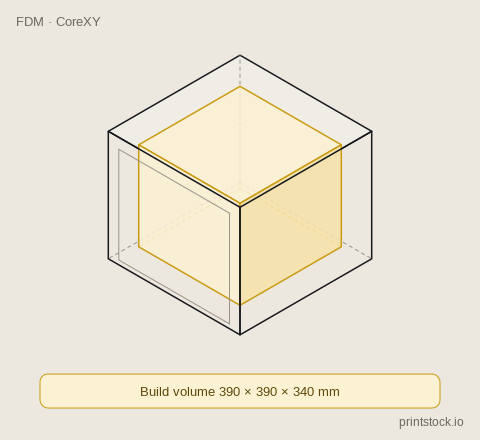
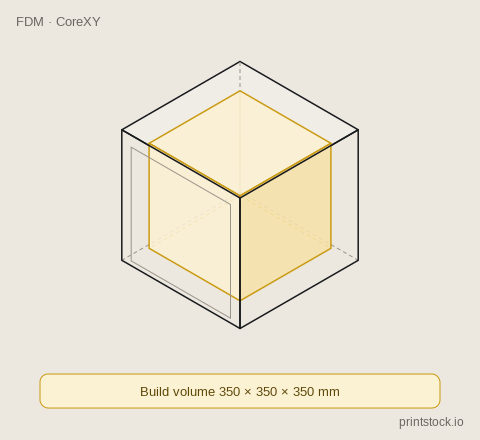
FDMCoreXYEnclosed350 × 350 × 350 mm
Creality's large enclosed flagship: 350 mm cube build volume, 60 °C actively heated chamber, 350 °C nozzle and up to 16 colors with the CFS. Big and capable, with a long list of reported early problems.
Where to buy
Prices as of Nov 11, 2026Taxes, shipping and any import duties are worked out by the store at checkout and depend on your country; ask the store if in doubt.
Store links may be affiliate links: we may earn a commission, and it does not change your price. Affiliate disclosure
Price history, 90 days
Lowest: $933.57 · Highest: $1,099Overview
The K2 Plus is Creality's answer to large enclosed printers like the Bambu H2 series, at a lower price. Its 350 mm cube build volume fits helmets, large cosplay pieces and full batches, and an actively heated 60 °C chamber plus a 350 °C hardened-tip nozzle let it print ABS, ASA and carbon-filled nylons without warping.
The K2 Plus Combo adds the CFS (Creality Filament System), a four-spool feeder with RFID that stacks up to four units for 16 colors. Motion uses closed-loop servo motors, and two cameras handle flow calibration and failure detection. It runs Klipper-based firmware and slices in Creality Print or OrcaSlicer.
The catch is reliability. The Creality forum has many threads from owners with CFS jams, sensor errors, warped beds and units returned in the first weeks, alongside owners who report hundreds of trouble-free hours. It is also very large and heavy: 640 mm tall, 916 mm with the CFS on top, and about 35 kg. At our last check the Creality store listed the K2 Plus Combo at $1,099.
Best for
- Large single parts up to 350 mm in every direction
- ABS, ASA and carbon-filled filaments that need a heated chamber
- Multi-color prints with up to 16 spools (with extra CFS units)
Look elsewhere if
- You want a trouble-free experience out of the box: owner reports show frequent early issues
- Space or weight is a problem: it is about 35 kg and 92 cm tall with the CFS
- You only print PLA and PETG at normal sizes: a smaller printer costs far less
Before you buy
- Check the bed for flatness when the printer arrives; warped beds are a reported defect on early batches.
- With the CFS on top the printer needs about 92 cm of height, plus room to open the lid.
- For high-temperature composites, check the CFS load and retract settings; jams are most common with ASA-CF and PA-CF.
- Keep receipts and buy from a seller with an easy return process, given the number of first-weeks returns reported.
Pros and cons
Pros
- 350 mm cube build volume with an enclosed, heated chamber
- 350 °C hardened-tip nozzle for engineering filaments
- Up to 16 colors with stacked CFS units
- Closed-loop servo motors and active belt tensioning
Cons
- Many reports of CFS jams and sensor errors
- Very large and heavy
- Quality control varies between units
Maker's test data
- Noise
- 45 dB or less at 300 mm/s, measured by Creality Lab with one spool loaded.
- Print time
- Creality Lab: a 3D Benchy in about 10 minutes and a 100 mm cube in about 3 hours with Hyper PLA at the typical 300 mm/s.
Published by the manufacturer from its own tests. PrintStock has not verified these figures; owner reports below may confirm or contradict them.
What owners like
Outstanding quality at speed
Praised by most ownersReviewers praise outstanding print quality and impressive speed; one says it blew their mind.
Large heated enclosure
Often praisedThe 350 mm cube volume with an active chamber heater helps with large and high temperature prints.
Collected the same way as known issues: from independent reviews, owner reports and public discussions, merged and grouped.
Known issues
Last reviewed Nov 13, 2026Popular models have longer lists simply because more people own them and talk about them. Severity and status show how much each problem matters today.
Warped bed out of the box
Major (repair or return)Workaround availableThe thin 350 mm aluminum bed on some early units is not flat, causing first-layer problems that auto-leveling cannot fully correct. Affected owners got replacement beds or printers.
CFS jams on feed and retract
Moderate (affects prints)Still reportedThe most common complaint from K2 Plus Combo owners: filament jams or disconnects between the CFS and the toolhead, including a faulty filament encoder that throws feed errors. It is worse with high-temperature composites such as ASA-CF and PA-CF.
Hotend errors traced to the adapter board
Moderate (affects prints)Workaround availableSome owners get persistent hotend-related error codes. Replacing the K2 series hotend adapter board, an inexpensive part, fixed it for several, though one reports the fault returning months later.
Heat break clogs with hot composites
Moderate (affects prints)Workaround availableThe extruder clicks and flow stops when plastic creeps up the heat break, worse with high-temperature composites in a 60 degree C chamber.
Heavy purge waste on multicolor prints
Moderate (affects prints)Workaround availableReviewers logged heavier purge per color change than on Bambu AMS printers; mixing materials such as PLA and PETG makes it worse.
Chamber stalls below 60 degrees C
Minor (annoyance)Workaround availableIn rooms below about 15 degrees C on 110 V mains the chamber stops at 45 to 50 degrees C; preheating or a warmer room helps.
AI camera false alarms
Minor (annoyance)Workaround availablePrints pause on good parts when glare, dust or contrasty patterns confuse the detector; lowering sensitivity or turning it off avoids it.
CFS noise on filament swaps
Minor (annoyance)Still reportedOwners list CFS noise during swaps among the main complaints.
No purge bin in the box
Minor (annoyance)Workaround availableOwners print their own bin for the purge chute.
Slow support and warranty disputes
Minor (annoyance)Still reportedTrustpilot reviewers often describe slow replies, generic advice and trouble getting warranty claims accepted; buying from a local retailer can make returns easier.
Already fixed: 1 (show)
Strain gauge damaged by a worn wiper
Moderate (affects prints)Fixed in a hardware revisionA worn or detached wiper lets the nozzle strike the strain gauge, after which leveling refuses to run (TE2762); the wiper module and gauge are replaced.
How we build this list: we collect independent reviews, owner reports and public discussions on forums and social networks, merge duplicates and group them by cause. Only serious or recurring problems make the list, so a single complaint will not appear here, and a listed problem does not mean every unit is affected.
Specs
Printing
- Type
- FDM
- Build volume
- 350 × 350 × 350 mm
- Kinematics
- CoreXY
- Max speed
- 600 mm/s
- Max acceleration
- 30,000 mm/s²
- Multi-color
- Yes
- Nozzles / toolheads
- 1
- Materials
- PLA, PETG, ABS, ASA, PET, PLA-CF, PA-CF
- Layer height
- 0.05 to 0.3 mm
- Supported filaments
- PLA, PETG, ABS, ASA, PET, PLA-CF, PA-CF, PPA-CF
Extruder and bed
- Extruder
- Direct drive
- Stock nozzle
- 0.4 mm
- Nozzle / hotend
- Tri-metal nozzle
- Max nozzle temp
- 350 °C
- Filament
- 1.75 mm
- Max bed temp
- 120 °C
- Bed leveling
- Automatic
- Enclosure
- Yes
Control and sensors
- Screen
- Touchscreen, 4.3 in
- Features
- Filament runout sensorFilament tangle or clog detectionAI print failure detectionBuilt-in lightAir filter
- Screen languages
- EnglishSpanishGermanFrenchRussianPortugueseItalianTurkishJapaneseChinese
Files and setup
- Files the slicer opens
- STL, OBJ
- Arrives
- Ships assembled
- Variants
- Standard, Combo
Bed
- Max bed temperature
- 120 °C (800 W AC heater)
- Build plate
- Flexible PEI plate
Chamber
- Chamber heating
- Active, up to 60 °C, with air filter
Features
- Motion
- FOC closed-loop step-servo motors, linear rail on X, active belt tensioning
- Cameras
- Two AI cameras: nozzle (flow calibration) and chamber (monitoring)
Physical
- Rated power
- 1200 W
Connectivity
- Interfaces
- Wi-Fi 2.4/5 GHz, Ethernet, USB; 32 GB eMMC storage
From maker and store specifications, checked Nov 12, 2026. Power, size, network and warranty are in their own blocks below.
Power and setup
Electricity
- Mains input
- 100 to 240 V (universal)
- Rated power
- 1,200 W
Network and cloud
- Works without internet
- Yes, fully (SD card / USB / LAN)
- Maker account
- Only for cloud / remote features
- Local control for other software
- Open (documented or open source)
- Slicers from other makers
- Supported
- Built-in camera
- Yes
- Note
- Klipper-based Creality OS with Moonraker and a Fluidd web page on port 4408 built in; Creality Cloud is optional. Orca Slicer can send jobs over the LAN, while the tightest camera and CFS integration stays with Creality Print. Root access is an official option in the settings menu.
Space and room
- Size (W × D × H)
- 495 × 515 × 640 mm
- Weight
- 33.5 kg
On a standard power circuit
- US 15 A / 120 V standard circuit: fine, and about 200 W stays free for other things on that circuit while it heats up
- EU/UK 16 A / 230 V standard circuit: fine, and about 1,700 W stays free for other things on that circuit while it heats up
Our calculation from the maker's rated power, keeping a circuit at 80% for long loads.
Safety and support
Safety
- Noise (maker figure)
- 50 dB, under 50 dB (maker)
- Safety and conformity marks
- CE (EU)
Computer you need
- Runs on
- Windows, macOS (Apple silicon)
Warranty and repair
- Warranty
- 12 months; 24 months in the EU, Switzerland, Iceland and Norway; wear parts shorter
- Spare parts store
- Official page ↗
- Repair guides
- Official page ↗
Running costs
| PLA filament, per kg | Cheapest in our catalog: Elegoo PLA Basic | $9.34 |
|---|---|---|
| Spare nozzle or hotend | "Unicorn" Quick-Swap Nozzle Kit for K2 / K2 Plus / Creality Hi | $11.09 |
| Spare build plate | K2 Plus PEI Frosted Build Plate | $23.99 |
Starter budget: about $954 for the printer at its best listed price, 1 kg of PLA and a spare nozzle.
Cheapest compatible items in our catalog, USD prices as last checked. Prices change; see each item for the date.
Software and firmware
- Slicer / control software
- Creality Print 5.0 or newer (official), OrcaSlicer
- Firmware
- Klipper-based (Creality OS); rooted community firmware exists
- Connectivity
- Wi-Fi 2.4/5 GHz, Ethernet, USB, Creality Cloud app
Official firmware and downloads ↗ We never host firmware files.
Questions people ask
What is the difference between the Creality K2 Plus and the K2 Plus Combo?
The Combo includes the CFS, Creality's four-spool multi-color feeder. The printer is the same. At our last check the Creality store listed the Combo at $1,099.
Creality K2 Plus or K2 Pro?
The K2 Plus prints a 350 mm cube with a bed up to 120 °C; the K2 Pro prints a 300 mm cube with a bed up to 110 °C. Both have a 60 °C heated chamber. Choose the Plus only if you need the extra size.
How big is the Creality K2 Plus?
The printer measures 495 × 515 × 640 mm and weighs about 35 kg. With the CFS on top it is 916 mm tall.
Can the K2 Plus print carbon fiber filament?
Yes. It has a hardened steel nozzle tip, a 350 °C hotend and a heated chamber, and Creality lists PLA-CF, PA-CF and PPA-CF among supported filaments.
Models proven to print on the Creality K2 Plus
Coming soonFilaments that fit (77)
Matched by PrintStock from published specs: filament diameter, the materials Creality lists for this printer. Not a print test.
- PETG
- Anycubic PETG, Bambu Lab PETG Basic, Bambu Lab PETG Matte, Creality Hyper PETG, Elegoo PETG Pro, Elegoo Rapid PETG, eSUN PETG, eSUN PETG-Matte, Overture High Speed PETG, Polymaker PETG, Polymaker PolyLite PETG, Prusament PETG, Spectrum PETG, Spectrum PETG Premium High Speed, SUNLU PETG, SUNLU PETG 2.0
- PLA
- Anycubic PLA+, Anycubic PLA Basic, Anycubic PLA High Speed, Anycubic PLA Silk, Bambu Lab PLA Basic, Bambu Lab PLA Matte, Bambu Lab PLA Silk+, Bambu Lab PLA Translucent, Creality Hyper PLA, Creality Hyper PLA RFID, Elegoo PLA, Elegoo PLA Basic, Elegoo PLA Matte, Elegoo PLA Pro, Elegoo PLA Silk, eSUN PLA+, eSUN PLA Basic, eSUN PLA+HS, eSUN PLA-Matte, eSUN PLA-Silk Rainbow, Overture Easy PLA, Overture Matte PLA Dual Colors, Overture PLA+, Overture Silk PLA Gradient, Polymaker Panchroma PLA, Polymaker Panchroma PLA Matte, Polymaker Panchroma PLA Silk, Polymaker PLA Pro, Polymaker PolyLite PLA, Polymaker PolyLite PLA Pro, Polymaker PolyLite Silk PLA, Polymaker PolyMax PLA, Polymaker PolyTerra PLA, Prusament PLA, Spectrum Huracan PLA, Spectrum PLA, Spectrum PLA Pro, Spectrum Premium PLA High Speed, SUNLU High-Speed PLA, SUNLU PLA+ 2.0, SUNLU Silk PLA+ 2.0
- ABS
- Bambu Lab ABS, Creality Hyper ABS, Elegoo ABS, Polymaker PolyLite ABS, Siraya Tech Fibreheart ABS HT HF, SUNLU ABS
Compatible accessories
Everything that fits the Creality K2 Plus
$32.99 as of Nov 11, 2026Check price
$30.59 as of Nov 11, 2026Check price
$11.09 as of Nov 11, 2026Check price
$23.99 as of Nov 11, 2026Check price
$12.99 as of Nov 11, 2026Check price
Closest alternatives by price
Compare all side by side