
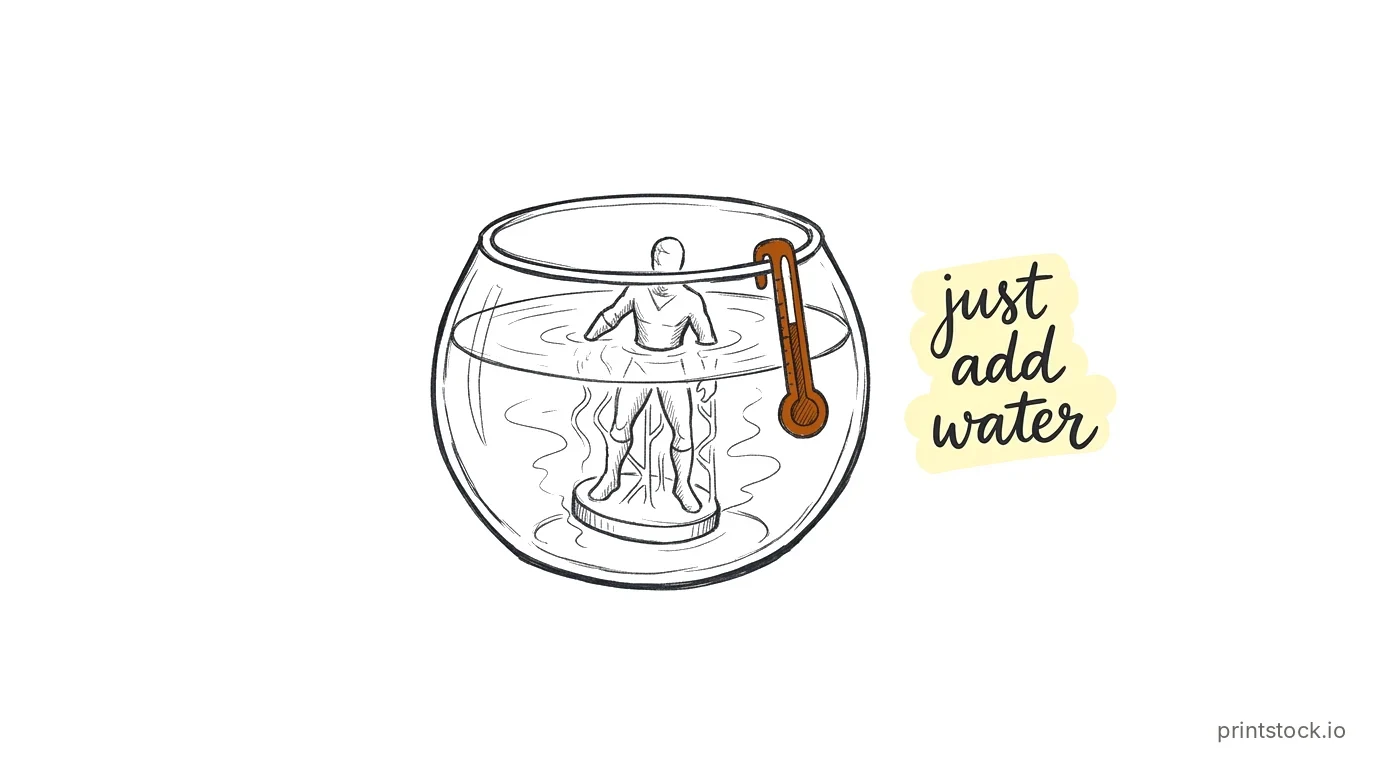
PVA filament prints supports you never have to cut off. The model goes in PLA or another compatible material, the supports go in PVA, and a bath of water does the rest. Overhangs come out smooth, internal channels come out open, and print-in-place hinges come out free. The catch is that PVA soaks up moisture from the air almost as fast as it dissolves in water. This guide covers what PVA can support, the printer you need, makers' settings and drying, and how to dissolve it without damaging the model.
PVA in numbers
These figures are live from our catalog: every PVA line we track, with the maker's settings and the lowest current price per kg.
- Filaments we track
- 2 from 2 brands
- Nozzle, makers' range
- 180-230 °C
- typical middle 213 °C
- Bed, makers' range
- 25-60 °C
- Drying, makers' range
- 45-80 °C
- stated for 2 of 2 lines
- Density
- 1.25 g/cm³
- Price per kg
- $64.46 to $64.46
- median $64.46, as of Nov 17, 2026
- Colours across these lines
- 2
- up to 1 in one line
- Printers in our catalog it fits
- 78 of 123 FDM printers
PrintStock catalog data for PVA: makers' published values and in-stock US prices, updated with the catalog.
The lines we track today are Polymaker PolyDissolve S1 and eSUN PVA. We add more as we verify makers' data.
What is PVA filament?
PVA (polyvinyl alcohol) is a water-soluble plastic that 3D printers use only for supports. Prusa describes PVA and BVOH as special water-soluble materials used mainly for printing supports, printed at about the same temperature as PLA, non-toxic and without odour (Prusa knowledge base).
Bambu Lab is explicit that its PVA is for supports only, not for standalone models. PVA parts would go soft in humid air and dissolve in the first rain.
Soluble supports are worth it for:
- deep overhangs and undercuts where breakaway supports scar the surface;
- internal channels, cavities and threads you cannot reach with pliers;
- print-in-place hinges, chains and other moving assemblies;
- delicate parts that would snap while you pry supports off.
Which printers can print PVA?
Any printer that can put two materials in one print: a filament changer (Bambu AMS, Prusa MMU), an IDEX printer with two independent heads, or a tool changer. A single-extruder printer without a changer cannot print PVA supports.
- Filament changers (AMS, MMU, CFS). They swap PVA and the model material through one nozzle and purge between them. Prusa recommends raising the purge volume for soluble supports from the default 140 mm³ to 200 to 240 mm³ on the MMU2S.
- IDEX and tool changers. Each material has its own nozzle, so no purging and less clog risk. Polymaker recommends these for PolyDissolve S1 and advises against single-nozzle swapping.
- Feeder fit. Bambu Lab says dry PVA works in the AMS and AMS lite, but damp PVA turns soft and sticky and must be dried again before it goes back in.
Which materials can PVA support?
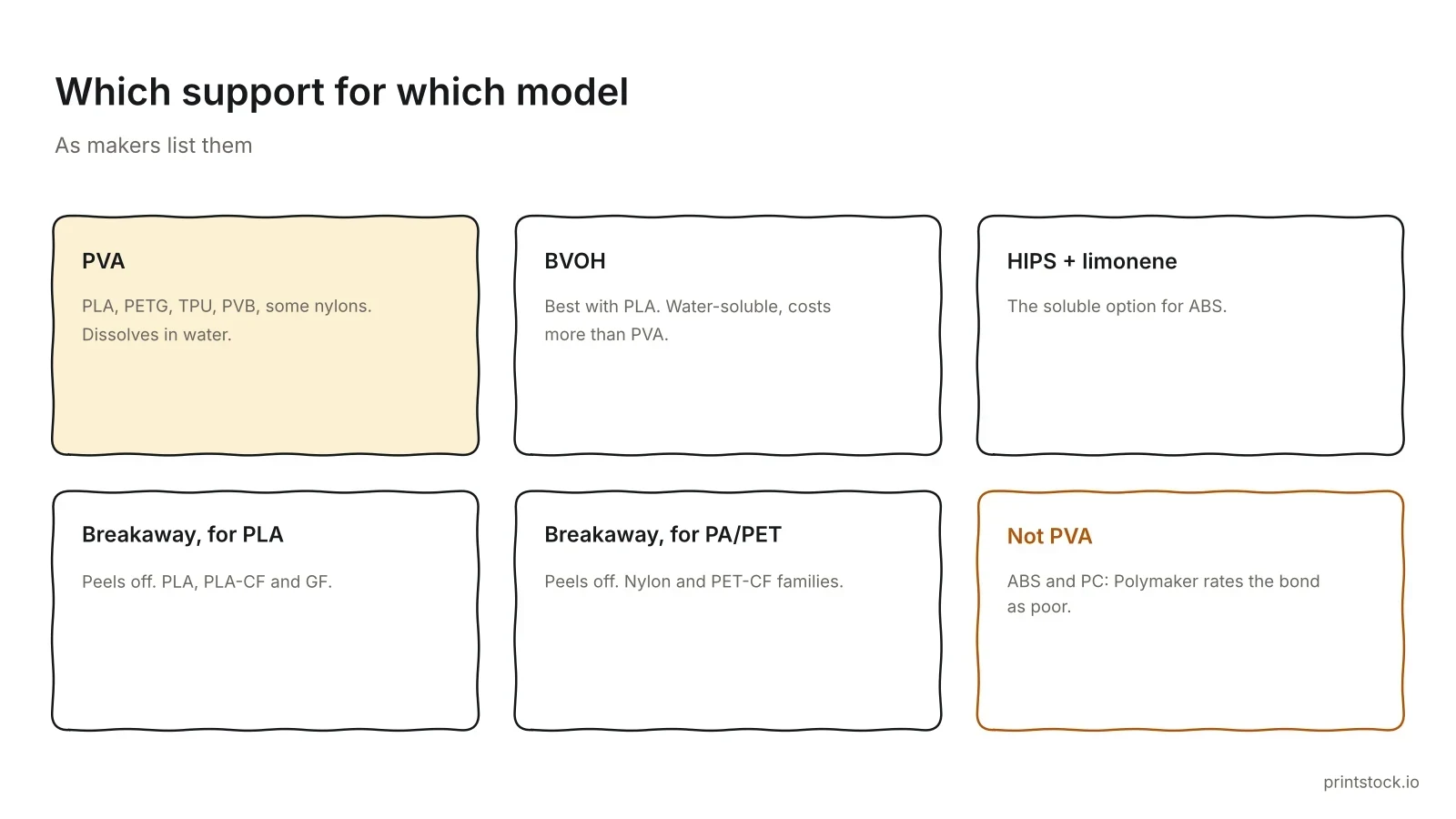
PVA bonds well to PLA and, depending on the line, PETG, TPU, PVB and nylon; Polymaker rates its adhesion to ABS and PC as poor. Support and model must print at similar temperatures and stick to each other.
Line | Supports, as the maker lists |
|---|---|
Polymaker PolyDissolve S1 | PLA, TPU, PVB and nylon materials from Polymaker's range |
Bambu Lab PVA | PLA, PETG and their carbon- and glass-fibre versions |
Prusa (PVA and BVOH in general) | Ideally PLA, because of similar print temperatures |
For ABS, Prusa suggests HIPS supports dissolved in limonene instead.
PVA settings by brand
PVA prints at PLA temperatures: makers' nozzle windows in our catalog run from 180 to 230 °C, with beds from 25 to 60 °C. This table comes from our catalog, with each maker's numbers as published.
| Filament | Nozzle (maker) | Bed (maker) | Drying (maker) | Heat deflection | Length per spool | From, per kg |
|---|---|---|---|---|---|---|
| eSUN PVAeSUN | 180 to 230 °C | 45 to 60 °C | 45 °C, 10 h | Not stated | ≈ 165 m | $64.46as of Nov 17, 2026 |
| Polymaker PolyDissolve S1Polymaker | 215 to 225 °C | 25 to 60 °C | 80 °C, 12 h | Not stated | n/a | n/a |
Live from our catalog: settings, drying and heat deflection as each maker publishes them (heat deflection is comparable only at the same load); length is calculated by PrintStock. Open a filament for every offer.
Setup advice from the makers:
- Z distance. Prusa sets the support-to-model distance to 0 mm for soluble supports, so the underside of the model comes out almost as clean as the top.
- First layer. Prusa says PVA and BVOH stick much better to PLA than to a PEI sheet, and suggests a 1 to 2 layer PLA raft, or models that do not need PVA directly on the bed.
- Interface only. Print just the support interface in PVA and the rest of the support in the model material. Bambu Lab and Prusa both describe this mode; it saves most of the PVA.
- Nozzle size. Bambu Lab lists its PVA as not compatible with 0.2 mm nozzles.
How to dry and store PVA
Dry PVA before printing and move it straight into a sealed dry box; it picks up water faster than any other common filament. Bambu Lab says the dried spool should go into a dry environment immediately, without waiting for it to cool, and kept below 20% relative humidity while printing (Bambu Lab PVA printing guide).
Line | Drying, as the maker lists |
|---|---|
Polymaker PolyDissolve S1 | 80 °C for 12 hours |
Bambu Lab PVA | 80 °C for 12 hours |
eSUN PVA | 45 °C for more than 10 hours |
Prusa warns that wet water-soluble filament does not stick to the bed and tends to clog and tangle in the extruder gears. Store open spools in a sealed box with fresh desiccant, or print straight from a dryer. See our filament drying guide.
How to dissolve PVA supports
Soak the print in warm water, change the water and keep it moving; expect several hours. Polymaker gives 6 to 12 hours for PolyDissolve S1, and Prusa says the time depends on the ratio of material to water and on the water temperature.
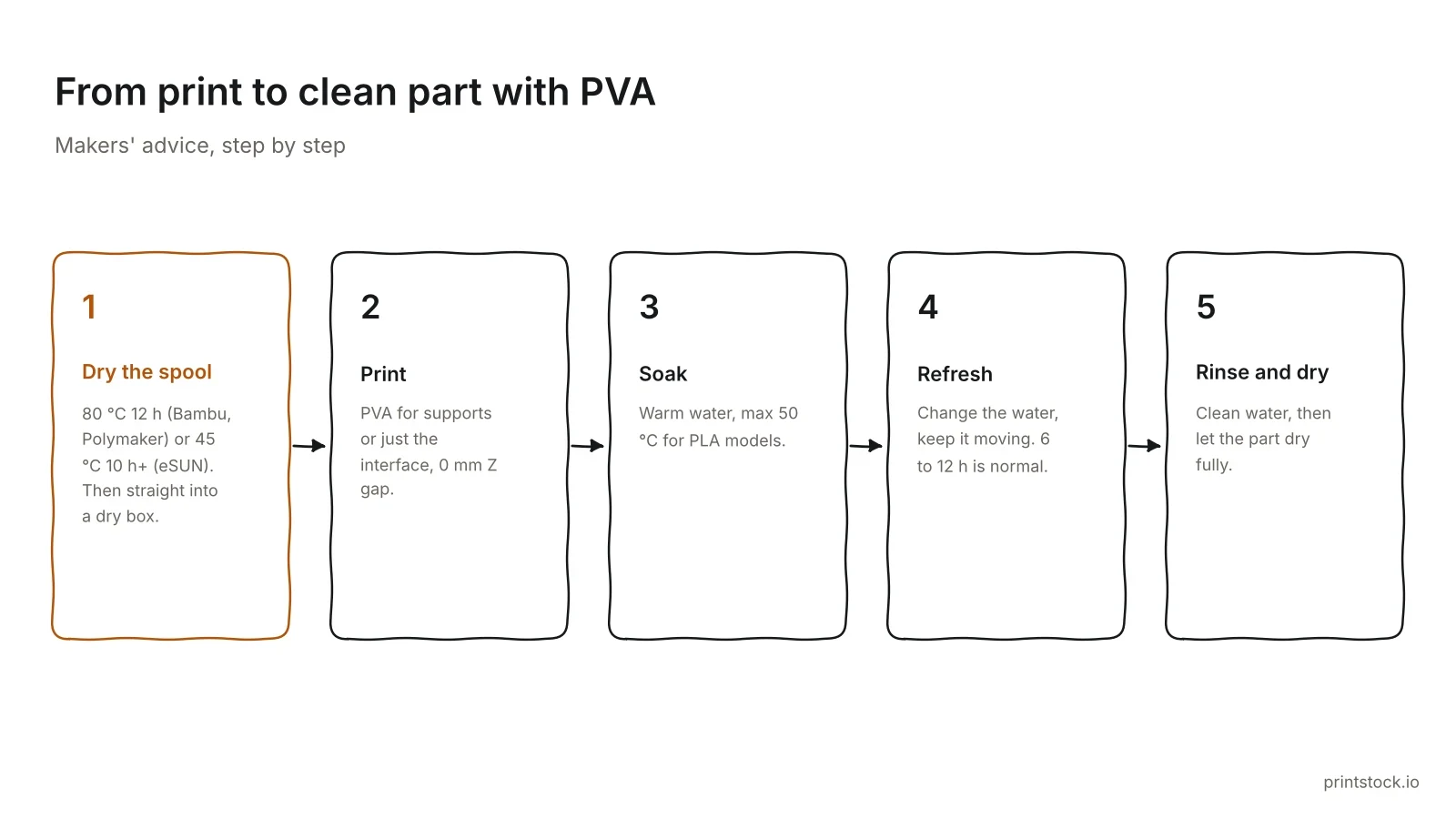
- Remove the print from the bed and break off any large, easy chunks of PVA by hand.
- Put it in a container with plenty of warm water. Bambu Lab says no hotter than 50 °C if the model is PLA, so the model does not deform.
- Change the water every few hours; saturated water dissolves PVA much more slowly. Moving water helps too.
- When the supports are gone, rinse the part in clean water and let it dry fully before use.
Prusa says that unless you dissolve several kilos a day, the PVA solution can go down the drain.
Is PVA worth it, or will it waste my spool?
PVA is worth it for parts you cannot support any other way; for simple overhangs, breakaway supports are cheaper and faster. The common fear is a spool that turns gummy before you finish it. Lower that risk:
- buy the smallest spool you can (both lines in our catalog come in 500 or 750 g);
- dry it before the first use and keep it sealed with desiccant between prints;
- print only interfaces in PVA;
- use breakaway support filament where the surface under the support is hidden or will be sanded anyway.
PVA vs BVOH vs breakaway supports
BVOH is the dearer water-soluble alternative that Prusa rates higher; breakaway supports do not dissolve at all but cost far less.
| PVA | BVOH | Breakaway support filament |
|---|---|---|---|
Removal | Dissolves in water, hours | Dissolves in water, hours | Peeled off by hand |
Best with | PLA, PETG, TPU, some nylons | PLA | The material it is made for (e.g. Bambu Support for PLA, Support for PA/PET) |
Moisture sensitivity | Very high | Very high | Normal |
Cost | High | Higher | Lower |
Internal channels | Yes | Yes | No |
Prusa calls BVOH the better but more expensive option. Bambu Lab's breakaway supports are matched to materials: its Support for PLA works with PLA and PLA-CF or GF, and its Support for PA/PET with nylon and PET-CF families.
Common mistakes with PVA
- Printing from a spool that sat in room air. It goes soft, clogs and will not stick.
- Hot water on a PLA model. Bambu Lab's limit is 50 °C; hotter water can deform PLA.
- Too little purge on a filament changer. Model material mixed into the support stops it dissolving fully, as Prusa warns.
- PVA directly on PEI. Start on a PLA raft or keep PVA off the first layer.
- Using PVA with ABS or PC. Polymaker rates the bond as poor; use HIPS for ABS or breakaway supports.
Where to go from here
- Dry filament: dryers, ovens and storage.
- PLA and TPU: the model materials PVA supports best.
- Nylon filament: nylon models with soluble supports.
- Browse all PVA filament in our catalog, with prices as of the date shown.