
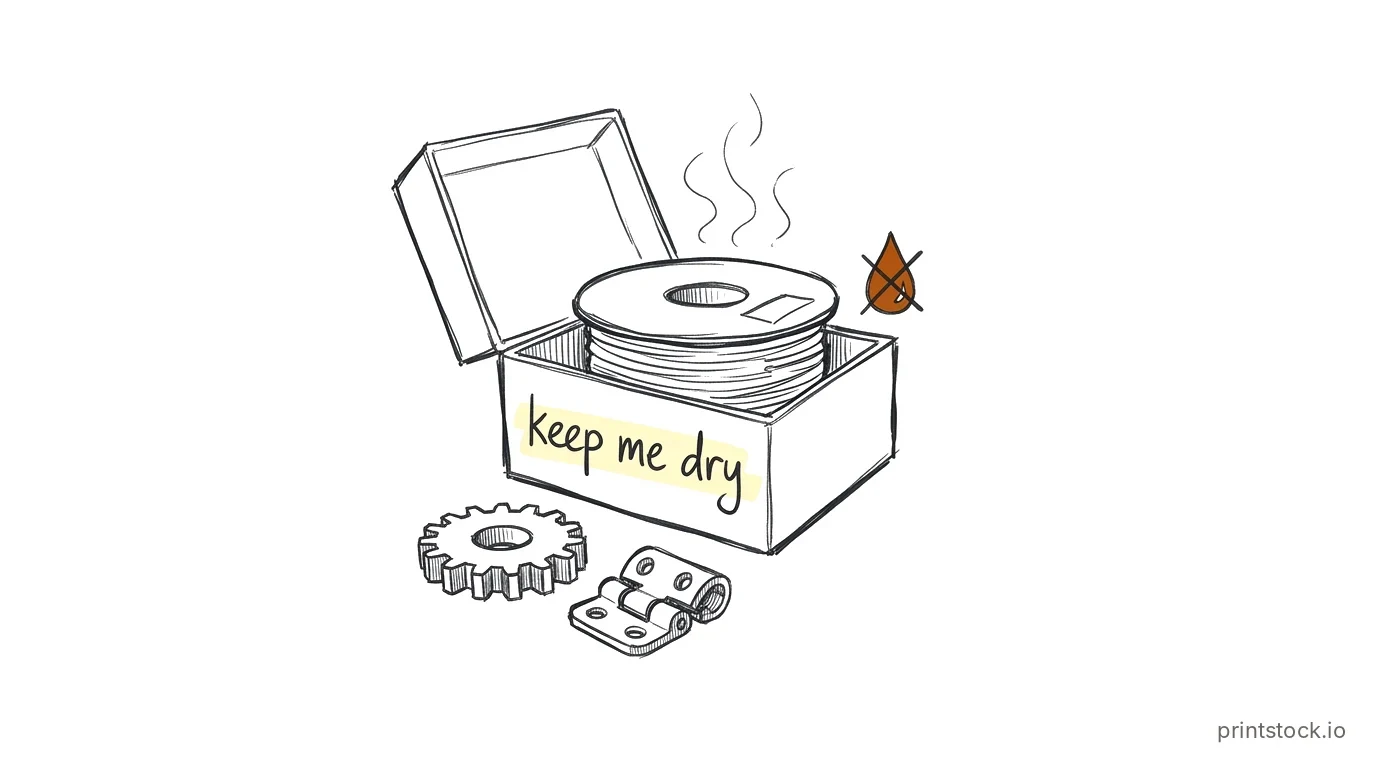
Nylon (polyamide, PA) is the filament for parts that move: gears that mesh, hinges that flex, clips that snap on a hundred times. It is tough, slippery and resists wear and oil better than any everyday filament. It is also the most moisture-hungry material most makers will ever print. This guide sets out what each maker publishes, how plain and carbon-fibre nylon differ, and what your printer and storage need.
Nylon in numbers
These figures are live from our catalog: every plain nylon line we track, with the maker's settings and the lowest current price per kg. Carbon-fibre nylon follows below as its own material.
- Filaments we track
- 3 from 2 brands
- Nozzle, makers' range
- 250-290 °C
- typical middle 270 °C
- Bed, makers' range
- 30-90 °C
- Heat deflection (0.45 MPa)
- 50-100 °C
- median 75 °C, 2 data sheets
- Drying, makers' range
- 70 °C
- stated for 1 of 3 lines
- Density
- 1.012-1.12 g/cm³
- Length of 1 kg (1.75 mm)
- 370-410 m
- from makers' density
- Price per kg
- $22.09 to $65.29
- median $34.58, as of Nov 17, 2026
- Colours across these lines
- 5
- up to 2 in one line
- Printers in our catalog it fits
- 84 of 123 FDM printers
PrintStock catalog data for PA: makers' published values and in-stock US prices, updated with the catalog.
- Filaments we track
- 7 from 5 brands
- Nozzle, makers' range
- 260-300 °C
- typical middle 280 °C
- Bed, makers' range
- 40-120 °C
- Heat deflection (0.45 MPa)
- 155-215 °C
- median 193 °C, 6 data sheets
- Drying, makers' range
- 70-110 °C
- stated for 7 of 7 lines
- Density
- 1.06-1.24 g/cm³
- Length of 1 kg (1.75 mm)
- 335-380 m
- from makers' density
- Price per kg
- $50.54 to $100.72
- median $77.41, as of Nov 17, 2026
- Colours across these lines
- 7
- up to 1 in one line
- Printers in our catalog it fits
- 21 of 123 FDM printers
- some blends need a hardened nozzle
PrintStock catalog data for PA-CF: makers' published values and in-stock US prices, updated with the catalog.
The lines we track today are eSUN PA, eSUN PA12 and SUNLU Easy PA for plain nylon, and seven carbon-fibre lines from Bambu Lab, Polymaker, Prusament, eSUN and SUNLU. We add more as we verify makers' data.
What is nylon filament good for?
Nylon suits parts that need toughness, low friction and wear resistance more than stiffness or a perfect surface. Prusa describes polyamide as mechanically strong, tough in large volumes, flexible in thin layers and resistant to high temperatures, and recommends it for technical parts that face heat, chemicals and mechanical load (Prusa knowledge base).
Typical jobs:
- gears, pulleys and bushings, where its low friction matters;
- living hinges, clips and snap fits that must bend without cracking;
- brackets, mounts and tool holders that get knocked about;
- parts that touch oil or grease.
Nylon is not the right choice for decorative prints, very large flat parts on an open printer, or anything you need to print without drying first. For heat resistance alone, polycarbonate is easier to keep dry; for outdoor parts, ASA is easier to print.
Plain nylon vs carbon-fibre nylon
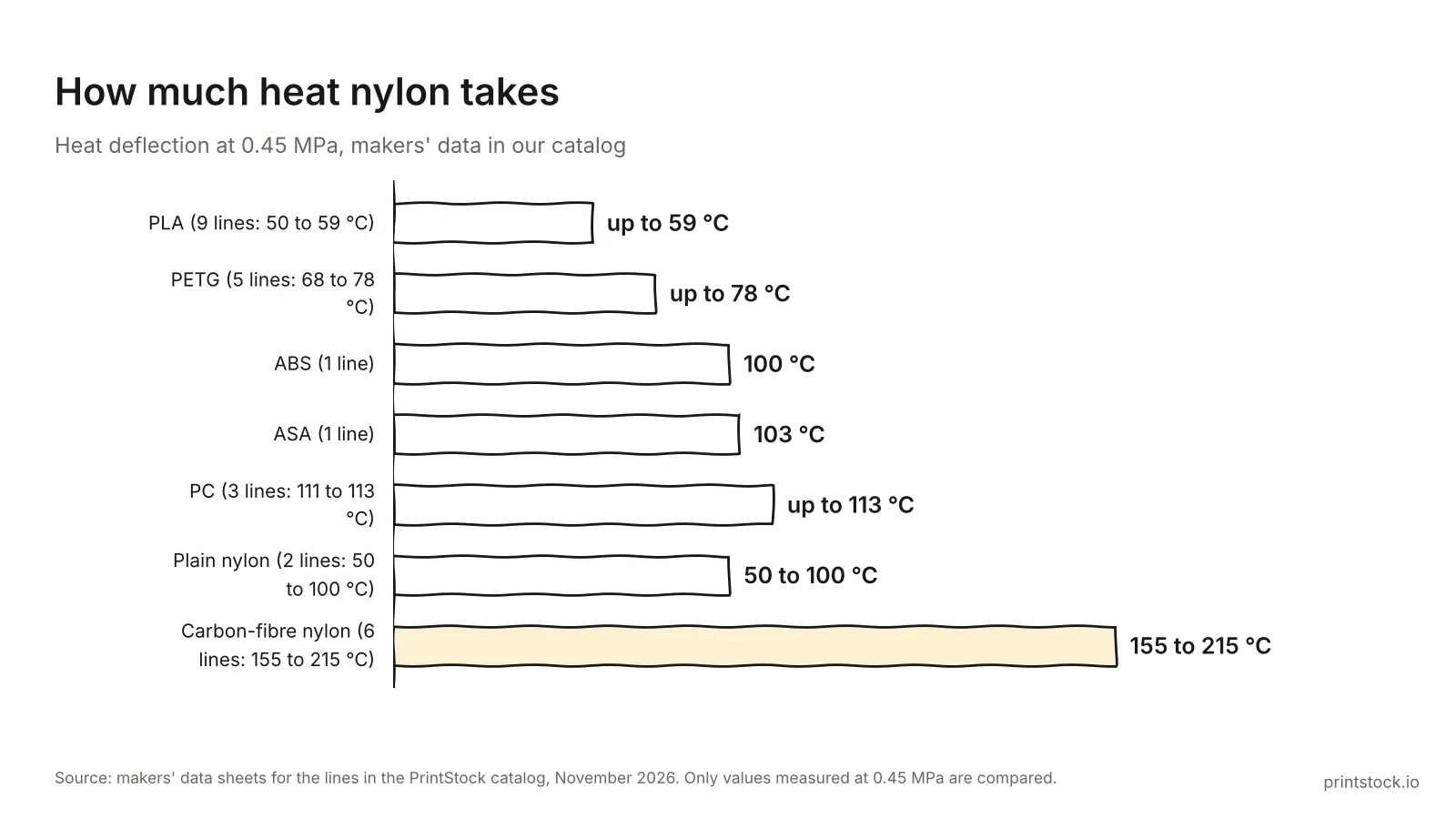
Carbon fibre turns nylon from a tough, bendy plastic into a stiff, heat-resistant one that warps far less. In our catalog, plain nylon lines list heat deflection of 50 °C (eSUN PA) and 100 °C (eSUN PA12) at 0.45 MPa; carbon-fibre lines list 155 to 215 °C on the same test. That puts PA-CF above every everyday filament, including PC.
| Plain nylon (PA) | Carbon-fibre nylon (PA-CF) |
|---|---|---|
Heat deflection, 0.45 MPa (makers' data) | 50 to 100 °C | 155 to 215 °C |
Warping | High; enclosure strongly advised | Much lower; Prusa says PA11 CF can print without an enclosure |
Feel | Tough, slightly flexible, slippery | Stiff, matte, dimensionally stable |
Nozzle | Brass is fine | Hardened steel or ruby; brass wears out |
Price per kg in our catalog | Lower | Higher; see the live figures above |
The trade-off is flexibility. Carbon fibre makes parts stiffer and more brittle, so a living hinge or a snap fit is still a job for plain nylon. Bambu Lab also notes that its PA6-CF loses strength and stiffness after absorbing water and is not recommended for thin, elongated parts that must hold their dimensions.
Nylon settings by brand
Makers' nozzle windows run from 250 to 300 °C, and every one includes 280 °C. Bed temperatures vary much more, from 30 to 120 °C, so follow the spool. This table comes from our catalog, with each maker's numbers as published, plain and carbon-fibre nylon together.
| Filament | Nozzle (maker) | Bed (maker) | Drying (maker) | Heat deflection | Length per spool | From, per kg |
|---|---|---|---|---|---|---|
| Bambu Lab PA6-CFBambu Lab | 260 to 290 °C | 80 to 100 °C | 80 °C, 8-12 h | 186 °C at 0.45 MPa | ≈ 380 m | $77.41as of Nov 17, 2026 |
| Bambu Lab PAHT-CFBambu Lab | 260 to 290 °C | 80 to 100 °C | 80 °C, 8-12 h | 194 °C at 0.45 MPa | ≈ 195 m | $100.72as of Nov 17, 2026 |
| eSUN PAeSUN | 250 to 290 °C | 70 to 90 °C | 70 °C, 12 h | 50 °C at 0.45 MPa | ≈ 370 m | $34.58as of Nov 17, 2026 |
| eSUN PA12eSUN | 260 to 290 °C | 70 to 90 °C | Not stated | 100 °C at 0.45 MPa | ≈ 410 m | $65.29as of Nov 17, 2026 |
| eSUN PA-CFeSUN | 260 to 300 °C | 45 to 60 °C | 70 °C, 12 h | 155 °C at 0.45 MPa | ≈ 335 m | $50.54as of Nov 17, 2026 |
| Polymaker Fiberon PA6-CF20Polymaker | 280 to 300 °C | 40 to 50 °C | 100 °C, 10 h | 215 °C at 0.45 MPa | ≈ 180 m | $82.86as of Nov 17, 2026 |
| Prusament PA11 Carbon FiberPrusa Research | 280 to 290 °C | 100 to 120 °C | 90 °C, 6 h | 192 °C at 0.45 MPa | n/a | n/a |
| SUNLU Easy PASUNLU | 255 to 280 °C | 30 to 50 °C | Not stated | Not stated | n/a | $22.09as of Nov 17, 2026 |
| SUNLU PA12-CFSUNLU | 260 to 280 °C | 60 to 70 °C | 80-110 °C | 175 °C (load not stated) | n/a | $73.67as of Nov 17, 2026 |
| SUNLU PA6-CFSUNLU | 270 to 290 °C | 50 to 70 °C | 80-110 °C, 4-24 h | 209 °C at 0.45 MPa | ≈ 345 m | n/a |
Live from our catalog: settings, drying and heat deflection as each maker publishes them (heat deflection is comparable only at the same load); length is calculated by PrintStock. Open a filament for every offer.
Practical notes from the makers' own guidance:
- Bed surface and glue. Bambu Lab recommends PVP glue on its Engineering, High Temperature or Textured PEI plate for PAHT-CF; eSUN lists solid glue or PEI for its PA; Prusa says its PA Nylon sheet gives the best adhesion for most polyamides.
- Cooling. Low. eSUN lists 0% fan for its PA; Bambu Lab allows 0 to 40% for PAHT-CF.
- Chamber. Bambu Lab lists a 45 to 60 °C chamber for PAHT-CF, which in practice means a closed printer.
- Speed. Slower than PLA: Bambu Lab lists up to 100 mm/s for PAHT-CF.
Which nylon: PA6, PA12, PA11 or a copolymer?
The number after PA describes the polymer chain, and in practice it tells you how much water the nylon takes up. PA6 and the PA6/66 copolymers are the most common and the most hygroscopic; PA12 and PA11 have longer chains and absorb less water, so their parts change less in humid air.
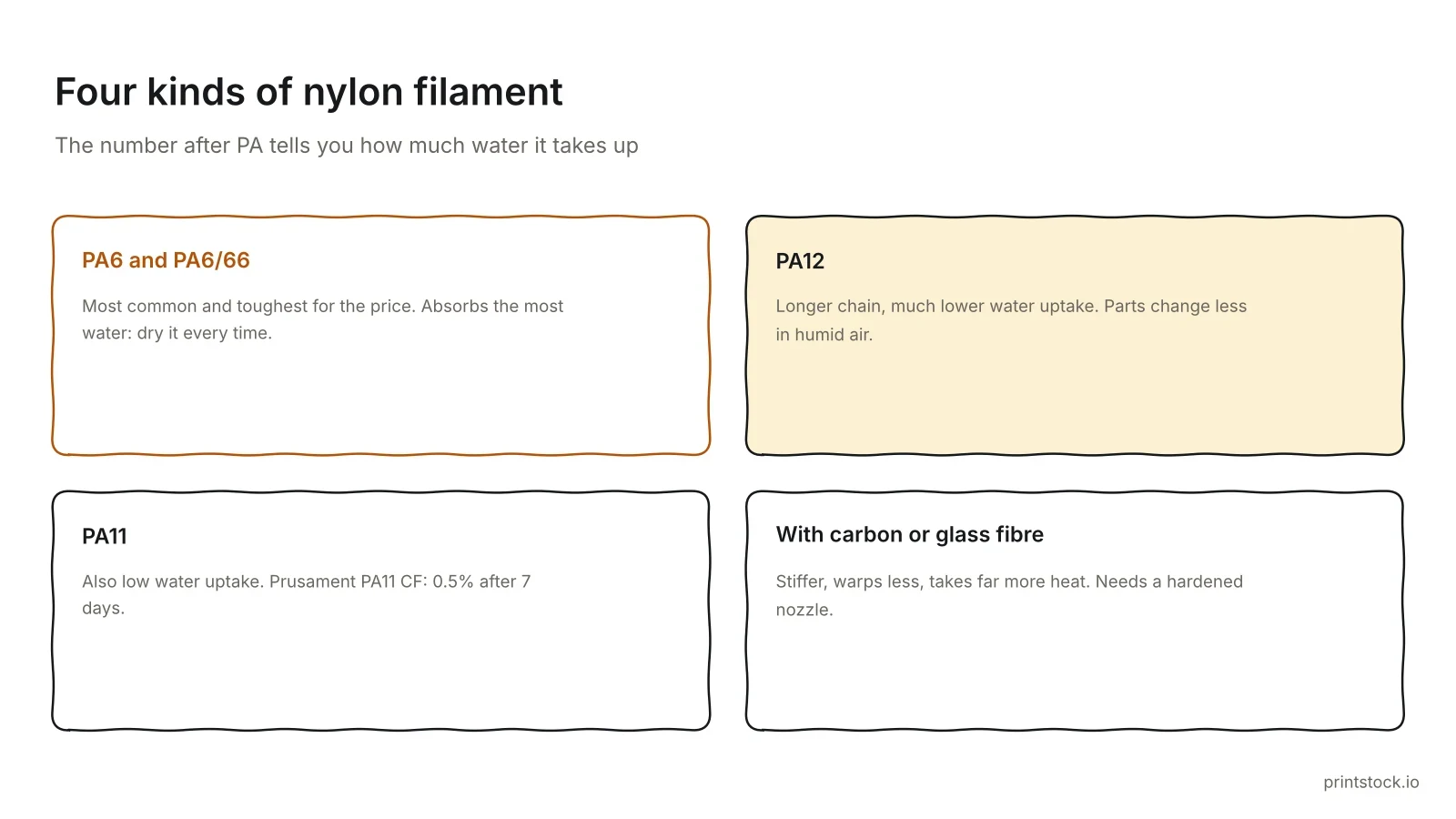
- PA6 and PA6/66 (eSUN PA, SUNLU Easy PA, most PA6-CF). Tough and widely available, but thirsty. Polymaker lists equilibrium water absorption of 3.33% for PolyMide PA6-CF.
- PA12 (eSUN PA12, Bambu PAHT-CF, SUNLU PA12-CF). Bambu Lab measures saturated water absorption of 0.88% for PAHT-CF against 1.70% for ordinary PA-CF at 25 °C and 55% humidity, and says PAHT-CF keeps more of its strength when wet.
- PA11 (Prusament PA11 Carbon Fiber). Prusa's data sheet lists 0.20% absorption after 24 hours and 0.50% after 7 days at 24 °C and 22% humidity.
- Copolymers (CoPA) and "easy" nylons. Blends tuned to warp less and print at lower bed temperatures; SUNLU Easy PA runs its bed at 30 to 50 °C.
How to dry and store nylon
Dry nylon before every print once the bag has been opened, and print it from a dry box. Prusa notes that poorly stored nylon can absorb up to 10% of its weight in water, and that moisture causes bubbles, uneven layers and a poor surface.
Makers' drying settings for the lines in our catalog:
Line | Drying |
|---|---|
eSUN PA, eSUN PA-CF | 70 °C, at least 12 hours |
Bambu Lab PA6-CF, PAHT-CF | 80 °C, 8 to 12 hours in a drying oven |
Polymaker Fiberon PA6-CF20 | 100 °C, 10 hours |
SUNLU PA6-CF | 80 to 110 °C (3DJake's listing adds 80 °C for 24 hours or 110 °C for 4 hours) |
Prusa, general advice | At least 4 hours below 90 °C |
Check your dryer's maximum temperature against the figure for your spool before you buy. Bambu Lab and Polymaker both ask for printing and storage below 20% relative humidity. Our filament drying guide covers dryers and ovens.
What your printer needs
A hotend that holds 280 °C or more, a bed of 80 to 110 °C for most lines, an enclosure for plain nylon, and a hardened nozzle for carbon-fibre nylon.
- All-metal hotend rated to about 300 °C. PTFE-lined hotends cannot run nylon temperatures safely.
- Hardened nozzle for PA-CF. Every carbon-fibre nylon in our catalog is abrasive.
- Heated bed. 100 °C or more covers every line except Prusament PA11 CF at its top end (120 °C).
- Enclosure. Strongly advised for plain nylon; Bambu Lab lists PAHT-CF as unsuitable for open-frame printers.
- A dry box or a dryer you can print from.
Each nylon page in our catalog lists the printers it fits, worked out from the printer's published maximum nozzle and bed temperatures and whether it is enclosed.
Is printing nylon worth the trouble?
Yes, if your part needs toughness or wear resistance that PETG cannot give, and if you will dry the spool every time. The fear most makers have is wasting an expensive spool on failed prints. Lower the risk in three steps:
- Start with a carbon-fibre or "easy" nylon: they warp far less than plain PA6.
- Dry the spool to the maker's figure before the first print, then keep it in a sealed box with desiccant.
- Print a small test part with glue on the bed before committing to a long job.
Nylon also gives off a stronger smell than PLA. Prusa notes that it emits strong odours and ultrafine particles, so print in a ventilated room or an enclosure.
Common mistakes with nylon
- Printing straight from an opened bag. The single biggest cause of stringy, bubbly, weak nylon.
- Brass nozzle with carbon-fibre nylon. It wears out within one or two spools, sometimes within one print.
- No glue on smooth PEI. Plain nylon peels off; use glue or a nylon-friendly sheet.
- Full part cooling. Nylon wants little or no fan.
- Using PA-CF for flexing parts. Carbon fibre makes nylon stiff; hinges and clips want plain nylon.
Where to go from here
- Polycarbonate filament: the other heat-resistant engineering filament.
- Dry filament: drying times and temperatures.
- Hardened steel nozzles: what carbon-fibre filament needs.
- Browse nylon and carbon-fibre nylon in our catalog, with prices as of the date shown.