
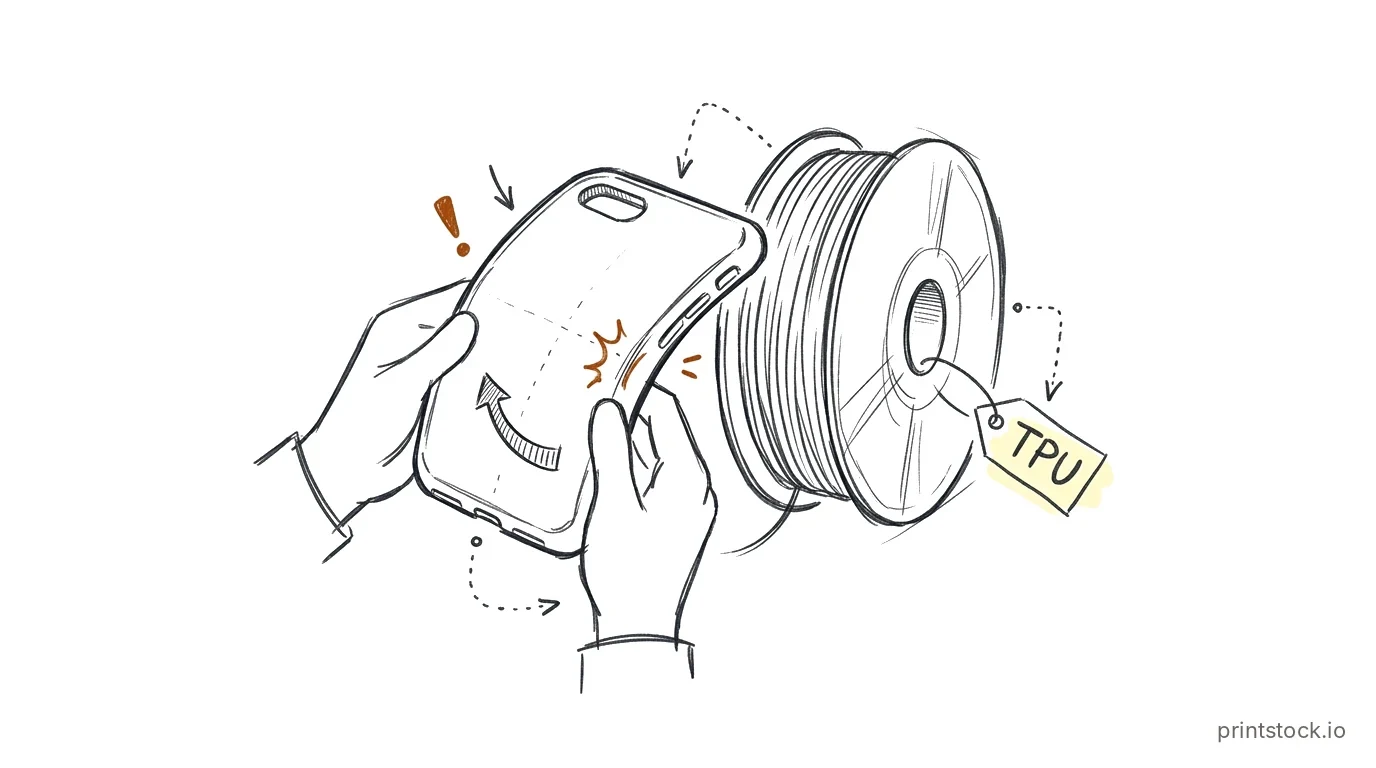
TPU is how a 3D printer makes rubber. A phone case, a seal, a non-slip foot or a drone bumper all start as a spool of TPU. It is easy on temperature and hard on the extruder, so success depends more on speed and feeding than on heat.
TPU in numbers
TPU prints cooler than PETG but much slower. These figures come live from our catalog.
- Filaments we track
- 5 from 2 brands
- Nozzle, makers' range
- 200-250 °C
- typical middle 225 °C
- Bed, makers' range
- 20-60 °C
- Drying, makers' range
- 70 °C
- stated for 1 of 5 lines
- Density
- 1.18 g/cm³
- Price per kg
- $21.00 to $34.39
- median $27.69, as of Nov 11, 2026
- Colours across these lines
- 23
- up to 19 in one line
- Printers in our catalog it fits
- 87 of 123 FDM printers
- some blends need a hardened nozzle
PrintStock catalog data for TPU: makers' published values and in-stock US prices, updated with the catalog.
TPU settings by brand
The temperature windows are close; speed is what you tune. The table lists every TPU line in our catalog with its maker's settings.
| Filament | Nozzle (maker) | Bed (maker) | Drying (maker) | Heat deflection | Length per spool | From, per kg |
|---|---|---|---|---|---|---|
| Overture High Speed TPU 95AOverture 3D | 200 to 240 °C | 25 to 60 °C | Not stated | Not stated | ≈ 685 mestimate | $21.00as of Nov 11, 2026 |
| Overture Matte TPUOverture 3D | 210 to 240 °C | 35 to 50 °C | Not stated | Not stated | ≈ 345 mestimate | n/a |
| Overture TPU 95AOverture 3D | 210 to 240 °C | 25 to 60 °C | 70 °C, 7 h | Not stated | ≈ 705 m | n/a |
| Siraya Tech Fibreheart TPU-GFSiraya Tech | 220 to 250 °C | 40 to 60 °C | Not stated | Not stated | ≈ 345 mestimate | $34.39as of Nov 11, 2026 |
| Siraya Tech Flex TPU 95A MatteSiraya Tech | 220 to 240 °C | 20 to 50 °C | Not stated | Not stated | ≈ 345 mestimate | n/a |
Live from our catalog: settings, drying and heat deflection as each maker publishes them (heat deflection is comparable only at the same load); length is calculated by PrintStock. Open a filament for every offer.
Printing TPU well
Go slow and feed gently. Start with print speeds well below what you use for PLA, unless the spool is a high-speed TPU made for fast printers. Keep retraction short or off. Dry the spool first: TPU takes up moisture quickly, and wet TPU strings and bubbles. See how to dry filament.
For stiffer flexible parts, glass fibre filled TPU is an option, but it is abrasive and needs a hardened nozzle.
Where to go from here
Compare TPU spools and prices in the filament catalog. If prints are stringy, see fixing stringing.