
There are dozens of resins on the shelf, and the names do not help: standard, 8K, ABS-like, tough, PC-like, water-washable, plant-based. This guide sorts them into families, shows what makers actually publish about each, and tells you which one to buy for what. New to resin printing? Start with resin printing for beginners and resin printing safety.
Resin types at a glance
Most of the difference between resin families is toughness: how far a part bends or stretches before it snaps. Detail, price and how you wash the part come next.
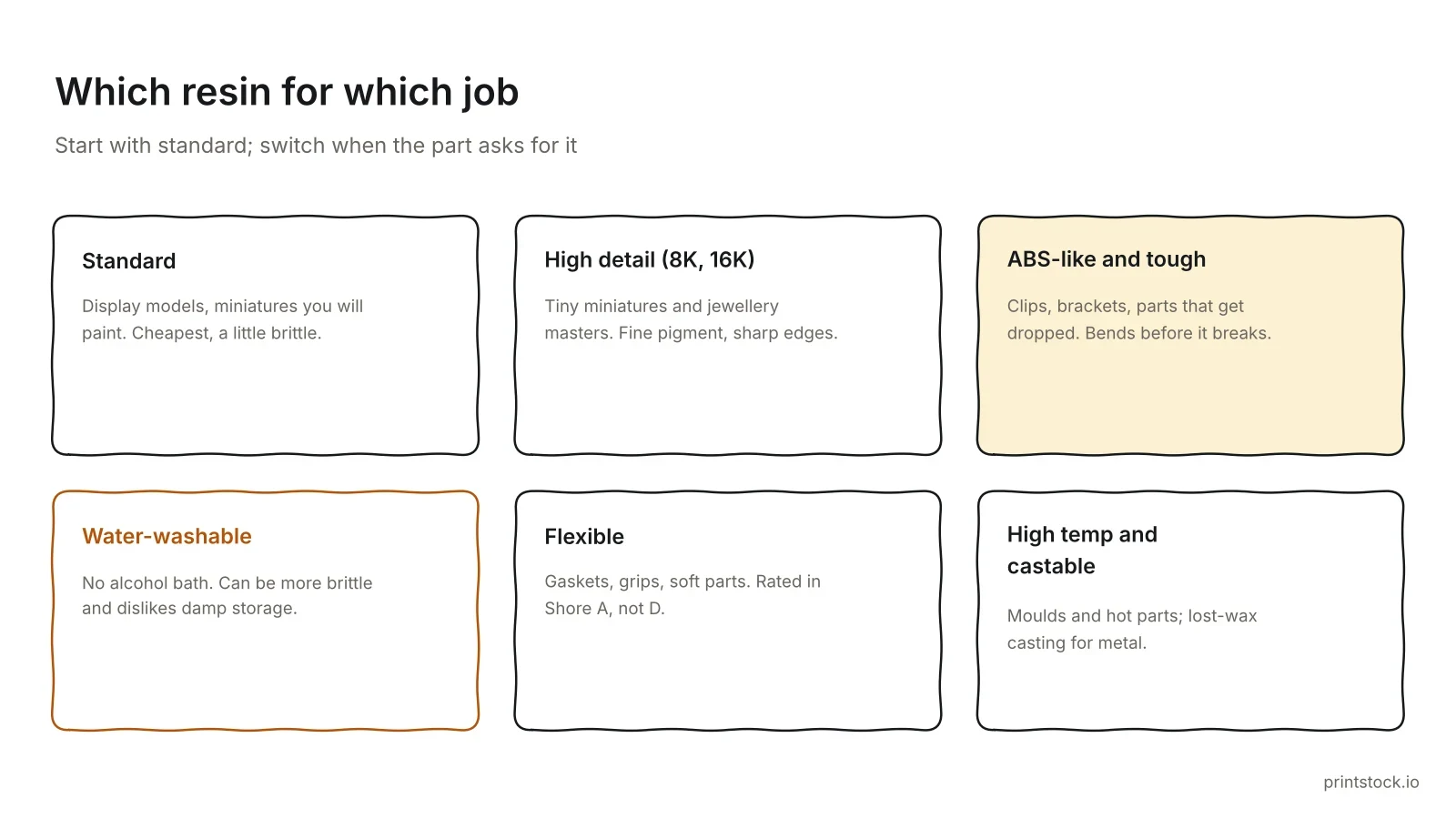
- Standard: the default for display models and miniatures. Cheapest, easiest to print, stiff and a bit brittle.
- High detail (8K, 12K, 16K): standard resin with finer pigment, made for high-resolution screens. For small miniatures and fine textures.
- ABS-like: tougher than standard, so thin parts survive handling. The best all-round choice for many people.
- Tough or engineering ("PC-like", "nylon-like"): for clips, brackets, jigs and parts that take impact. Higher viscosity, so they need a warmer room and slower settings.
- Water-washable: washed in water instead of alcohol. Convenient, but often more brittle.
- Plant-based: part of the formula comes from plant oils. Prints like standard resin.
- Flexible: rubbery parts such as gaskets and grips. Hardness is given on the softer Shore A scale.
- High temperature: for moulds and parts near heat. Very stiff and brittle.
- Castable: contains wax and burns out cleanly for lost-wax metal casting, mainly jewellery.
- Clear: transparent resin for see-through parts; needs polishing or a clear coat to look like glass.
Dental and other biocompatible resins exist too, but they need validated printers, workflows and post-processing, so we leave them out here.
Every resin in our catalog, compared
This table comes straight from our catalog: each value is what the maker publishes, and "Not stated" means the maker does not give that number. Prices are the lowest in-stock price per kg, with the date it was checked.
| Resin | Type | Wash with | Hardness | Tensile strength | Elongation | Heat deflection | From, per kg |
|---|---|---|---|---|---|---|---|
| Anycubic Standard Resin V2Anycubic | Standard | Alcohol (IPA) | 80-83 D | 35-45 MPa | 25-30% | Not stated | $23.99as of Nov 14, 2026 |
| Elegoo Standard Resin V2.0Elegoo | Standard | Alcohol (IPA) | 80-86 D | 33.21 MPa | 10.03% | Not stated | $19.99as of Nov 14, 2026 |
| Phrozen Aqua Macaroon ResinPhrozen | Standard | Not stated | Not stated | Not stated | Not stated | Not stated | $42.04as of Nov 11, 2026 |
| Phrozen Aqua ResinPhrozen | Standard | Not stated | Not stated | Not stated | Not stated | Not stated | $37.84as of Nov 11, 2026 |
| Anycubic 16K Standard ResinAnycubic | High detail (8K and similar) | Alcohol (IPA) | 83-85 D | 40-50 MPa | 12-16% | Not stated | $23.99as of Nov 14, 2026 |
| Elegoo 8K Standard ResinElegoo | High detail (8K and similar) | Not stated | 80-86 D | 44.72 MPa | 14.58% | Not stated | $21.99as of Nov 14, 2026 |
| Phrozen Aqua Hyperfine ResinPhrozen | High detail (8K and similar) | Not stated | Not stated | Not stated | Not stated | Not stated | $60.74as of Nov 11, 2026 |
| Anycubic ABS-Like Resin Pro 2Anycubic | ABS-like | Alcohol (IPA) | 82-84 D | 35-45 MPa | 35-40% | Not stated | $28.99as of Nov 14, 2026 |
| Elegoo ABS-Like Resin V3.0Elegoo | ABS-like | Not stated | 80-88 D | 40 MPa | 24% | Not stated | $17.99as of Nov 14, 2026 |
| Siraya Tech Fast ABS-Like ResinSiraya Tech | ABS-like | Alcohol (IPA) | 75 D | 60 MPa | 18% | 65 °C at 0.45 MPa | $27.37as of Nov 14, 2026 |
| Anycubic Tough Resin 2.0Anycubic | Tough / engineering | Alcohol (IPA) | 82-84 D | 30-42 MPa | 60-72% | Not stated | $39.99as of Nov 14, 2026 |
| Elegoo Tough ResinElegoo | Tough / engineering | Not stated | 78-81 D | 32.12 MPa | 43.76% | Not stated | $28.99as of Nov 14, 2026 |
| Siraya Tech Blu Lava PC-Like Tough ResinSiraya Tech | Tough / engineering | Alcohol (IPA) | 87 D | 60 MPa | 12% | 75 °C at 0.45 MPa | $33.99as of Nov 11, 2026 |
| Siraya Tech Magna Durable ResinSiraya Tech | Tough / engineering | Alcohol (IPA) | 74 D | 44 MPa | 65% | 57 °C at 0.45 MPa | $28.89as of Nov 11, 2026 |
| Anycubic Water-Wash Resin 2.0Anycubic | Water-washable | Water or alcohol | 82-85 D | 38-43 MPa | 16-22% | Not stated | $25.99as of Nov 14, 2026 |
| Elegoo 8K Water-Washable Resin V2.0Elegoo | Water-washable | Water | 80-85 D | 32.11 MPa | 12.81% | Not stated | $25.99as of Nov 14, 2026 |
| Elegoo Water-Washable Resin V2.0Elegoo | Water-washable | Water | 78-86 D | 22.89 MPa | 14.91% | Not stated | $22.99as of Nov 14, 2026 |
| Siraya Tech Simple Water-Washable ResinSiraya Tech | Water-washable | Water | Not stated | Not stated | Not stated | Not stated | $23.39as of Nov 14, 2026 |
| Anycubic Plant-Based UV Resin 2.0Anycubic | Plant-based | Alcohol (IPA) | 81-83 D | 35-40 MPa | 18-20% | Not stated | $24.99as of Nov 14, 2026 |
| Elegoo Plant-Based ResinElegoo | Plant-based | Not stated | 78-86 D | 27.46 MPa | 21.81% | Not stated | $24.99as of Nov 14, 2026 |
| Siraya Tech Tenacious Flex 70A Flexible ResinSiraya Tech | Flexible | Alcohol (IPA) | Not stated | 5 MPa | 140% | Not stated | $45.49as of Nov 14, 2026 |
| Siraya Tech Sculpt High-Temp ResinSiraya Tech | High temperature | Alcohol (IPA) | 90 D | 35 MPa | 5% | 180 °C at 0.45 MPa | $32.39as of Nov 14, 2026 |
| Siraya Tech Cast Castable ResinSiraya Tech | Castable | Alcohol (IPA) | 65-70 D | 20 MPa | 4-5% | 50 °C at 0.45 MPa | $62.12as of Nov 14, 2026 |
| Anycubic High Clear ResinAnycubic | Clear | Alcohol (IPA) | 77-79 D | 28-38 MPa | 14-18% | Not stated | $39.99as of Nov 14, 2026 |
Live from our catalog: values as each maker publishes them; makers test differently, so treat small differences as noise. Hardness is Shore D. Open a resin for colours, packs and every offer.
A few things stand out:
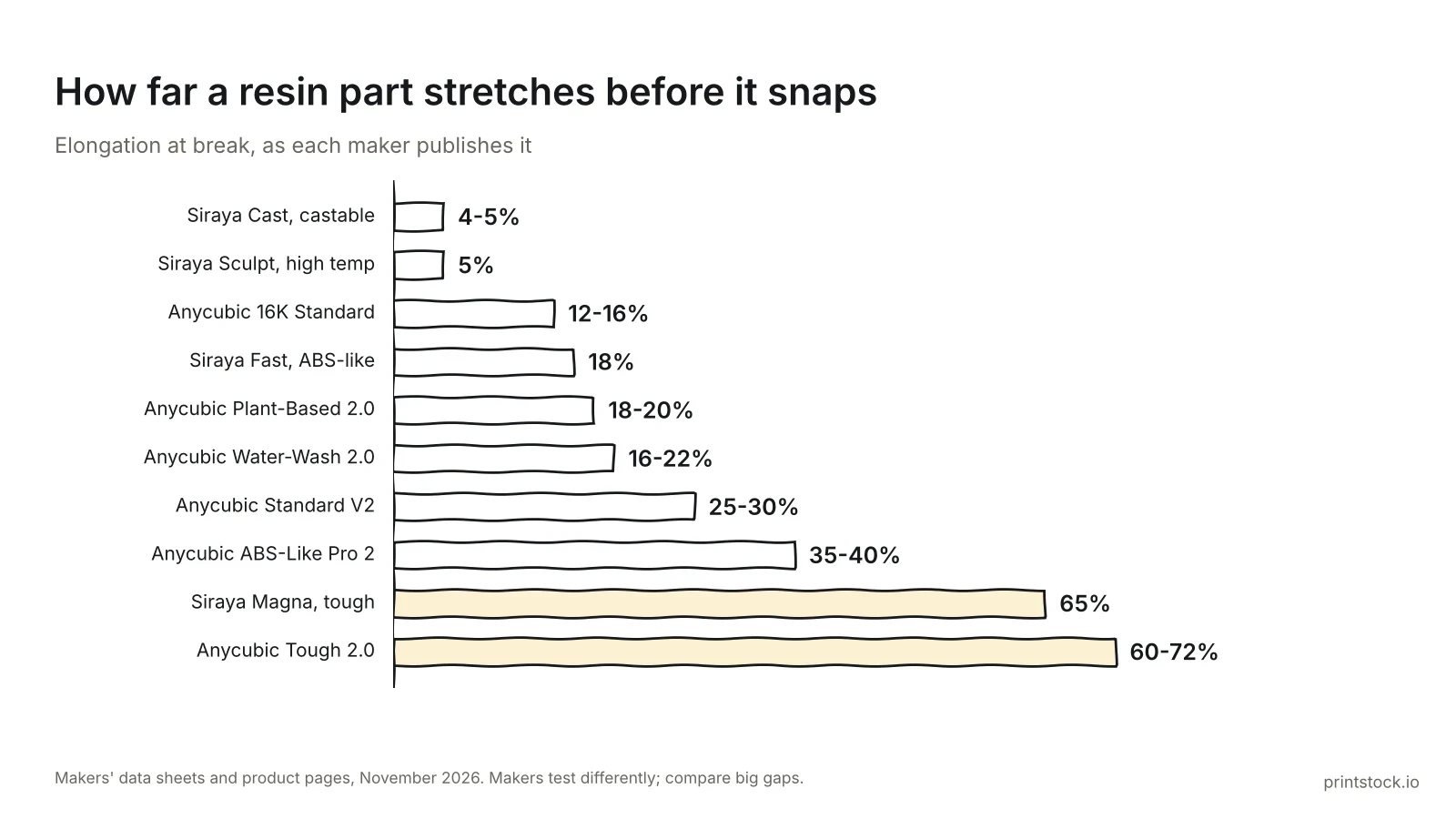
- Names do not match numbers. Anycubic lists 25 to 30% elongation at break for its Standard Resin V2 and 12 to 16% for its 16K Standard. Siraya Tech lists 18% for its Fast ABS-like resin. Read the data sheet, not just the label.
- Tough resins really are tougher. Anycubic Tough Resin 2.0 (60 to 72%) and Siraya Tech Magna (65%) stretch several times further than standard resin before breaking.
- High-temperature resin pays for its heat resistance with brittleness. Siraya Tech lists 180 °C heat deflection for Sculpt, and only 5% elongation.
- Within one brand the ladder holds. Elegoo lists 10% elongation for its Standard Resin V2.0, 24% for ABS-Like V3.0 and 44% for its Tough Resin.
- Some makers publish very little. Phrozen's store gives no mechanical numbers for its Aqua resins, so those rows are thin. We add numbers as makers publish them.
Toughness: the number that matters most
Elongation at break tells you how far a part can stretch before it snaps; the higher it is, the better a part survives drops, snap-fits and screws. Tensile strength (how hard you can pull) is similar for most hobby resins, roughly 30 to 60 MPa in our catalog, so it separates them less.
Hardness on the Shore D scale is also close across most rigid resins, around 75 to 90 D. A higher number means a harder, more scratch-resistant surface, not a stronger part.
Treat all of these as makers' figures. Brands test with different methods and cure settings, and some sheets contain obvious typos. Compare large gaps, such as 5% against 60%, rather than small ones.
ABS-like, tough and "PC-like": what the names mean
"ABS-like" means "tougher than our standard resin", not "behaves like ABS plastic". The resin is still an acrylate photopolymer. Makers use the name for a formula that bends further before breaking, and quality varies a lot between brands.
Tough resins go further. They give up some stiffness and fine detail in exchange for impact resistance. They are also thicker: Siraya Tech lists 1,550 mPa·s for Magna and 1,600 mPa·s for Blu Lava, against a few hundred for typical standard resins. Thick resin flows back under the plate slowly, so these need a warm room (Siraya asks for 25 to 30 °C for Magna), heavier supports and longer drain times before washing.
If a part needs to be properly strong or heat resistant, a filament printer and an engineering filament may still be the better tool; see resin vs filament.
Water-washable resin: convenience with a catch
Water-washable resin lets you skip isopropyl alcohol, but prints are often more brittle, and the wash water is still resin waste.
Phrozen, which sells both kinds, says water-washable resin tends to be more brittle than normal resin and that prints can crack, especially in humid conditions. The resin is designed to mix with water, and the cured part can keep some of that affinity. Tougher water-washable formulas exist: Anycubic lists 16 to 22% elongation for its Water-Wash Resin 2.0, comparable to many standard resins, and Anycubic says it can be washed in alcohol or water.
Two rules make it work:
- Dry parts completely before curing. Water trapped in a part can cause cracks and cloudiness.
- Treat the wash water as resin waste. Leave it in the sun or under UV until the resin settles out and cures, then filter it. Never pour it down the drain. See resin printing safety.
Plant-based resin: what it is and what it is not
Plant-based resin replaces part of the formula with chemicals made from plant oils such as soybean oil; it is not a non-toxic resin. The rest is the same kind of reactive acrylates and photoinitiators as in any resin, so it can still irritate skin and cause allergies. Wear the same gloves, ventilate the same way, and cure the waste before disposal.
In our catalog, Anycubic lists 18 to 20% elongation for its Plant-Based UV Resin 2.0, in line with ordinary standard resins.
Specialty resins: flexible, high temperature, castable and clear
- Flexible. Siraya Tech Tenacious Flex is rated 70 on the Shore A scale (a soft rubber) and stretches 140% before breaking. Siraya Tech asks for 10 to 25 minutes of UV curing for it, much longer than for standard resin.
- High temperature. For moulds, vacuum forming and parts near heat. Siraya Tech Sculpt lists 180 °C heat deflection at 0.45 MPa. Parts are glass-hard and brittle.
- Castable. Contains wax (Siraya Tech lists 16 to 24% for its Cast line) so the print burns out of a plaster mould without ash. Siraya asks for a print room of at least 25 °C and recommends short washes, because waxy parts are soft.
- Clear. Prints come off the plate slightly frosted. Sanding and a clear coat give the glass look. Over-curing turns clear resin yellow, so cure it briefly.
How much does resin cost?
From the makers' own stores, most hobby resins in our catalog cost about $18 to $40 per kg; castable and some specialty resins cost more. Larger bottles usually bring the price per kg down; most makers sell their popular lines in 2 kg, 5 kg or bigger packs.
The cheapest bottle is not always the cheapest print. A tougher resin that saves one failed print a week, or a resin that suits your printer's settings out of the box, quickly pays for the difference.
Buying and storing resin
- Check the wavelength. Nearly all hobby resins cure at 405 nm, the wavelength of consumer resin printers. Some are listed for a 365 to 405 nm range.
- Start from the maker's profile. Most resin makers publish settings for popular printers. Run an exposure test (see resin printing) when you open a new resin.
- Grey first. Grey and other opaque, mid-tone colours show detail and are the easiest to dial in. Clear and very dark resins need different exposure.
- Store it dark, closed and at room temperature. UV light cures resin in the bottle. Most makers quote a shelf life of about a year.
- Shake well. Pigments settle; shake the bottle for a minute before pouring, and stir the vat if it has been standing.
Where to go from here
- Resin printing for beginners: how it works, setup and your first print.
- Resin printing safety: gloves, fumes and disposal.
- FEP film: the vat film that every resin print depends on.
- Browse all resins in our catalog, with prices as of the date shown.