
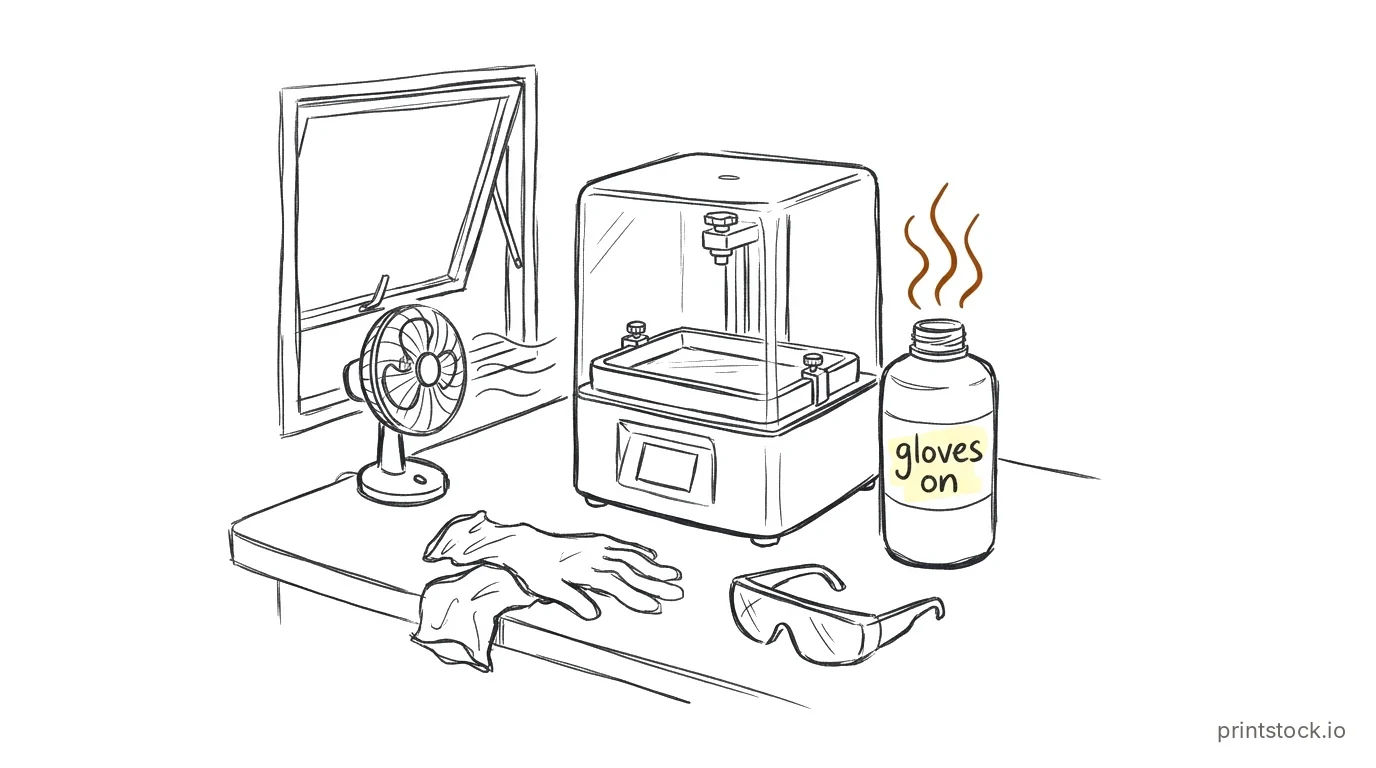
Resin printers make the sharpest parts a desktop machine can produce, and they ask for more care than a filament printer. Liquid resin is a chemical, it can give you an allergy that does not go away, and the printer gives off fumes. None of that makes resin printing dangerous if you set it up properly. This guide puts the evidence first and the gear second.
What the risks actually are
The biggest risk is skin contact with uncured resin; the second is breathing what the printer releases. Fully cured resin is a different material and far less of a concern.
Skin. Most hobby resins are built on acrylates and methacrylates. These are known skin irritants and sensitisers: repeated contact can make your immune system react to them. Medical case reports describe allergic contact dermatitis in people who handled 3D printing resin, including a dental technician in 2024 who reacted to a whole series of methacrylates. Once you are sensitised, a small exposure can set off a rash again, and related acrylates in nail products or dental materials can trigger it too.
Air. Studies that measured resin printers indoors found they add volatile organic compounds to the air, some of them odorous and irritating. In a 2025 chamber study, emissions peaked at the end of a print, when the build plate lifted out of the resin, and the build plate kept releasing them as it cooled. In a normal room the levels returned to background within about two hours after printing ended.
Isopropyl alcohol. The usual wash liquid is flammable and its vapour can ignite.
The gear that matters
Nitrile gloves and eye protection cover most of the risk. Everything else depends on your room.
- Nitrile gloves whenever you touch resin, the vat, the build plate or unwashed prints. Latex and vinyl protect poorly against resin chemicals. Change gloves as soon as they get resin on them, and keep a box next to the printer so you never skip them.
- Safety glasses or goggles when pouring resin, washing parts and cutting off supports. Supports can snap and fly.
- Long sleeves or an apron you keep for resin work.
- A respirator, only if ventilation is poor. It must have organic vapour cartridges. A dust mask or N95 stops particles such as sanding dust, not vapours.
These are the gloves, wash-and-cure stations, resin handling tools and air purifiers in our catalog:
Setting up a safe resin corner
Give resin its own space, away from where you sleep and eat, with air that moves.
- Ventilate. An open window with a fan pushing air out, or an extractor, is better than a filter alone. Do not sleep in the same room as a running printer.
- Keep your distance. In the 2025 study, moving further from the printer cut exposure by roughly 70 to 85 %. Do not hang over the vat while it prints.
- Cover the vat. A lid on an idle vat reduced emissions by 70 to 97 % in a 2024 study. Pour resin back into the bottle, or keep the printer cover closed, between prints.
- Protect surfaces. A silicone mat and paper towels catch drips. Keep phones, food and drinks out of the area, and keep children and pets away.
Isopropyl alcohol and washing
Treat isopropyl alcohol as a fire risk. Keep bottles and wash tanks closed when not in use, work away from heaters, open flames and sparks, and never use a heat gun near alcohol vapour. Wear gloves: alcohol with dissolved resin is still resin on your skin.
Water-washable resin removes the alcohol, not the resin. The wash water carries dissolved resin and has to be handled the same way as dirty alcohol.
Disposing of resin waste
Never pour resin, or alcohol or water with resin in it, down the drain or into the ground. Cure it first; once fully cured, resin is ordinary plastic waste.
- Leftover liquid resin, failed prints, supports and dirty paper towels: spread them in a clear container and leave them in sunlight or under a UV lamp until hard, then bin them.
- Dirty alcohol: leave the container in the sun. The dissolved resin cures and settles at the bottom, and the clear alcohol on top can be poured off and reused for a first wash. Cure the sludge before you throw it away.
- Water from water-washable resin: same as dirty alcohol, cure it before disposal.
- Gloves and bottles: cure any resin on them in the sun, then bin them.
Local rules for chemical waste differ, so check what your area accepts for larger amounts.
If something goes wrong
Skin: wash at once with soap and plenty of water; use soap and water, not alcohol. Eyes: rinse with water for several minutes and get medical help if irritation stays. A rash that keeps coming back is a sign of sensitisation: stop exposure and see a doctor before you print again. The safety data sheet for your resin lists the specific first aid.
Where to go from here
New to resin? Our guide to resin vs filament explains what you gain and what you take on. Look after the vat film with our FEP film guide, and compare resins and their prices in the resin catalog.