
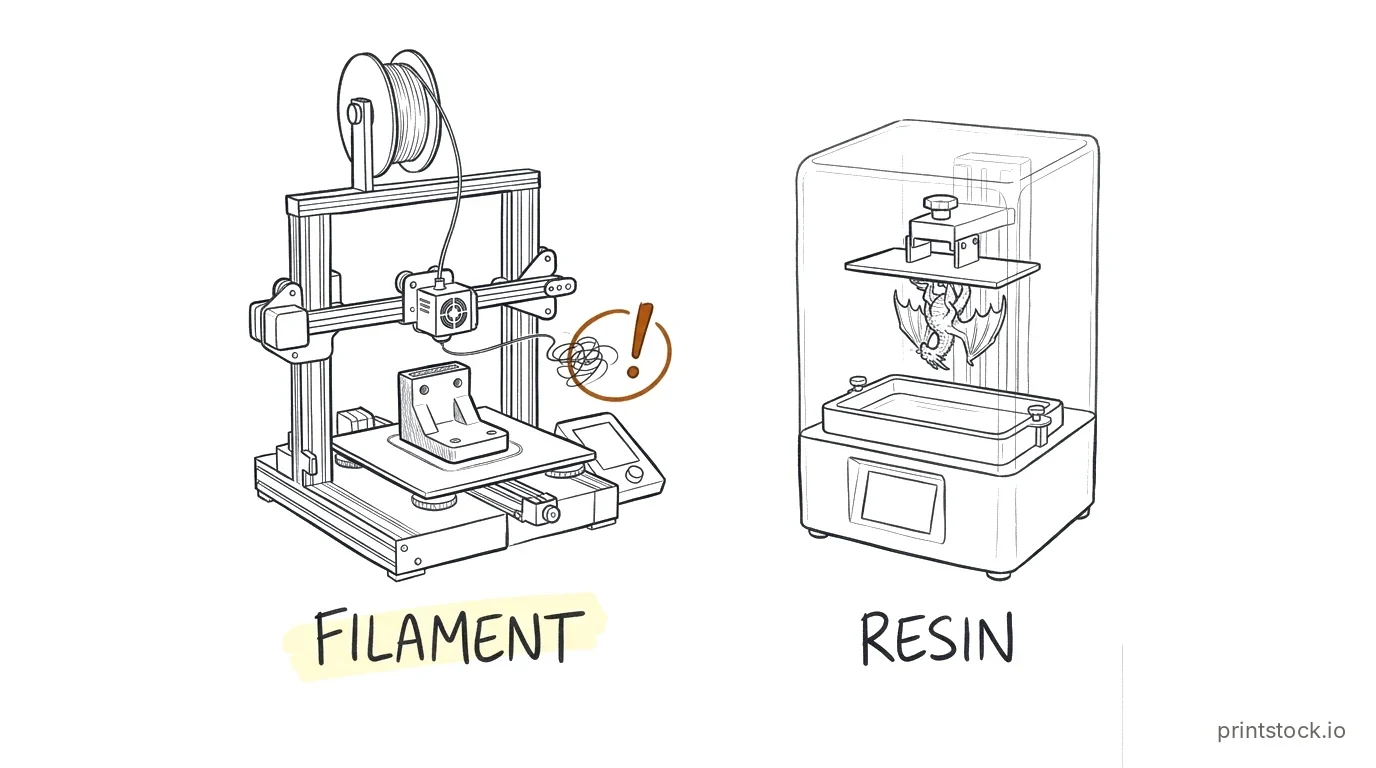
Resin or filament is the first real decision most new buyers face, and online opinions can make it sound like a matter of taste. It is not. The two technologies are good at different things, and once you know what you mostly want to print, the right choice is usually obvious. This comparison covers what changes day to day: quality, strength, cost, time, mess and safety.
Resin or filament: the quick answer
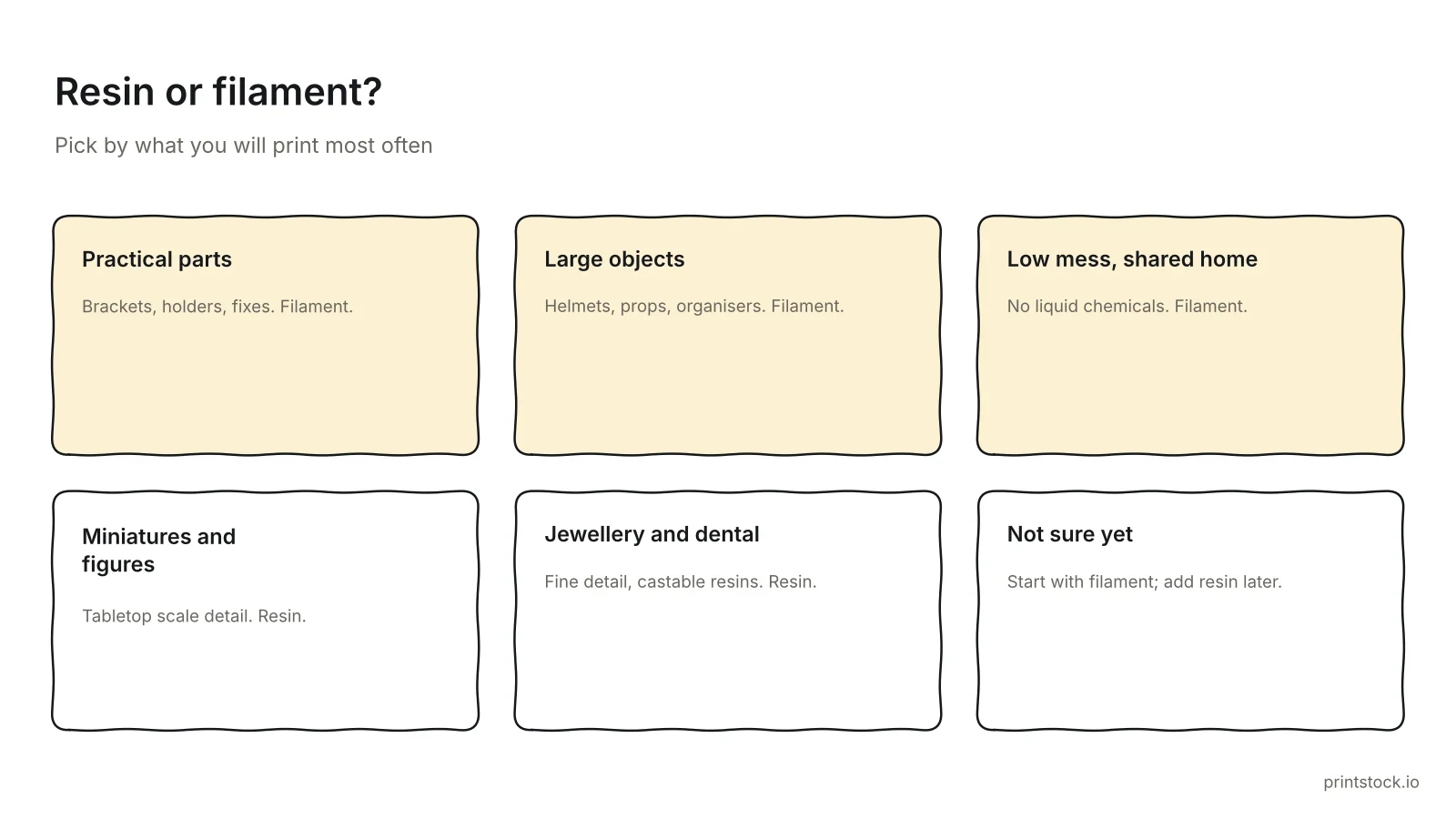
Choose a filament printer for practical parts, larger prints and an easy, low-mess hobby; choose a resin printer for small, highly detailed models such as miniatures and jewellery. If you are not sure what you will print, start with filament.
How the two technologies differ
A filament printer melts plastic and draws each layer through a nozzle; a resin printer hardens liquid resin with UV light through an LCD screen. That single difference explains almost everything else in this comparison.
A filament printer's resolution is limited by the nozzle, usually 0.4 mm wide, and by layers of 0.1 to 0.3 mm. A resin printer cures a whole layer at once through a screen with pixels a few hundredths of a millimetre across, in layers of about 0.05 mm or thinner. That is why resin captures the face of a 28 mm miniature or the texture on a ring, and filament does not. Our guide on how a 3D printer works explains both processes in detail.
Side by side: resin vs filament
Resin wins on detail and surface finish; filament wins on strength, size, cost, simplicity and safety.
| Filament (FDM) | Resin (MSLA) |
|---|---|---|
Detail | Good; visible layer lines | Excellent; layers nearly invisible |
Surface | Ridged, needs sanding for smooth | Smooth straight off the printer |
Strength | Tough, many engineering materials | Usually brittle; tough resins exist |
Print size | Medium to large | Small to medium |
After printing | Remove supports | Wash, dry, cure, remove supports |
Safety | Hot parts, some fumes | Chemical handling, gloves, fumes |
Mess | Little | Sticky resin, alcohol, waste |
Running costs | Low | Higher: resin, cleaner, films, screens |
Best for | Functional parts, prototypes, cosplay, large models | Miniatures, jewellery, dental, small detailed parts |
Price is no longer a big difference between the machines themselves. Here is the live picture from our catalog: how many models of each type we track and the lowest current price we have found.
| Machine type | Models we track | Lowest price now |
|---|---|---|
| FDM | 143 | $139.24as of Nov 11, 2026 |
| Resin | 46 | $148.59as of Nov 11, 2026 |
| Laser | 77 | $75.99as of Nov 11, 2026 |
| CNC | 12 | $372.87as of Nov 11, 2026 |
| 3D scanner | 41 | $223.35as of Nov 11, 2026 |
| 3D pen | 8 | $39.99as of Nov 11, 2026 |
| Powder bed (SLS, MJF) | 15 | $23,990as of Nov 15, 2026 |
| Material jetting | 6 | n/a |
| Metal | 20 | n/a |
| Ceramic | 2 | n/a |
Live from our catalog: in-stock offers in US dollars from official stores and retailers.
What a resin print really involves
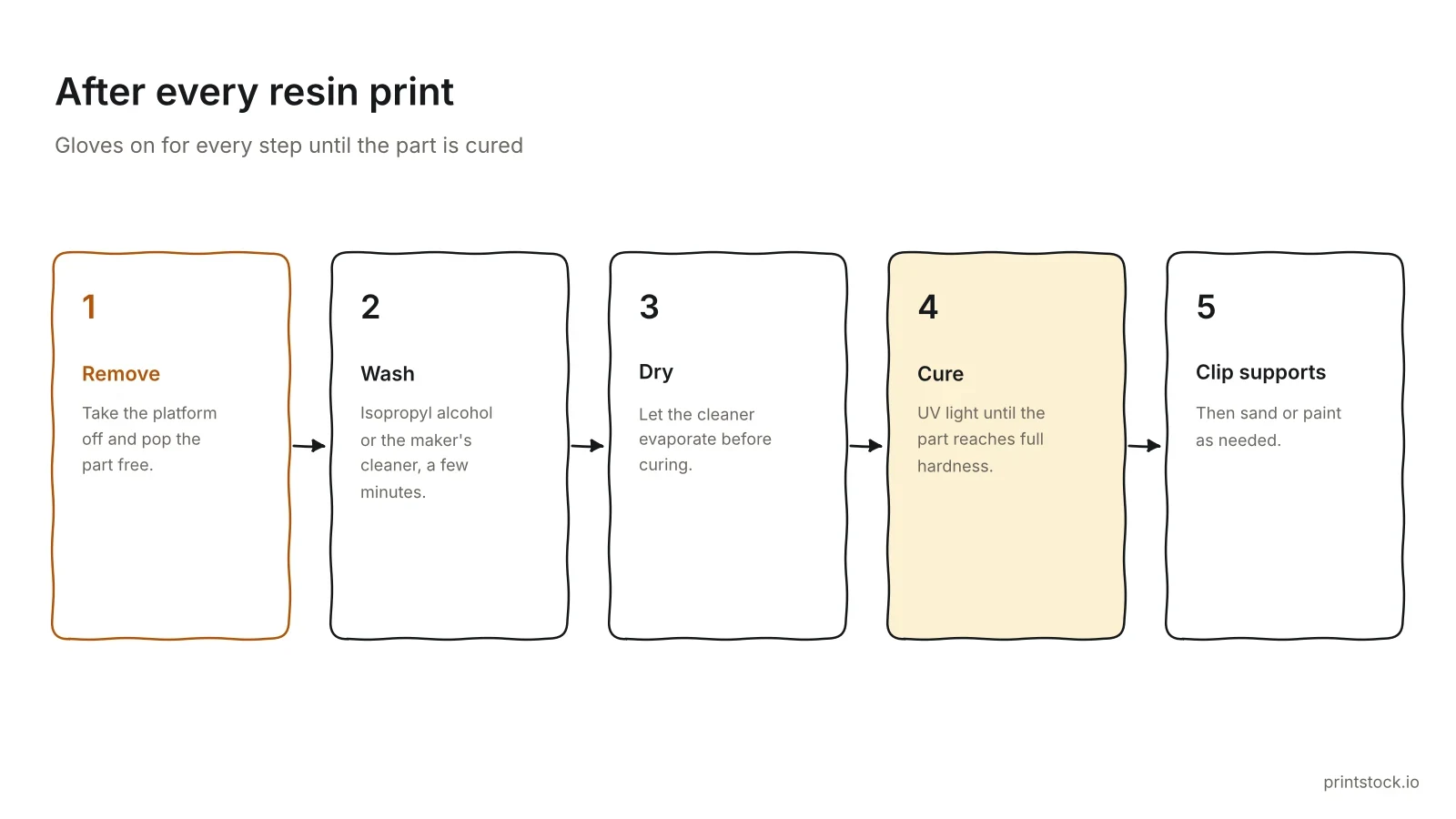
Every resin print needs washing, drying and curing after it comes off the printer, and that is the part that surprises new owners. The printing itself is simple: load the file, pour resin, press start.
After the print, you remove the build platform wearing gloves, take the part off, and wash it in isopropyl alcohol or the resin maker's cleaner to remove uncured resin. Then the part dries, gets cured under UV light until it reaches its final hardness, and finally you remove the supports. A wash and cure station makes this faster and cleaner, but it is still a process with sticky tools, paper towels and a container of dirty alcohol to deal with.
Waste needs care too. Uncured resin and alcohol contaminated with it must never go down the drain; the usual approach is to let resin cure in sunlight, decant clean liquid for reuse, and dispose of the cured residue as local rules require.
Safety: what you should know before buying resin
Uncured resin is a skin irritant and sensitiser, so resin printing needs gloves, ventilation and care; filament printing needs mostly common sense around hot parts. This is the factor that most often decides the question for families and shared homes.
Repeated skin contact with liquid resin can cause allergic reactions that get worse over time, which is why experienced resin users wear nitrile gloves every time, without exception. Resin also gives off fumes, so the printer belongs in a ventilated space, ideally with an air filter, and not in a bedroom. Fully cured parts are much safer to handle.
Filament printing is not free of concerns: a study by UL Chemical Safety and Georgia Tech found that filament printers release ultrafine particles and volatile organic compounds, so ventilation matters there as well. But there is no liquid chemical to handle, and PLA in particular is mild.
Running costs: resin vs filament
Filament is cheaper to run: PLA costs less per kilogram than resin, and resin printing has more consumables. The live prices below come from our catalog, per kilogram, from in-stock offers.
| Material | Filaments we track | Nozzle range from makers | From, per kg |
|---|---|---|---|
| PLA | 41 | 180 to 260 °C | $9.34as of Nov 11, 2026 |
| PETG | 16 | 220 to 270 °C | $9.71as of Nov 11, 2026 |
| Resin | 24 | No nozzle (light-cured) | $17.99as of Nov 14, 2026 |
Live from our catalog: nozzle ranges span the settings filament makers publish; prices are in-stock offers in US dollars.
The material price is only part of it. Resin printing also uses alcohol or cleaner, gloves and paper towels, and two parts wear out: the release film at the bottom of the vat, which gets scratched and cloudy, and the LCD screen, which loses pixels over time. On a filament printer, the main wear parts are the nozzle and the build plate, both cheap. You can see the wear parts for your specific printer in our catalog:
Which should a beginner buy?
Most beginners should start with a filament printer. It is more forgiving, more useful for everyday things, cheaper to run and safer around a household, and modern models largely set themselves up.
The exception is someone who already knows they want miniatures, tabletop terrain, jewellery or dental models. For them a filament printer will disappoint on detail, and starting with resin makes sense, as long as they set up a proper space and accept the washing and curing routine. The worry many people have, that they will pick wrong and waste the money, is smaller than it seems: many makers end up with one of each, and the skills from one carry over to the other.
Common mistakes when choosing between resin and filament
The most common mistake is buying resin for detail without planning for the handling. A resin printer on a kitchen table, without gloves or ventilation, quickly becomes a printer nobody wants to use.
- Expecting resin parts to be as tough as filament parts. Standard resin is brittle; choose tough resin or filament for anything that takes force.
- Expecting large prints from a resin printer. Build volumes are smaller, and large solid resin parts use a lot of expensive material.
- Forgetting post-processing time. A resin print is not done when the printer stops.
- Buying filament for miniatures. It works for larger figures, but at tabletop scale resin is in a different league.
Where to go from here
Compare filament and resin machines side by side in the printer catalog, with prices we check and owner-reported problems for each model. For a wider overview, read types of 3D printers, and if you choose resin, our guide on resin vat and FEP film care covers the parts that wear out.