$14.39 as of Nov 11, 2026Check price
Bambu Lab
Bambu Lab H2D
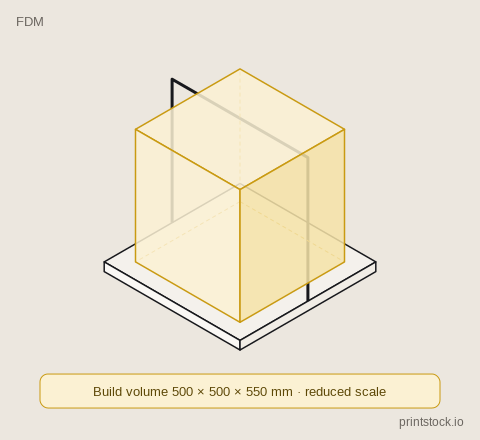
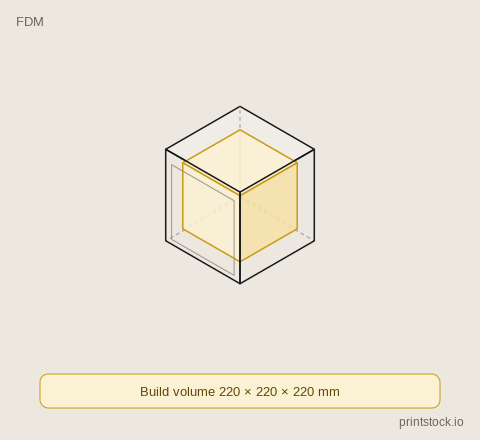
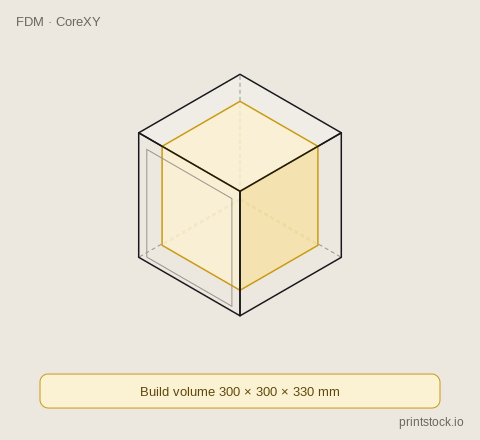
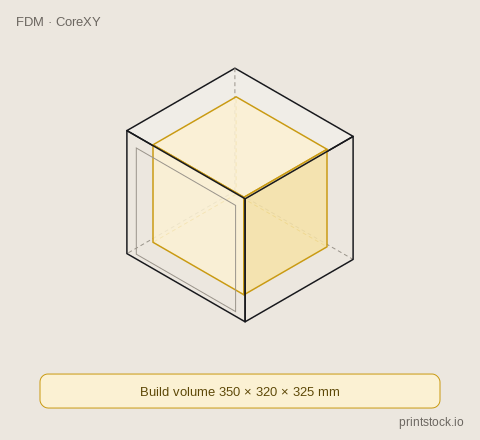
FDMCoreXYEnclosed350 × 320 × 325 mm
Bambu Lab's dual-nozzle 'personal manufacturing' machine (2025): 350 × 320 × 325 mm, two 350 °C nozzles, 65 °C heated chamber, servo extruder, optional 10 W or 40 W laser, cutting blade and pen modules.
Where to buy
Prices as of Nov 11, 2026Taxes, shipping and any import duties are worked out by the store at checkout and depend on your country; ask the store if in doubt.
Store links may be affiliate links: we may earn a commission, and it does not change your price. Affiliate disclosure
Price history, 90 days
Lowest: $1,399 · Highest: $2,399Overview
The Bambu Lab H2D, released in March 2025, is Bambu's first dual-nozzle printer and its bid to make one machine a small workshop. Two nozzles on one toolhead switch automatically, so two materials or colors print with far less purging than a single nozzle with an AMS, and combined with AMS units it handles many colors. Hackster called it the most influential printer release of 2025, and Tom's Hardware gave it 5/5.
It is also built for engineering materials: a 65 °C actively heated chamber, 350 °C nozzles and a 120 °C bed handle ABS, ASA, PC and carbon or glass fiber filled nylons. A servo extruder senses load and clogs, and optical motion calibration targets 5 µm resolution. Optional modules turn it into a 10 W or 40 W laser engraver and cutter, a vinyl cutter or a pen plotter, with a BirdsEye camera for alignment.
At our last check Bambu listed the H2D from $1,399, $1,599 with AMS and $1,949 with the 10 W laser. It is large and heavy, and the laser module is Class 4, so plan space and safety. The H2D Pro adds harder nozzles and enterprise features, the H2S is the single-nozzle sibling, and the H2C uses a nozzle changer.
Best for
- Two-material prints such as PLA with soluble or breakaway supports
- Engineering filaments in a heated chamber
- One machine for printing, laser engraving and cutting
Look elsewhere if
- You only need one nozzle: the H2S is cheaper with the same chamber
- You print mostly PLA: the P2S or A1 costs far less
Before you buy
- Choose the combo carefully: AMS, laser and cutter bundles change the price a lot.
- The laser module is Class 4; plan ventilation and the laser safety windows.
- Check your voltage version (100 to 120 V or 200 to 240 V).
- Allow space and a sturdy table for a large, heavy machine.
Pros and cons
Pros
- Dual nozzles cut purge waste
- 65 °C chamber and 350 °C nozzles
- Laser, cutter and pen modules
- Excellent calibration and sensors
Cons
- Expensive with modules
- Large footprint
- Laser is Class 4
Maker's test data
- Motion accuracy
- Below 50 microns across the whole bed with the optional Vision Encoder, which calibrates against 10,000 markers read at 5 micron optical resolution.
Published by the manufacturer from its own tests. PrintStock has not verified these figures; owner reports below may confirm or contradict them.
What owners like
Dual hotend saves material
Praised by most ownersTom's Hardware praises the dual hotend for cutting waste, plus near-perfect auto bed leveling.
PLA with the door closed
Often praisedIt prints PLA with the door shut, unlike earlier enclosed Bambu printers.
Acceptable noise
Noted by some ownersOwners describe the noise as a background hum rather than obnoxious.
Collected the same way as known issues: from independent reviews, owner reports and public discussions, merged and grouped.
Known issues
Last reviewed Nov 13, 2026Popular models have longer lists simply because more people own them and talk about them. Severity and status show how much each problem matters today.
Nozzle offset calibration failures
Moderate (affects prints)Workaround availableCalibration fails with HMS errors and dual-nozzle prints misalign. Filament residue, loose eddy sensor cables and badly seated nozzles are the causes; one firmware release that made the right nozzle hit the wiper was recalled.
Laser smoke and soot inside the chamber
Moderate (affects prints)Workaround availableWith the laser module, smoke and soot settle on the rails, camera and bed and can degrade motion and calibration over time. Ventilation, filters and regular cleaning are needed.
TPU clogs and oozes
Moderate (affects prints)Workaround availableSoft TPU wraps around the extruder gear and oozes from the idle nozzle; Bambu documents it as a known limitation with workarounds.
Still purges with more than two colors
Moderate (affects prints)Still reportedThe two nozzles avoid purging only for two materials; beyond that the AMS purges through the chute as on X and P series.
Expensive extras and proprietary parts
Minor (annoyance)Still reportedTom's Hardware lists the price, proprietary replacement parts and costly add-ons as the main cons.
Already fixed: 4 (show)
Rear Z lead screw misaligned on early units
Moderate (affects prints)Fixed in a hardware revisionOn early batches the rear lead screw sat loosely in its bearing, causing grinding, repeated calibration failures and uneven first layers. Later batches are reported fixed; affected units get warranty parts.
Heavy purging on the right nozzle
Minor (annoyance)Fixed in firmwareEarly Bambu Studio tool-change G-code made the right nozzle purge far more than needed; Bambu Studio 2.1.0.59 and later fixed it.
Early firmware rough edges
Minor (annoyance)Fixed in firmwareAfter a recalled update, a beta firmware shipped with PTFE detachment detection disabled and no bed temperature control in Bambu Handy. Later releases addressed these.
Bed heat-up power trips UPS units
Minor (annoyance)Fixed in firmwarePeak power at bed heat-up overloaded UPS units and shared circuits; firmware 01.03.00.00 added a Low-Power Mode.
How we build this list: we collect independent reviews, owner reports and public discussions on forums and social networks, merge duplicates and group them by cause. Only serious or recurring problems make the list, so a single complaint will not appear here, and a listed problem does not mean every unit is affected.
Specs
Printing
- Type
- FDM
- Build volume
- 350 × 320 × 325 mm
- Kinematics
- CoreXY
- Max speed
- 1,000 mm/s
- Multi-color
- Yes
- Nozzles / toolheads
- 2
- Materials
- PLA, PETG, TPU, PVA, PLA-CF, PETG-CF, ABS, ASA, PA, PC, PET, PPA, PPS, PA-CF
Extruder and bed
- Extruder
- Direct drive
- Stock nozzle
- 0.4 mm
- Max nozzle temp
- 350 °C
- Filament
- 1.75 mm
- Max bed temp
- 120 °C
- Bed leveling
- Automatic
- Enclosure
- Yes
- Heated chamber
- Up to 65 °C
Control and sensors
- Screen
- Touchscreen, 5 in
- Features
- Filament runout sensorFilament tangle or clog detectionAI print failure detectionAir filter
Files and setup
- Variants
- H2D, H2D AMS Combo, H2D Laser Full Combo 10W, H2D Laser Full Combo 40W
Extrusion
- Nozzles
- Two nozzles, up to 350 °C; 40 mm³/s flow
Features
- Calibration
- 5 µm optical motion calibration; automatic nozzle offset calibration
- Laser module
- Optional 10 W or 40 W 455 nm laser; 40 W cuts up to 5 mm basswood plywood; Class 4 module
- Other modules
- Cutting blade and pen drawing modules; BirdsEye camera for alignment
Multi-color
- Multi-material
- AMS 2 Pro and AMS HT; two nozzles reduce purge waste
From maker and store specifications, checked Nov 12, 2026. Power, size, network and warranty are in their own blocks below.
Power and setup
Electricity
- Mains input
- 100 to 240 V (universal)
- Rated power
- 2,200 W at 220 to 240 V, 1,320 W at 110 to 120 V
- Average while printing
- 197 W
- Idle
- 27 W
- Note
- PC about 395 W on average (maker test)
Network and cloud
- Works without internet
- Yes, fully (SD card / USB / LAN)
- Maker account
- Only for cloud / remote features
- Local control for other software
- Limited or behind a special mode
- Slicers from other makers
- Supported
- Built-in camera
- Yes
- Note
- Full control from third-party software needs LAN-only mode with Developer Mode (firmware since 2025)
Space and room
- Size (W × D × H)
- 492 × 514 × 626 mm
- Weight
- 31 kg
On a standard power circuit
- US 15 A / 120 V standard circuit: fine, and about 100 W stays free for other things on that circuit while it heats up
- EU/UK 16 A / 230 V standard circuit: fine, and about 700 W stays free for other things on that circuit while it heats up
- A 10-hour run (for example, several figures printed one after another): about 2 kWh. Multiply by your price per kWh for the cost.
Our calculation from the maker's rated power and average power while printing, keeping a circuit at 80% for long loads.
Safety and support
Safety
- Air filtration
- Pre-filter + HEPA filter + Activated carbon filter
- Safety and conformity marks
- UL 2904 / GREENGUARD emissions
Warranty and repair
- Warranty
- 24 months; for consumers in the EU, Switzerland, Norway, Iceland, the US and Canada (US and Canada extended from 12 months in 2026); receipts only from Bambu Lab or authorized resellers
- Repair guides
- Official page ↗
- Open source
- No
Running costs
| PLA filament, per kg | Cheapest in our catalog: Elegoo PLA Basic | $9.34 |
|---|---|---|
| Spare nozzle or hotend | H2D TPU High-Flow Kit | $14.39 |
| Spare build plate | Bambu Textured PEI Plate | $15.99 |
Starter budget: about $1,423 for the printer at its best listed price, 1 kg of PLA and a spare nozzle.
Cheapest compatible items in our catalog, USD prices as last checked. Prices change; see each item for the date.
Software and firmware
- Slicer / control software
- Bambu Studio (official), OrcaSlicer
- Firmware
- Bambu firmware over the air
- Connectivity
- Wi-Fi, Ethernet, LAN mode, USB
Official firmware and downloads ↗ We never host firmware files.
Questions people ask
H2D or H2S?
The H2D has two nozzles for two-material printing with little purge waste; the H2S has one nozzle with the same heated chamber, at a lower price.
Can the Bambu Lab H2D laser cut?
Yes, with the optional 10 W or 40 W laser module; the 40 W module cuts up to 5 mm basswood plywood.
What is the H2D build volume?
325 × 320 × 325 mm with one nozzle, 300 × 320 × 325 mm usable by both nozzles, and 350 × 320 × 325 mm combined.
Does the H2D have a heated chamber?
Yes, active chamber heating to 65 °C with a HEPA and carbon filter.
Models proven to print on the Bambu Lab H2D
Coming soonFilaments that fit (97)
Matched by PrintStock from published specs: filament diameter, the materials Bambu Lab lists for this printer. Not a print test.
- PETG
- Anycubic PETG, Bambu Lab PETG Basic, Bambu Lab PETG Matte, Creality Hyper PETG, Elegoo PETG Pro, Elegoo Rapid PETG, eSUN PETG, eSUN PETG-Matte, Overture High Speed PETG, Polymaker PETG, Polymaker PolyLite PETG, Prusament PETG, Spectrum PETG, Spectrum PETG Premium High Speed, SUNLU PETG, SUNLU PETG 2.0
- PLA
- Anycubic PLA+, Anycubic PLA Basic, Anycubic PLA High Speed, Anycubic PLA Silk, Bambu Lab PLA Basic, Bambu Lab PLA Matte, Bambu Lab PLA Silk+, Bambu Lab PLA Translucent, Creality Hyper PLA, Creality Hyper PLA RFID, Elegoo PLA, Elegoo PLA Basic, Elegoo PLA Matte, Elegoo PLA Pro, Elegoo PLA Silk, eSUN PLA+, eSUN PLA Basic, eSUN PLA+HS, eSUN PLA-Matte, eSUN PLA-Silk Rainbow, Overture Easy PLA, Overture Matte PLA Dual Colors, Overture PLA+, Overture Silk PLA Gradient, Polymaker Panchroma PLA, Polymaker Panchroma PLA Matte, Polymaker Panchroma PLA Silk, Polymaker PLA Pro, Polymaker PolyLite PLA, Polymaker PolyLite PLA Pro, Polymaker PolyLite Silk PLA, Polymaker PolyMax PLA, Polymaker PolyTerra PLA, Prusament PLA, Spectrum Huracan PLA, Spectrum PLA, Spectrum PLA Pro, Spectrum Premium PLA High Speed, SUNLU High-Speed PLA, SUNLU PLA+ 2.0, SUNLU Silk PLA+ 2.0
- ABS
- Bambu Lab ABS, Creality Hyper ABS, Elegoo ABS, Polymaker PolyLite ABS, Siraya Tech Fibreheart ABS HT HF, SUNLU ABS
- PA-CF
- Bambu Lab PA6-CF, Bambu Lab PAHT-CF, eSUN PA-CF, Polymaker Fiberon PA6-CF20, Prusament PA11 Carbon Fiber, SUNLU PA12-CF, SUNLU PA6-CF
Compatible accessories
Everything that fits the Bambu Lab H2D
$21.58 as of Nov 11, 2026Check price
$41.98 as of Nov 11, 2026Check price
$47.99 as of Nov 11, 2026Check price
$39.99 as of Nov 11, 2026Check price
$17.99 as of Nov 11, 2026Check price
Closest alternatives by price
Compare all side by side