$114.99 as of Nov 11, 2026Check price
Prusa Research
Prusa Pro HT90
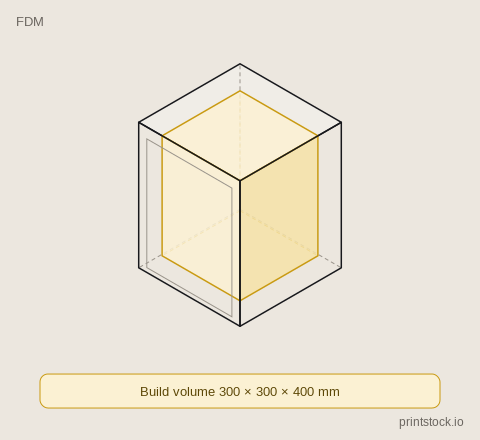
ProfessionalFDMDeltaEnclosed300 × 300 × 400 mm
Prusa's industrial delta printer for engineering polymers: Ø300 × 400 mm, 90 °C actively heated chamber, 155 °C bed, swappable 300 °C high-flow and 500 °C high-temperature heads for PEEK, PEKK and PEI.
- Hottest nozzle of the 21 FDM printers we list
Where to buy
Prices as of Nov 11, 2026Taxes, shipping and any import duties are worked out by the store at checkout and depend on your country; ask the store if in doubt.
Store links may be affiliate links: we may earn a commission, and it does not change your price. Affiliate disclosure
Price history, 90 days
Lowest: $10,737.41 · Highest: $10,737.41Overview
The Pro HT90 is Prusa's step into industrial materials. High-performance polymers such as PEEK, PEKK and PEI need a nozzle well above 350 °C, a very hot bed and a heated chamber so parts cool slowly and crystallize without warping. Machines that do this have traditionally cost tens of thousands. The HT90 delivers a 500 °C nozzle, a 155 °C bed and an actively heated 90 °C chamber at around €11,490.
Unlike Prusa's other printers it is a delta: a cylindrical Ø300 × 400 mm volume with fast, light motion up to 250 mm/s. It ships with two magnetically swappable heads, a high-flow 300 °C head for everyday engineering plastics and a 500 °C head with an abrasion-resistant Revo nozzle for PEEK-class and fiber-filled materials. Air is filtered through a closed HEPA and carbon loop with no exhaust, electronics sit outside the hot chamber, and it runs Klipper on a Duet board. It is TAA compliant for US government buyers.
VoxelMatters and 3D Printing Industry confirmed in testing that it prints PEEK. Prusa positions it for small to mid-sized PEEK and PEI parts rather than large ones, since the 90 °C chamber is below what high-end industrial systems reach. It comes fully assembled with Prusa Pro support.
Best for
- Engineering teams printing PEEK, PEKK, PEI and carbon-filled parts
- Replacing outsourced high-temperature prototyping
- Government and defense buyers needing TAA compliance
Look elsewhere if
- You print ABS, ASA and PA only: a CORE One L+ costs a fraction
- You need large PEEK parts with industrial chamber temperatures
Before you buy
- Dry high-temperature filaments thoroughly; a dryer is essential.
- Preheat and stabilize the chamber before PEEK prints.
- Budget for high-temperature build surfaces and spare nozzles.
- Check regional pricing; it varies significantly.
Pros and cons
Pros
- 500 °C nozzle and 90 °C chamber at a low price
- Two swappable heads included
- Closed-loop filtration
- Fast delta motion
Cons
- Expensive for non-industrial users
- Cylindrical build volume
- Chamber cooler than high-end industrial systems
What owners like
Excellent for engineering prototypes
Often praisedReviewers call it an excellent choice for engineers making prototypes and functional parts, with excellent surface quality.
Collected the same way as known issues: from independent reviews, owner reports and public discussions, merged and grouped.
Known issues
Last reviewed Nov 13, 2026Popular models have longer lists simply because more people own them and talk about them. Severity and status show how much each problem matters today.
Locked firmware
Moderate (affects prints)Still reportedAn owner found SSH and config files locked, a bare Mainsail interface with no macros, and infrequent firmware updates.
Spare parts only as whole assemblies
Moderate (affects prints)Still reportedReplacement heads cost around $760 to $839 and hotend parts are not sold separately; the owner returned the printer partly for this reason.
Head swaps are tedious
Moderate (affects prints)Still reportedChanging heads needs hard-to-reach connectors, a loose thumb screw and a power-off, and the high-temp head cannot run PLA, PETG or ABS.
No power-loss recovery
Moderate (affects prints)Still reportedThe printer has no power-loss recovery and draws up to 1600 W, so a UPS only lasts minutes.
Loud and hot
Minor (annoyance)Still reportedThe electronics fan whines even when idle, the printer is too loud for an office, and the uninsulated door heats the room.
Door needs 2 m of clearance
Minor (annoyance)Still reportedThe door needs about 200 cm of height to open fully, and there are no handles to move the printer.
How we build this list: we collect independent reviews, owner reports and public discussions on forums and social networks, merge duplicates and group them by cause. Only serious or recurring problems make the list, so a single complaint will not appear here, and a listed problem does not mean every unit is affected.
Specs
Printing
- Type
- FDM
- Made for
- Professional
- Build volume
- 300 × 300 × 400 mm
- Kinematics
- Delta
- Max speed
- 250 mm/s
- Max acceleration
- 20,000 mm/s²
- Multi-color
- No
- Nozzles / toolheads
- 1
Extruder and bed
- Extruder
- Direct drive
- Stock nozzle
- 0.4 mm (Revo nozzles from 0.25 to 0.8 mm)
- Nozzle / hotend
- E3D Revo RapidChange nozzles
- Max nozzle temp
- 500 °C
- Filament
- 1.75 mm
- Build plate
- Textured PEI steel sheet
- Max bed temp
- 155 °C
- Bed leveling
- Automatic
- Enclosure
- Yes
- Heated chamber
- Up to 90 °C
Control and sensors
- Screen
- Touchscreen, 7 in
- Features
- Input shapingFlow calibrationBuilt-in light
Files and setup
- Files the slicer opens
- STL, OBJ
Extrusion
- Heads
- High-flow head up to 300 °C; high-temperature head up to 500 °C with 0.6 mm abrasion-resistant Revo nozzle
Cooling
- Cooling
- Servo-operated flap and high-pressure turbine
Hardware
- Electronics
- 32-bit Duet board, Klipper
Materials
- Materials
- PEEK, PEKK, PEI (Ultem), PPS, PSU, PC-CF, PA-CF, ASA, TPU
From maker and store specifications, checked Nov 12, 2026. Power, size, network and warranty are in their own blocks below.
Power and setup
Electricity
- Rated power
- 1,900 W
Network and cloud
- Works without internet
- Yes, fully (SD card / USB / LAN)
- Maker account
- Only for cloud / remote features
- Local control for other software
- Open (documented or open source)
- Slicers from other makers
- Supported
- Built-in camera
- Yes
- Note
- Runs Klipper with a Moonraker web page; Ethernet plus a detachable Wi-Fi module, and Prusa says it is ready for fully offline operation with the Wi-Fi module removed. Prusa Connect adds cloud management and needs an account. Built-in chamber camera.
Space and room
- Size (W × D × H)
- 530 × 530 × 1,050 mm
On a standard power circuit
- US 15 A / 120 V standard circuit: too much while heating; give it its own 20 A circuit
- EU/UK 16 A / 230 V standard circuit: fine, and about 1,000 W stays free for other things on that circuit while it heats up
Our calculation from the maker's rated power, keeping a circuit at 80% for long loads.
Safety and support
Safety
- Safety and conformity marks
- CE (EU)
Warranty and repair
- Warranty
- 12 months; 2 years in the EU, 1 year elsewhere; on kits the warranty covers each part, not the assembly; paid +1 or +2 year extension at purchase for some models
- Repair guides
- Official page ↗
Software and firmware
- Slicer / control software
- PrusaSlicer
- Firmware
- Klipper on a Duet 32-bit board
- Connectivity
- LAN, Prusa Connect, USB camera support
Official firmware and downloads ↗ We never host firmware files.
Questions people ask
Can the Prusa Pro HT90 print PEEK?
Yes, with the 500 °C head, a 90 °C chamber and a 155 °C bed; reviewers have confirmed PEEK prints.
Why is it a delta printer?
Delta kinematics keep the motors and electronics away from the hot chamber and allow fast motion.
How much does it cost?
From €11,490 in Europe; US resellers list around $11,999.
Models proven to print on the Prusa Pro HT90
Coming soonCompatible accessories
Everything that fits the Prusa Pro HT90
$83.99 as of Nov 11, 2026Check price
$109.99 as of Nov 11, 2026Check price
$254.99 as of Nov 11, 2026Check price
Closest alternatives by price
Compare all side by side