Markforged Metal X (Gen 2)
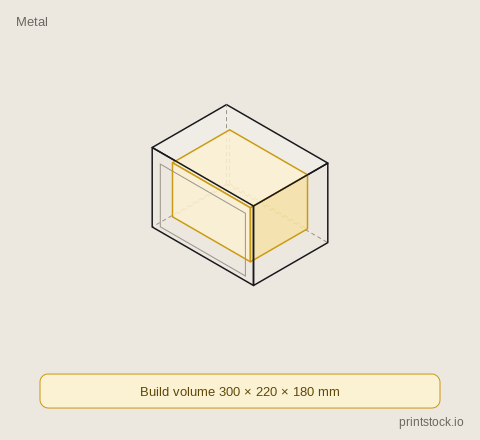
Office-friendly metal printing: prints metal powder bound in plastic filament, then washes and sinters it; 300 × 220 × 180 mm build, no loose powder at the printer.
How to buy
Markforged sells this machine through quotes and resellers; the price depends on configuration, software and service.
Taxes, delivery, installation and any import duties are set by the seller when you order; agree them with the maker or its reseller.
Overview
The Metal X takes a very different route from laser powder bed machines. It prints filament made of metal powder held in a plastic and wax binder, much like an FDM printer, so there is no loose powder at the printer. The printed green part is then washed in a solvent bath (Wash-1) to remove most binder and sintered in a furnace (Sinter-1 or Sinter-2) where the metal particles fuse and the part shrinks to final size.
That makes it suited to shops that want metal tooling, fixtures and spare parts in stainless and tool steels without a powder room, at a lower system cost. Trade-offs: the full cycle takes days, parts shrink and must be designed for sintering, and density and tolerances are below LPBF. Gen 2 kept printing performance and improved operator safety.
Markforged sells the printer with wash and sinter stations on quotation; an earlier sheet listed 100 to 240 V at 2.4 kW for the printer.
Best for
- Metal tooling, fixtures and spare parts in steel
- Shops without a powder-safe room
- Engineering teams already using Markforged composites
Look elsewhere if
- Large or high-density aerospace parts
- Fast turnaround: the full cycle takes days
Before you buy
- Price the full system: printer, Wash-1, Sinter-2 and gas.
- Learn design rules for sintering shrinkage.
- Check which materials are currently offered.
Pros and cons
Pros
- No loose powder
- Office-friendly printer
- Lower cost than LPBF
Cons
- Multi-day process
- Shrinkage to design around
- Lower density than LPBF
Known issues
Last reviewed Nov 15, 2026We have not found serious or recurring problems with this model so far.
How we build this list: we collect independent reviews, owner reports and public discussions on forums and social networks, merge duplicates and group them by cause. Only serious or recurring problems make the list, so a single complaint will not appear here, and a listed problem does not mean every unit is affected.
Specs
Printing
- Type
- Metal
- Process
- Bound metal deposition
- Made for
- Professional
- Build volume
- 300 × 220 × 180 mm
- Materials
- Stainless steel, Tool steel, Copper, Nickel alloy
- Layer height
- Down to 50 µm
Hardware
- Enclosure
- Yes
Files and setup
- Variants
- Wash-1, Sinter-1 / Sinter-2
Process
- Technology
- Bound metal filament (ADAM), then solvent debind and sinter
- Wash-1
- 12 to 72 h typical, Opteon SF-79, 356 × 254 × 203 mm
- Sinter-2
- 17 to 31 h runs, 18,356 cm³, peak 1,300 °C
Materials
- Materials
- 17-4 PH and 316L stainless, H13, A2, D2 tool steels, copper, Inconel 625 (check current list)
Business
- Ownership
- Nano Dimension owns Markforged; a sale to Stratasys was agreed in 2026
From maker and store specifications, checked Nov 15, 2026. Power, size, network and warranty are in their own blocks below.
Power and setup
Network and cloud
- Works without internet
- Yes, but some features need the cloud
- Maker account
- Required
- Note
- Sliced and run through Markforged's cloud-based Eiger, the only slicer it accepts, which needs an Eiger account. Sites that cannot use the cloud can buy an Offline Eiger subscription that works over USB or a private network.
Space and room
- Size (W × D × H)
- 575 × 467 × 1,120 mm
- Weight
- 75 kg
For business buyers
What the room needs
- Wash-1 debinder uses Opteon SF-79 solvent
- Sinter-2 furnace: 1,200 × 700 × 1,500 mm, 350 kg, up to 1,300 °C; needs gas supply
- Earlier Metal X sheet: 100 to 240 V AC, 2,400 W
Software and firmware
- Slicer / control software
- Eiger
Questions people ask
How does the Metal X print metal?
It prints metal powder bound in plastic, then washes out binder and sinters the part.
What is the build volume?
300 × 220 × 180 mm before sintering shrinkage.
Does it need a furnace?
Yes, a Sinter-1 or Sinter-2 furnace is part of the system.