
Meltio M600
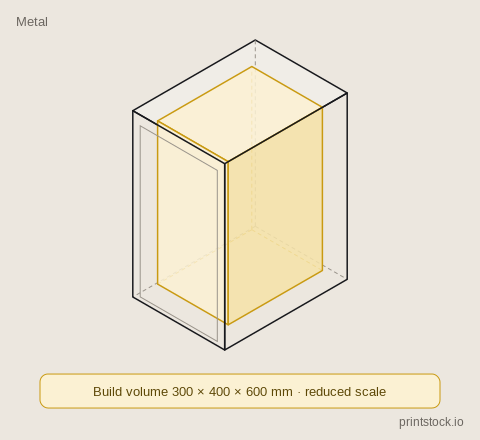
Wire-laser metal printer: welds standard wire with nine blue diode lasers (1 kW total) into near-net parts up to 300 × 400 × 600 mm, no loose powder.
Where to buy
Prices as of Nov 15, 2026Taxes, shipping and any import duties are worked out by the store at checkout and depend on your country; ask the store if in doubt.
Store links may be affiliate links: we may earn a commission, and it does not change your price. Affiliate disclosure
Overview
The Meltio M600 prints metal by melting welding wire with lasers, a form of directed energy deposition. Nine blue diode lasers, 1 kW in total, focus on wire fed through the centre of the head, building beads 0.6 to 1.2 mm tall. Because the feedstock is wire rather than powder, it is cheaper, safer to handle and cannot contaminate the room; argon shields the melt.
Parts come out near-net shape and need machining, so it suits large, chunky parts, repairs, tooling and spare parts more than fine detail. It prints stainless and mild steels, titanium and nickel alloys, with copper and aluminium added on the M600, and dual or quad wire upgrades allow multi-material parts. Meltio says blue lasers are absorbed better than infrared, cutting power use.
MatterHackers lists it at $296,229.94; the page did not confirm stock when we checked.
Best for
- Large near-net metal parts that will be machined
- Repairs and spare parts in steel, titanium or nickel alloys
- Shops that want metal printing without powder handling
Look elsewhere if
- Fine detail or thin features
- Parts that cannot be machined after printing
Before you buy
- Plan CNC machining for finished surfaces.
- Budget argon and wire; Meltio says wire cost drives running costs.
- Check three-phase power and floor space for up to 1 t.
Pros and cons
Pros
- No loose powder
- Cheap, common wire feedstock
- Multi-material options
Cons
- Rough near-net surfaces
- Needs machining
- Expensive machine
Known issues
Last reviewed Nov 15, 2026We have not found serious or recurring problems with this model so far.
How we build this list: we collect independent reviews, owner reports and public discussions on forums and social networks, merge duplicates and group them by cause. Only serious or recurring problems make the list, so a single complaint will not appear here, and a listed problem does not mean every unit is affected.
Specs
Printing
- Type
- Metal
- Process
- Directed energy deposition (wire or powder)
- Made for
- Professional
- Build volume
- 300 × 400 × 600 mm
- Materials
- Stainless steel, Titanium, Nickel alloy, Copper, Aluminium
- Layer height
- 0.6 to 1.2 mm
Hardware
- Enclosure
- Yes
Files and setup
- Variants
- Dual Wire / Quad Wire, Hot Wire
Build
- Build envelope
- 300 × 400 × 600 mm
Process
- Technology
- Wire-laser directed energy deposition
Lasers
- Lasers
- 9 direct diode lasers, 450 nm blue, 1,000 W total
Materials
- Wire
- 0.8 to 1.2 mm; BS300 spool or external drum (100 and 200 kg packs)
Software
- Software
- Meltio Horizon slicer
From maker and store specifications, checked Nov 15, 2026. Power, size, network and warranty are in their own blocks below.
Power and setup
Electricity
- Phases
- Three phase
- Rated power
- 12,000 W
- Note
- 380 to 415 V three-phase + N + PE, or 200 to 240 V three-phase + PE; 4 to 6 kW typical
Network and cloud
- Slicers from other makers
- Supported
- Note
- USB and Ethernet (newer Meltio datasheets also list Wi-Fi); jobs come from Meltio's own Horizon slicer, and Meltio works with CAM vendors so existing CAM software can also program it.
Space and room
- Size (W × D × H)
- 1,050 × 1,150 × 1,950 mm
- Gas or air supply
- Argon
- Cooling
- Chiller included
For business buyers
What the room needs
- Water chiller and 3-stage fume filtration included
- 1,050 × 1,150 × 1,950 mm, 800 to 1,000 kg
Software and firmware
- Slicer / control software
- Meltio Horizon
Questions people ask
What does the Meltio M600 print with?
Metal welding wire 0.8 to 1.2 mm, melted by lasers.
How big can parts be?
300 × 400 × 600 mm.
Does it need three-phase power?
Yes: 380 to 415 V or 200 to 240 V three-phase.