INTAMSYS FUNMAT PRO 310 APOLLO
IDEX printer built for continuous PAEK production: 305 × 260 × 260 mm, 450 °C nozzles, 100 °C chamber, PAEK at up to 200 mm/s, two heated 3 kg dry boxes.
- Most nozzles of the 30 FDM printers we list
Where to buy
Prices as of Nov 15, 2026Taxes, shipping and any import duties are worked out by the store at checkout and depend on your country; ask the store if in doubt.
Store links may be affiliate links: we may earn a commission, and it does not change your price. Affiliate disclosure
Overview
The FUNMAT PRO 310 APOLLO is INTAMSYS's answer to the step after prototyping: printing PAEK parts (PEEK, PEKK and VICTREX grades) repeatedly and for long runs. It keeps the compact PRO 310 frame but adds 450 °C nozzles, a 100 °C chamber and two sealed, heated 3 kg dry boxes, which INTAMSYS says can feed roughly a week of unattended printing.
The two nozzles move independently (IDEX), so the machine can print two copies of a part at once in duplicate or mirror mode, or use one nozzle for support. INTAMSYS quotes up to 200 mm/s for PAEK and more than 40 MPa of Z-axis strength, which are maker figures, not independent tests.
It is newer than the HT and PRO 410, so there are fewer owner reports. Its chamber is hotter than the HT's but still far below the 300 °C of the PRO 610HT, so check PEI support with a reseller before buying for ULTEM work.
Best for
- Small batches of PEEK and PEKK end-use parts
- Shops that want two parts per run with IDEX
- Long unattended prints from dry, monitored filament
Look elsewhere if
- You only need occasional PEEK prototypes: the FUNMAT HT costs far less
- Your main material is PEI (ULTEM) or PPSU at full properties
Before you buy
- Confirm which of your materials are validated profiles.
- Plan for nozzle wear and spares.
- Check power: up to 1,800 W.
- Few long-term owner reports yet.
Pros and cons
Pros
- IDEX doubles output on identical parts
- Heated dry boxes for week-long runs
- Network control and quality traceability
Cons
- New, few owner reports
- 100 °C chamber limits PEI
- Price well above the HT
Known issues
Last reviewed Nov 15, 2026Popular models have longer lists simply because more people own them and talk about them. Severity and status show how much each problem matters today.
Nozzles clog from carbonised material
Moderate (affects prints)Workaround availableAt PEEK temperatures, burnt material builds up inside the nozzle and narrows it until it clogs. INTAMSYS's service guide treats nozzles as wear parts and recommends cleaning and timely replacement; crystallised PEEK is hard to remove once it sets.
How we build this list: we collect independent reviews, owner reports and public discussions on forums and social networks, merge duplicates and group them by cause. Only serious or recurring problems make the list, so a single complaint will not appear here, and a listed problem does not mean every unit is affected.
Specs
Printing
- Type
- FDM
- Process
- FDM (filament)
- Made for
- Professional
- Build volume
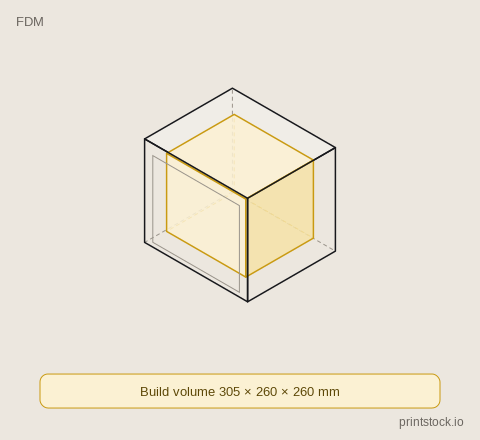
- 305 × 260 × 260 mm
- Kinematics
- Cartesian gantry
- Max speed
- 500 mm/s
- Multi-color
- No
- Nozzles / toolheads
- 2
- Materials
- PEEK, PEKK, PC, PA, PA-CF, PPS, ASA, ABS
- Layer thickness
- 0.1 to 0.3 mm
Extruder and bed
- Extruder
- Direct drive
- Stock nozzle
- 0.4 mm
- Nozzle / hotend
- IDEX: high-temperature PAEK head and standard head
- Max nozzle temp
- 450 °C
- Filament
- 1.75 mm
- Build plate
- Magnetic hardened or flexible plate
- Max bed temp
- 160 °C
- Bed leveling
- Automatic, 100 points
- Enclosure
- Yes
- Heated chamber
- Up to 100 °C
Control and sensors
- Screen
- Touchscreen, 7 in
- Features
- Filament tangle or clog detectionFilament runout sensorPower-loss recoveryAutomatic filament loadingNozzle wiper or cleaner
Files and setup
- Files the slicer opens
- STL, 3MF, OBJ, STEP
- Variants
- Single nozzle: 305 × 260 × 260 mm, Dual nozzle (IDEX): 260 × 260 × 260 mm
Extrusion
- Nozzles
- 2, independent (IDEX), mirror and duplicate modes
Materials
- Dry boxes
- 2 sealed boxes, 3 kg each, heated to 65 °C, humidity monitoring
Machine
- Filtration
- HEPA and activated carbon
From maker and store specifications, checked Nov 15, 2026. Power, size, network and warranty are in their own blocks below.
Power and setup
Electricity
- Mains input
- Separate 110 V and 220 V versions
- Rated power
- 1,800 W
- Note
- 100 to 120 V at 16 A or 200 to 240 V at 8 A
Network and cloud
- Note
- Prepared in Intamsys' own INTAMSUITE NEO slicer on Windows, which also handles remote monitoring and management.
Space and room
- Size (W × D × H)
- 700 × 655 × 750 mm
- Room temperature
- 0 to 30 °C
- Max humidity
- 70%
On a standard power circuit
- US 15 A / 120 V standard circuit: too much while heating; give it its own 20 A circuit
- EU/UK 16 A / 230 V standard circuit: fine, and about 1,100 W stays free for other things on that circuit while it heats up
Our calculation from the maker's rated power, keeping a circuit at 80% for long loads.
Safety and support
Computer you need
- Runs on
- Windows
For business buyers
Software and firmware
- Slicer / control software
- INTAMSUITE NEO
- Firmware
- INTAMSYS, OTA updates
- Connectivity
- Wi-Fi, Ethernet, USB; INTAMSUITE Linker API
Questions people ask
What is the APOLLO built for?
Batch and continuous production of PAEK parts such as PEEK and PEKK, with heated dry boxes and IDEX for duplicate printing.
How fast does it print PEEK?
INTAMSYS states up to 200 mm/s for PAEK and up to 500 mm/s overall.
How hot is the chamber?
Up to 100 °C.
Is it IDEX?
Yes, two independent nozzles with mirror and duplicate modes; dual-nozzle build volume is 260 mm cubed.
Models proven to print on the INTAMSYS FUNMAT PRO 310 APOLLO
Coming soonClosest alternatives by price
Compare all side by side