$179 as of Nov 11, 2026Check price
Creality
Creality Falcon A1C
LaserEnclosed
Creality's compact enclosed Class 1 beginner laser, without the AI camera: 5 W or 10 W diode, 150 × 150 mm area, true autofocus and a lifting platform. From $199.
Where to buy
Prices as of Nov 11, 2026Taxes, shipping and any import duties are worked out by the store at checkout and depend on your country; ask the store if in doubt.
Store links may be affiliate links: we may earn a commission, and it does not change your price. Affiliate disclosure
Overview
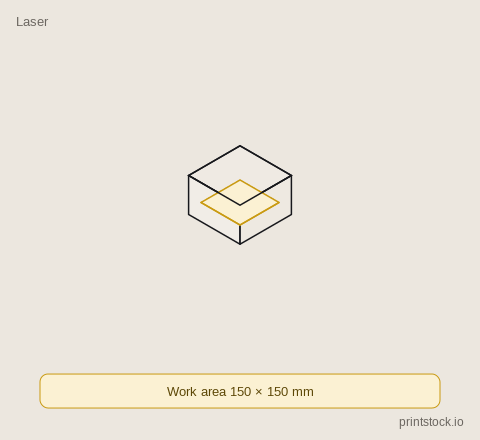
The Falcon A1C, launched in July 2026, is Creality's attempt to make laser engraving as approachable as a desktop printer. It is a small, fully enclosed Class 1 box, so it can sit on a desk at home without goggles, with a 150 × 150 mm working area and a platform that lifts objects up to the focus point, plus true autofocus, so small items of different heights can be engraved without manual adjustment. It comes with a 5 W or 10 W blue diode, and modules are interchangeable.
This is the standard version without a camera, priced from $199 with the 5 W module and $299 with 10 W at launch. You position work with the software and the platform; for camera placement and material recognition, the A1C AI costs a little more and TechRadar recommended the 10 W AI camera model as the most future-proof choice.
The trade-offs follow from the price and size. The working area suits ornaments, tags, coasters, phone cases and small gifts, not cutting sheets, and TechRadar noted the build is somewhat plastic. Low-power diodes engrave well but cut slowly and only thin material. As a first, safe laser for small personalized items it is one of the cheapest enclosed options available.
Best for
- First laser for home crafters
- Personalized small gifts, tags and ornaments
- Families and classrooms that need an enclosed laser
Look elsewhere if
- You want to cut sheets or thick wood: look at the Falcon A1 Pro or Falcon2 Pro
- You need metal marking: a fiber or IR laser is required
Before you buy
- Choose 10 W over 5 W if you plan to cut anything.
- Consider the AI camera version if you are a complete beginner.
- Budget for the air purifier for indoor use.
- Check the 150 × 150 mm area against the items you plan to engrave.
Pros and cons
Pros
- Fully enclosed Class 1
- Autofocus and lifting platform
- Low price
- Interchangeable modules
Cons
- Small working area
- Plastic build
- Limited cutting ability
Known issues
Last reviewed Nov 13, 2026Popular models have longer lists simply because more people own them and talk about them. Severity and status show how much each problem matters today.
Small work area
Moderate (affects prints)Still reportedThe 150 x 150 mm bed limits larger pieces and batches of several items.
Autofocus must be started by hand before each job
Moderate (affects prints)Workaround availableAutofocus is triggered manually in the app, and forgetting it before a job leads to poor results.
Camera cannot be added later
Moderate (affects prints)Still reportedThe version without the AI camera cannot be upgraded, which makes positioning work on the material harder.
LightBurn over Wi-Fi: framing and console commands do not work
Minor (annoyance)Still reportedWith LightBurn's Creality Falcon HTTP mode, the A1C homes but Frame and raw G-code are ignored. LightBurn staff said Creality uses different webhooks on this model; use USB or Falcon Design Space meanwhile.
Accessories add up
Minor (annoyance)Still reportedExtra laser heads, the rotary kit and an air filter add significant cost on top of the base price.
Plastic build feels cheap
Minor (annoyance)Still reportedThe all-plastic body works but feels less solid than larger rivals.
Learning curve for layers and image prep
Minor (annoyance)Workaround availableAssigning cut and engrave paths to layers takes practice, and fine-detail photo engraving needs careful image conversion and test runs.
How we build this list: we collect independent reviews, owner reports and public discussions on forums and social networks, merge duplicates and group them by cause. Only serious or recurring problems make the list, so a single complaint will not appear here, and a listed problem does not mean every unit is affected.
Specs
Printing
- Type
- Laser
- Max speed
- 250 mm/s
- Laser type
- Diode
- Laser output
- 10 W
- Cuts through
- WoodPlywoodLeatherPaper and cardboardFabric and feltCorkFoamMDFBambooAcrylicdark or opaqueRubber
- Engraves or marks
- WoodPlywoodMDFBambooLeatherPaper and cardboardFabric and feltCorkRubberAcrylicdark or opaqueStone and slateAnodized aluminiumPainted or coated metal
Hardware
- Enclosure
- Yes
Laser
- Laser
- 5 W or 10 W blue diode, interchangeable modules
Working area
- Area
- 150 × 150 mm, up to 148 mm height
Focus
- Focus
- True autofocus with smart lifting platform
Cameras
- Camera
- No camera (AI camera model sold separately)
Safety
- Laser class
- Class 1 fully enclosed
Materials
- Materials
- Over 300 materials listed: wood, leather, card, coated items
Accessories
- Optional
- Air purifier, rotary kits, flexible fixture
From maker and store specifications, checked Nov 12, 2026. Power, size, network and warranty are in their own blocks below.
Power and setup
Electricity
- Rated power
- 120 W
- Note
- External 24 V adapter: 24 V 5 A (120 W) for the 10 W diode or 1.2 W IR module, 24 V 3 A for the 5 W diode.
Network and cloud
- Software from other makers
- Supported
- Note
- Connects over USB or Wi-Fi; LightBurn 2.2 adds a Falcon HTTP connection over Wi-Fi, though owners report some commands such as framing do not work over it yet.
Space and room
- Size (W × D × H)
- 336 × 377 × 341 mm
- Weight
- 9.7 kg
On a standard power circuit
- US 15 A / 120 V standard circuit: fine, and about 1,300 W stays free for other things on that circuit while it heats up
- EU/UK 16 A / 230 V standard circuit: fine, and about 2,800 W stays free for other things on that circuit while it heats up
Our calculation from the maker's rated power, keeping a circuit at 80% for long loads.
Safety and support
Safety
- Laser class
- Class 1 laser product
Warranty and repair
- Warranty
- 12 months; complete machine; wear parts shorter
- Spare parts store
- Official page ↗
- Repair guides
- Official page ↗
Software and firmware
- Slicer / control software
- Creality Falcon Design Space, Creality Falcon app
- Firmware
- Updated through Falcon Design Space
- Connectivity
- Wi-Fi, Bluetooth, USB
Official firmware and downloads ↗ We never host firmware files.
Questions people ask
What is the difference between the A1C and A1C AI?
The AI version adds a camera for automatic positioning and material recognition; the laser and machine are otherwise the same.
Does it need goggles?
No, as a Class 1 enclosed laser it is eye safe when used as designed with the lid closed.
Can it cut wood?
The 10 W version cuts thin wood and card; it is mainly an engraver.
Compatible accessories
Everything that fits the Creality Falcon A1CClosest alternatives by price
Compare all side by side