$25 as of Nov 11, 2026Check price
Anycubic
Anycubic Photon Mono M7 Pro
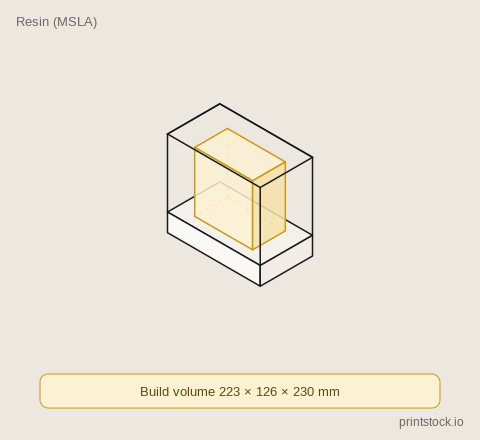
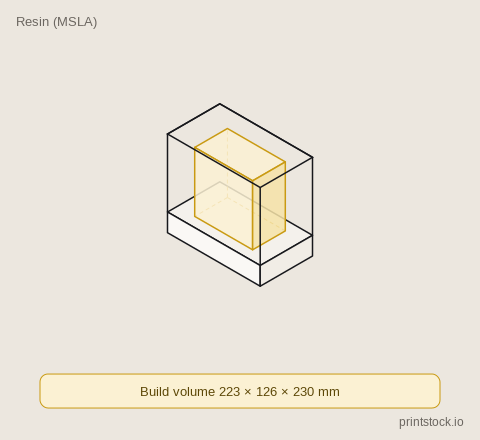
ResinMSLA223 × 126 × 230 mm
10.1-inch 14K resin printer with heated vat, leveling-free plate and Wi-Fi: 223 × 126 × 230 mm, 16.8 × 24.8 µm pixels, up to 170 mm/h.
Where to buy
Prices as of Nov 11, 2026Taxes, shipping and any import duties are worked out by the store at checkout and depend on your country; ask the store if in doubt.
Store links may be affiliate links: we may earn a commission, and it does not change your price. Affiliate disclosure
Overview
The Photon Mono M7 Pro was Anycubic's mid-size flagship of 2024, and GamesRadar called it the standout of everything it tested that year. It pairs a 10.1-inch 14K screen with a 6.5-liter build volume, and its main difference from the plain M7 is a heated vat plus Wi-Fi and app control, which keeps resin at a consistent temperature in cold rooms and makes exposure results more predictable.
The build plate is leveling-free, the Lighturbo 3.0 light source gives even exposure, and Anycubic rates it at up to 170 mm/h with fast resins. Pixels are not square, 16.8 × 24.8 µm, which matters little for miniatures and busts in practice.
In 2026 the Photon P1 offers the same volume with a ball screw, Wave Release and dual material, so the M7 Pro mainly makes sense at a discount. Compared with Elegoo's Saturn 4 Ultra it lacks tilt release but offers a similar heated, automated experience.
Best for
- Miniatures and busts with heated-vat consistency
- Cold workshops
- Users who want Wi-Fi resin printing
Look elsewhere if
- You want the latest tech: the Photon P1 adds Wave Release and dual material
- Budget is tight: the plain M7 skips the heater
Before you buy
- Use Anycubic's recommended resin settings as a starting point.
- Ventilate; there is no built-in carbon filter claim for heavy use.
- Compare current prices with the Photon P1.
- Keep spare release film.
Pros and cons
Pros
- 14K detail
- Heated vat
- Leveling-free
- Wi-Fi and app
Cons
- Non-square pixels
- Superseded by Photon P1
- No tilt release
Maker's test data
- Print speed
- Up to 130 mm/h with standard resin and 170 mm/h with Anycubic high-speed resin, both at 0.1 mm layer height, per Anycubic.
Published by the manufacturer from its own tests. PrintStock has not verified these figures; owner reports below may confirm or contradict them.
What owners like
Outstanding print quality
Praised by most ownersReviewers call the quality outstanding and the printer one of the best resin machines available.
Factory leveled with auto refill
Often praisedIt ships factory leveled and tops up resin automatically.
A standout for speed
Noted by some ownersGamesRadar+ called it the standout of everything tested that year.
Collected the same way as known issues: from independent reviews, owner reports and public discussions, merged and grouped.
Known issues
Last reviewed Nov 13, 2026Popular models have longer lists simply because more people own them and talk about them. Severity and status show how much each problem matters today.
14K screen failing in round patches
Major (repair or return)Still reportedThe most common hardware complaint is the 14K exposure LCD dying in round dark patches. The screen is a wear part and has to be replaced when this happens.
Auto-fill pump tube cracks and leaks resin
Major (repair or return)Workaround availableThe peristaltic pump tube of the auto-feeder can crack and dump resin onto the LCD. Inspect and replace the tube; a cap that is not airtight is the other common reason the feeder will not pump.
Resin leaks into the chassis
Major (repair or return)Workaround availableA torn film or loose frame screws let resin reach the optics and electronics; keep the screen protector fitted and torque screws evenly.
Vat heater only works before the print starts
Moderate (affects prints)Still reportedOwners report the resin heater warming the vat during preheat and then stopping once printing begins, which matters in cold rooms. Reviewers also find the wired heated vat awkward to remove.
Auto-feeder and purifier cannot run together
Moderate (affects prints)Still reportedBoth share one USB port and lid cutout, so only one works at a time.
False platform and residue warnings
Moderate (affects prints)Workaround availableThe single strain gauge drifts out of calibration and raises false dialogs; a hidden calibration helps some owners.
Banding from the lead screw
Minor (annoyance)Workaround availableGrease squeezed off the screw and nut wear cause bands; wipe and regrease about every quarter.
Slower than advertised
Minor (annoyance)Still reportedTests measured about 108 mm/h against the 170 mm/h claim, and the slicer underestimates print times by 15 to 30 percent.
Wi-Fi limits and no power-loss recovery
Minor (annoyance)Workaround availableOnly 2.4 GHz networks work, the server defaults to China, and a power cut loses the job.
Noisy fans and heavy, unbalanced vat
Minor (annoyance)Still reportedThe PSU fan runs even when switched off, the LCD fans are loud, and the heated vat weighs about 2.3 kg with one front spout.
How we build this list: we collect independent reviews, owner reports and public discussions on forums and social networks, merge duplicates and group them by cause. Only serious or recurring problems make the list, so a single complaint will not appear here, and a listed problem does not mean every unit is affected.
Specs
Printing
- Type
- Resin
- Build volume
- 223 × 126 × 230 mm
- Kinematics
- MSLA
- Resolution
- 14K (13312 × 5120), 16.8 × 24.8 µm
- XY resolution
- 16.8 × 24.8 µm
- Speed
- Up to 170 mm/h
Hardware
- Build plate
- Laser-engraved build plate
Control and sensors
- Screen
- Touchscreen, 4.3 in
Screen
- LCD
- 10.1-inch 14K mono, 13312 × 5120
Light
- Light source
- Lighturbo 3.0
Vat
- Heating
- Heated vat
Calibration
- Leveling
- Leveling-free
From maker and store specifications, checked Nov 12, 2026. Power, size, network and warranty are in their own blocks below.
Power and setup
Electricity
- Rated power
- 240 W
Network and cloud
- Works without internet
- Yes, fully (SD card / USB / LAN)
- Maker account
- Only for cloud / remote features
- Slicers from other makers
- Supported
- Note
- Files by USB drive, Wi-Fi or LAN. Cloud printing and monitoring go through the Anycubic app, which needs an account. Anycubic lists Photon Workshop, Chitubox and Lychee as supported slicers.
Space and room
- Size (W × D × H)
- 312 × 315 × 520 mm
- Weight
- 12.8 kg
On a standard power circuit
- US 15 A / 120 V standard circuit: fine, and about 1,200 W stays free for other things on that circuit while it heats up
- EU/UK 16 A / 230 V standard circuit: fine, and about 2,700 W stays free for other things on that circuit while it heats up
Our calculation from the maker's rated power, keeping a circuit at 80% for long loads.
Safety and support
Warranty and repair
- Warranty
- 12 months; 12 months on main parts; print head, extruder, belts, motors, camera and screens 3 months; nozzles, PTFE and FEP not covered
- Spare parts store
- Official page ↗
- Repair guides
- Official page ↗
Running costs
| Standard resin, per kg | Cheapest in our catalog: Elegoo ABS-Like Resin V3.0 | $17.99 |
|---|---|---|
| Release film (FEP / nFEP) | Phrozen FEP Film A4 | $10 |
Starter budget: about $419 for the printer at its best listed price, 1 kg of resin.
Cheapest compatible items in our catalog, USD prices as last checked. Prices change; see each item for the date.
Software and firmware
- Slicer / control software
- Anycubic Photon Workshop, CHITUBOX, Lychee
- Firmware
- Anycubic firmware via USB or app
- Connectivity
- USB, Wi-Fi, Anycubic app
Official firmware and downloads ↗ We never host firmware files.
Questions people ask
What is the difference between the M7 and M7 Pro?
Same screen and volume; the Pro adds a heated vat and Wi-Fi.
How fast is it?
Anycubic rates it at up to 170 mm/h.
M7 Pro or Photon P1?
The P1 is newer with Wave Release, a ball screw and dual material.
Models proven to print on the Anycubic Photon Mono M7 Pro
Coming soonCompatible accessories
Everything that fits the Anycubic Photon Mono M7 Pro
$99.99 as of Nov 11, 2026Check price
$28 as of Nov 11, 2026Check price
$19.99 as of Nov 11, 2026Check price
Closest alternatives by price
Compare all side by side