
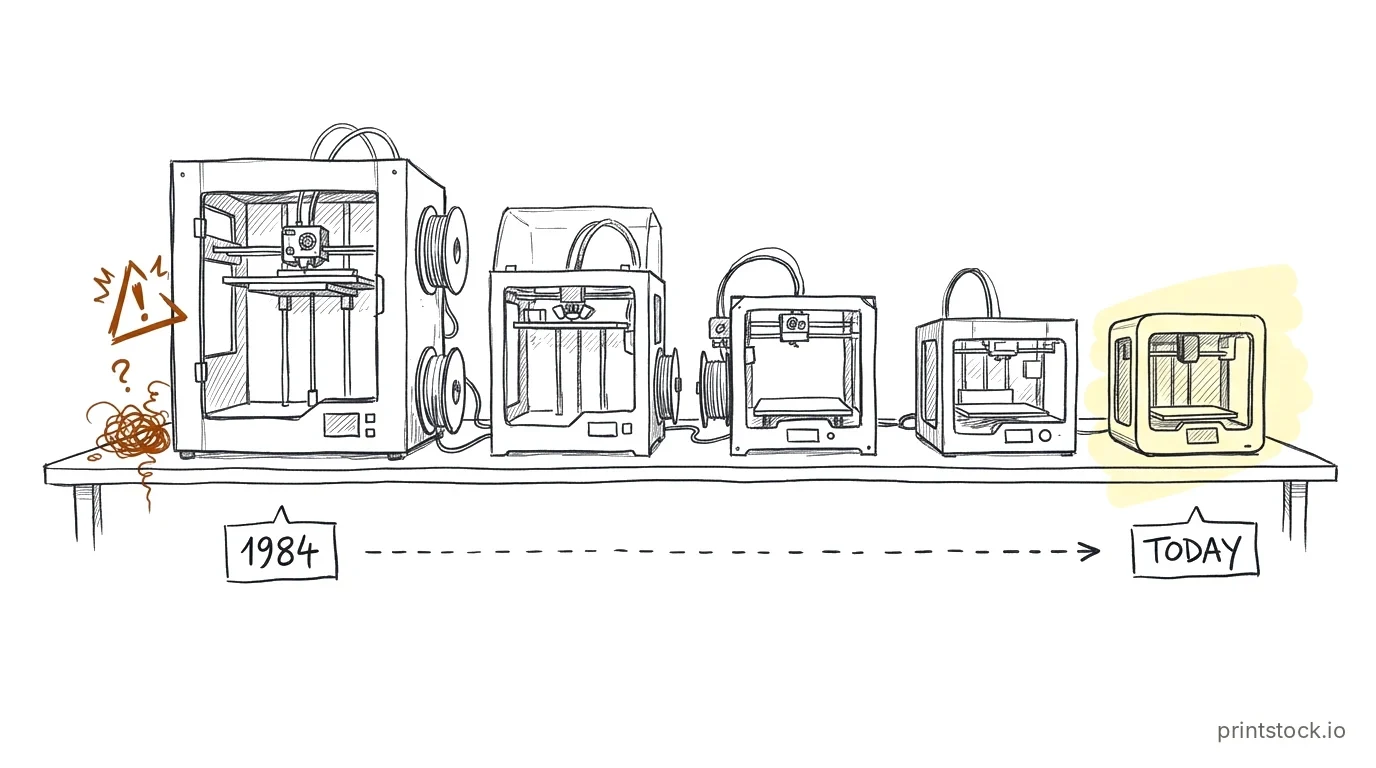
The 3D printer looks like a 21st-century gadget, but its story starts with 24 cameras in 1860s Paris and runs through a toy frog, a hot glue gun and a machine that printed its own child. Here is how the technology moved from an idea to factories and then to the printer on your desk, with the people who got there first and the ones who got the credit.
Who invented 3D printing?
Chuck Hull is credited with inventing 3D printing. He filed a patent for stereolithography on August 8, 1984, received it in 1986, and co-founded 3D Systems, which introduced the SLA-1, the first commercial 3D printer, in 1987. The US patent 4,575,330 and the ASME landmark citation for the SLA-1 are the primary records.
The honest answer is longer. Hull was the first to patent the process and turn it into a product, but at least two other teams described the same idea before him. Credit in this field goes to whoever filed the right paperwork and found the money to build the machine, which is a recurring theme in the rest of this story.
Before the printer: 19th-century ideas
The oldest ancestor of 3D printing is photosculpture, invented by the French artist François Willème around 1860. A sitter posed in the middle of a round studio while 24 cameras photographed them at once, one every 15 degrees. Each silhouette was traced and cut into a thin profile, and the profiles together formed a rough portrait in three dimensions that craftsmen then smoothed into a finished bust.
The principle will sound familiar: slice a shape into many thin outlines and stack them. Photosculpture was a hit with Paris society for a few years, but it needed too much hand work to make money, and Willème's studio closed in 1868. The idea of building a solid object from layers of data then waited about a century for computers and lasers.
In 1974 the British chemist David Jones, writing his whimsical "Daedalus" column in New Scientist, described hardening a liquid polymer with crossing beams of light to build an object. He meant it as a playful thought experiment. Ten years later it was a patent.
1980 to 1984: three inventors, one idea
Between 1980 and 1984, three separate teams invented the same thing: building a solid part by hardening liquid resin with light, one layer at a time. Only one of them ended up with a company.
Hideo Kodama, Japan, 1980. Working at the Nagoya Municipal Industrial Research Institute, Kodama filed the first patent application for a rapid prototyping system that hardened photopolymer with UV light, layer by layer. He also published the method in a scientific journal in 1981. The patent application lapsed before it was examined, and accounts agree on the reason: a tiny research budget and no money to build the machine further.
Alain Le Méhauté, Olivier de Witte and Jean-Claude André, France, July 16, 1984. The three engineers filed a patent for the stereolithography process three weeks before Hull. Their employers, the French industrial group CGE (later Alcatel-Alsthom) and the laser company CILAS, saw no business in it and let the idea go. Le Méhauté later said the episode showed a problem with backing innovation in France, and he has publicly credited Hull for having the nerve to start a company.
Chuck Hull, United States, August 8, 1984. Hull's day job at a company called Ultra Violet Products involved using UV light to harden thin plastic coatings on furniture and tables. He wondered what would happen if you hardened coat after coat on top of each other. In 1983, working evenings in the lab, he printed his first part, and in 1984 he filed the patent that coined the word stereolithography. His team also created the STL file format, still the most common format for 3D models today.
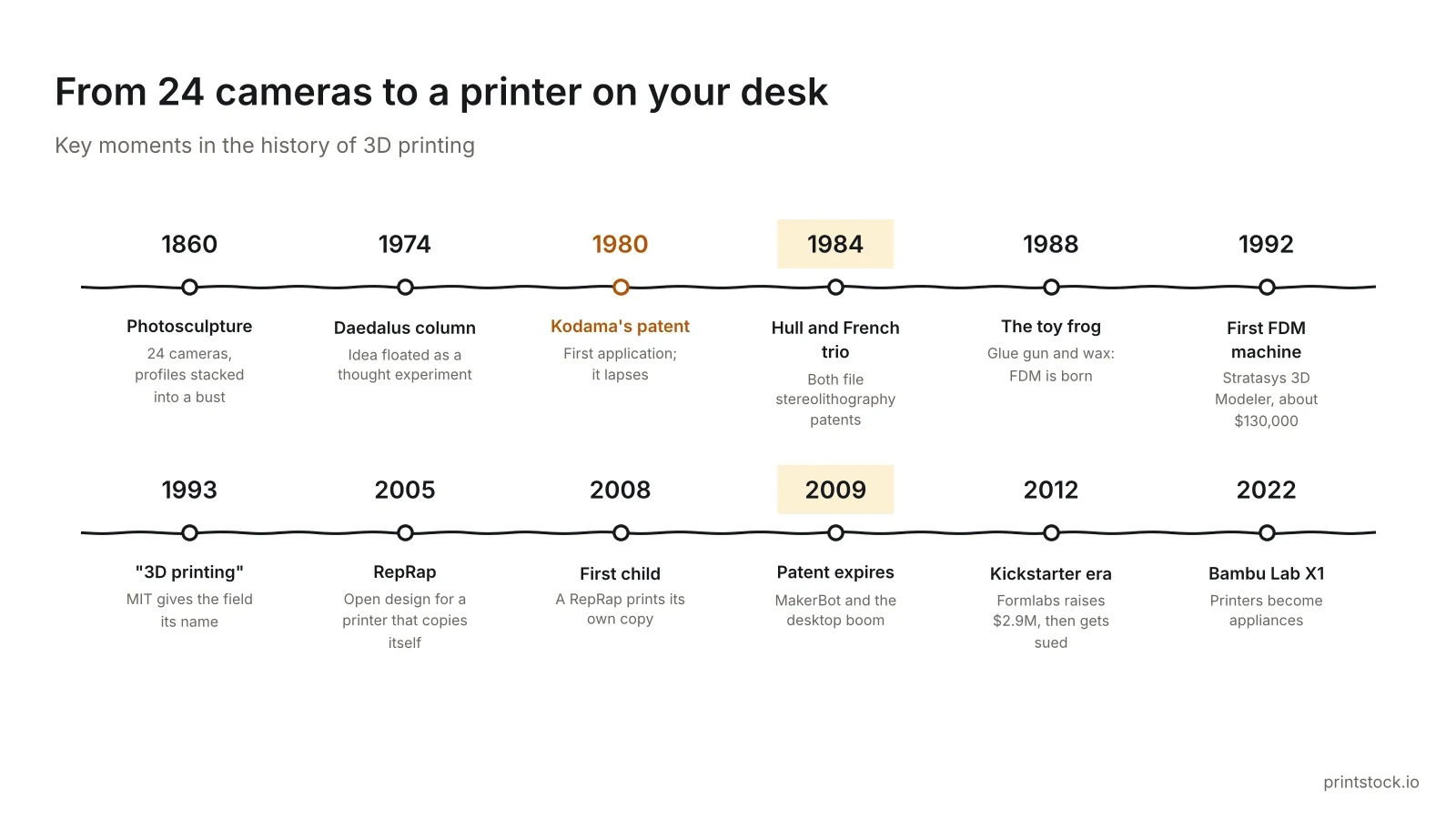
The pattern here matters more than the dates. The idea was "in the air" for anyone who combined computers, lasers and light-curing plastics. What separated Hull from Kodama and the French trio was not genius but persistence and funding: he kept paying for the patent, found investors, and co-founded 3D Systems in 1986.
The four technologies that started everything
Almost every 3D printer sold today, from a $150 desktop machine to a factory system, descends from four inventions made between 1984 and 1993. Each one solves the same problem, turning a digital model into layers, with a different material.
Technology | How it builds a layer | Who and when | What it became |
|---|---|---|---|
Stereolithography (SLA) | Light hardens liquid resin | Chuck Hull, filed 1984; SLA-1 sold 1987 | Today's resin printers |
Selective laser sintering (SLS) | A laser fuses plastic or metal powder | Carl Deckard, University of Texas at Austin, mid-1980s | Industrial nylon and metal printing |
Fused deposition modeling (FDM) | A heated nozzle lays down melted plastic | Scott and Lisa Crump, filed 1989; first machine 1992 | Most home and office printers |
Three-dimensional printing (binder jetting) | An inkjet glues layers of powder | Emanuel Sachs and Michael Cima, MIT, patented 1993 | Full-colour models, metal parts, and the name "3D printing" |
That last row explains the name. Through the 1980s the industry called all of this rapid prototyping. MIT's process was the first to be called 3D printing, and the catchy label slowly spread to every method on the list.
The toy frog that started FDM
Fused deposition modeling, the method inside most home printers, began as a toy. In 1988 the engineer Scott Crump decided to make a toy frog for his young daughter. He loaded a hot glue gun with a mix of polyethylene and candle wax and built the frog up layer by layer on the kitchen table.
It worked well enough that Crump spent his weekends automating it, first in the kitchen and then, at his wife Lisa's firm request, in the garage. The couple founded Stratasys, filed the FDM patent in 1989 and sold their first machine, the 3D Modeler, in April 1992.
The price tag shows why nobody had one at home: about $130,000, or $178,000 with the computer workstation needed to run it. Sales were slow at first; Stratasys shipped only a handful of systems in its first three years, so Crump aimed the machines at large companies such as carmakers and manufacturers, which could afford them.
Why 3D printers stayed in factories for 25 years
For its first two decades, 3D printing was an industrial tool because the machines were expensive, the materials were proprietary and the key processes were patented. A printer was something an engineering department bought to make prototypes faster, not something you put in a spare room.
That made sense at the time. Making a prototype by hand or by machining could take weeks, so a $100,000 machine that turned out a plastic model overnight paid for itself in saved time. The same patents that protected those businesses also kept cheap competitors out: anyone who wanted to sell a filament printer had to license Stratasys technology or wait.
There was also a less visible barrier: software. Turning a 3D model into hundreds of layers and machine moves required specialist programs that came with each industrial system. A home user would have had nothing to feed the printer even if they could afford one.
RepRap: the printer that tried to print itself
RepRap, short for replicating rapid prototyper, was the open-source project that made home 3D printing possible. Adrian Bowyer, a lecturer in mechanical engineering at the University of Bath, published the idea in February 2004: a printer that could make most of its own plastic parts, so every printer could help build the next one.
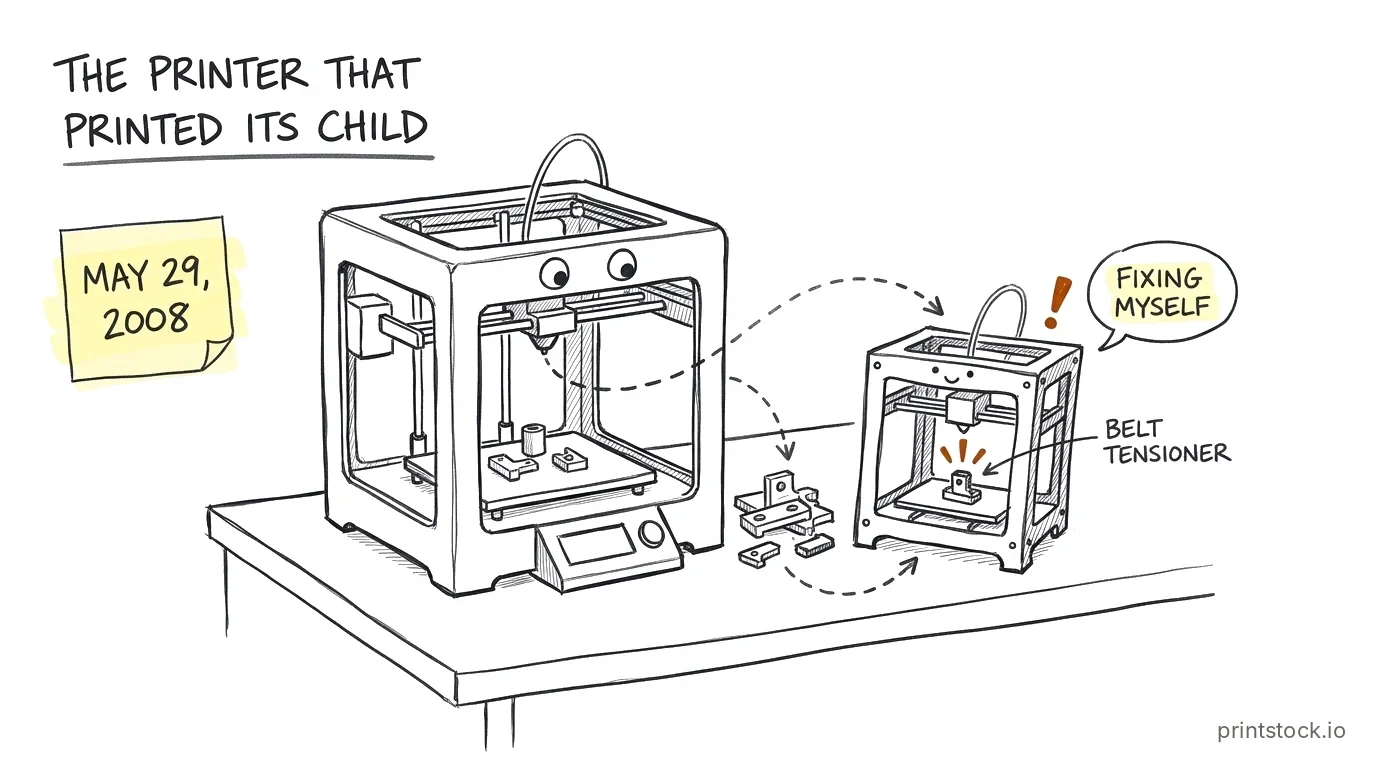
The design, licensed for anyone to copy, had a cheerful, almost biological ambition. Bowyer argued that a self-copying machine would either vanish or spread exponentially, with nothing in between. On May 29, 2008, the first RepRap "child" was assembled from parts printed by its parent, a model called Darwin. A few minutes later the child printed its first part for a "grandchild".
Two details from that year deserve a place in any history. The child's very first useful print was a part to fix itself: the team designed a belt tensioner, printed it on the new machine and fitted it, so self-repair arrived together with self-replication. And possibly the first everyday object a RepRap made, a few weeks earlier, was a clamp to hold an iPod on the dashboard of a Ford Fiesta.
RepRap never became a self-copying machine in the strict sense: the motors, electronics and metal rods still had to be bought, and the printed parts were only about half of the machine. But it did something more important. It published a working, cheap design with free software, and thousands of hobbyists started building, improving and selling printers based on it.
2009: the patents expire and the desktop boom begins
Home 3D printing took off around 2009, when the original FDM patent expired and RepRap-based kits went on sale. Without the patent in the way, anyone could build and sell a filament printer, and the open RepRap designs gave them a head start.
MakerBot, founded in 2009 in Brooklyn by people from the RepRap community, became the face of the boom. Its kits and later its assembled Replicator printers cost around $1,000 instead of tens of thousands. The company also started Thingiverse, a free library of printable models, which solved the old software problem from the other end: now there were things to print. Stratasys and MakerBot estimated that 35,000 to 40,000 desktop printers were sold in 2012, and in 2013 Stratasys, the company built on Crump's frog, bought MakerBot for $403 million in stock.
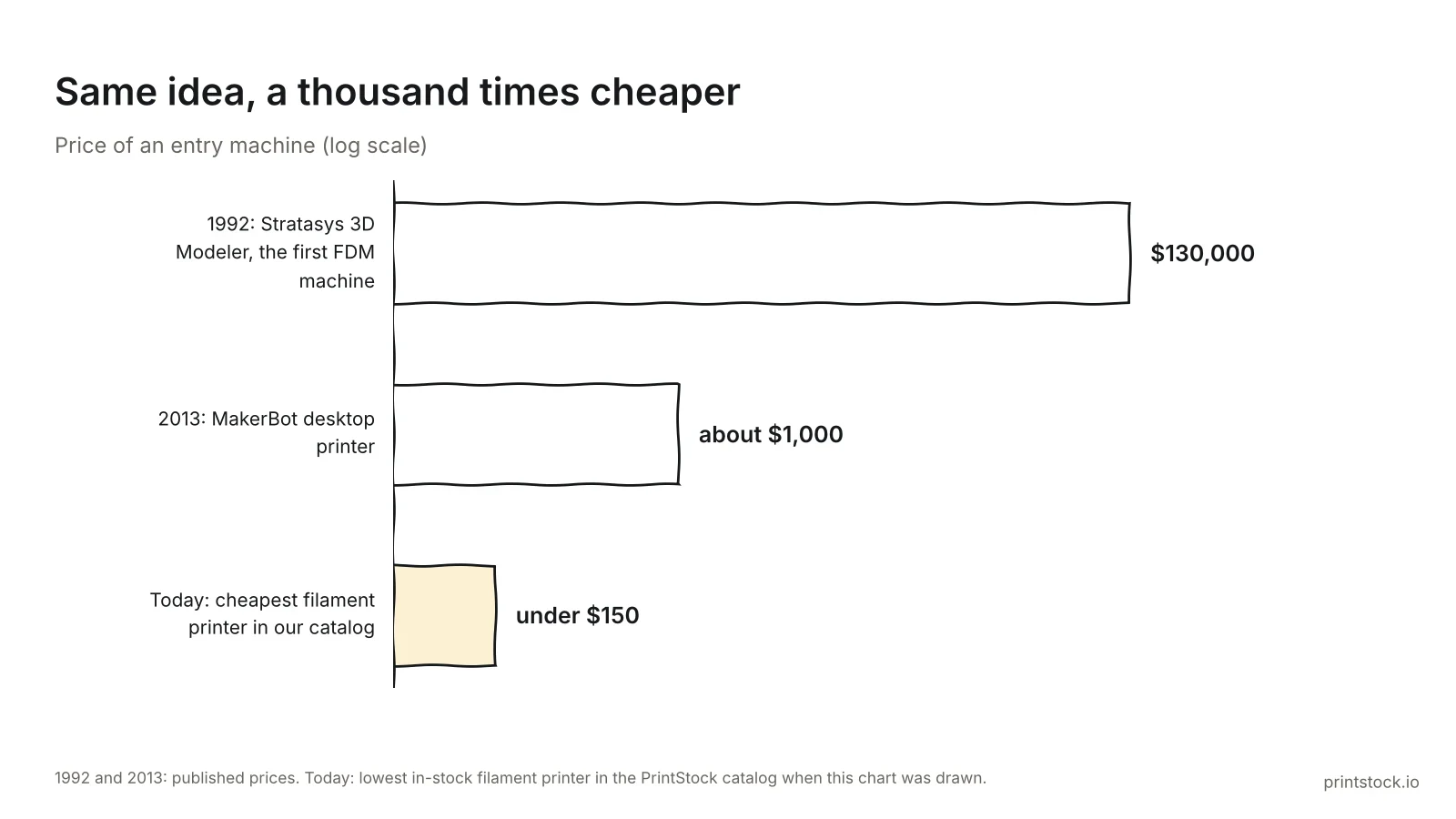
Look at the chart and notice what did not change. A printer that costs less than a nice pair of headphones still does what the 1992 machine did: it melts plastic and lays it down one layer at a time. The price fell because the patents ran out, the parts became mass-produced and the open designs were shared, not because someone invented a new process.
Hype, lawsuits and flops
The early 2010s brought a hype bubble: commentators predicted a 3D printer in every home, investors poured money in, and a wave of lawsuits and failures followed. It is the most entertaining chapter of the story and the most useful for buyers today.
The resin side of the industry produced the most famous fight. In 2012 the MIT spin-off Formlabs raised $2,945,885 on Kickstarter for the Form 1, a desktop stereolithography printer, after asking for $100,000. Within weeks 3D Systems, Hull's company, sued Formlabs for patent infringement and, unusually, sued Kickstarter too for promoting the campaign. The case against Kickstarter was dropped and the dispute with Formlabs was settled in 2014 under undisclosed terms. Formlabs went on to become one of the largest companies in the field.
Not every crowdfunded printer delivered. The Peachy Printer, promoted as a $100 resin printer, collapsed in 2016 and most backers never received one. Several of the big brands also stumbled: the consumer printers sold in the hype years were often unreliable, the "printer in every home" never arrived, and MakerBot cut staff in 2015 as the market cooled.
Is 3D printing a fad that will fade again?
This is a fair worry for anyone about to spend money on a printer. The honest answer is that the hype faded, but the technology did not. What failed in 2013 to 2015 was the promise that everyone would print their own household goods. What survived, and grew, is the use people actually have for it: replacement parts, prototypes, tools, miniatures, cosplay, and small businesses selling printed products.
The risk you can control is buying the wrong machine. A few habits keep the downside small: buy from brands with a track record of spare parts, check that parts and consumables for your model are easy to find, and read what owners report before you pay. Every printer page in our catalog lists compatible parts and owner-reported problems for exactly this reason.
From hobby kits to appliances
Since 2012, desktop printers have moved from kits that needed constant tinkering to machines that work close to out of the box. Three developments did most of the work.
First, open designs like the Prusa i3, published in 2012 by the Czech RepRap developer Josef Prusa, became a template that dozens of manufacturers copied and improved. Second, manufacturers in China, Creality, Anycubic, Elegoo and others, used that template and mass production to push prices of simple printers down to a couple of hundred dollars. Third, the resin side got its own price drop when printers began to use small LCD screens, similar to phone displays, to mask the UV light, instead of expensive lasers.
The latest turn came in 2022, when Bambu Lab, a start-up founded by former drone engineers, raised $7,047,538 from 5,575 backers on Kickstarter for its X1. The printer combined high speed, automatic calibration, a camera and a multi-colour system in one enclosed box, and pushed the rest of the industry to make printers easier to use. Records keep falling: later campaigns for desktop printers have raised more than $11 million.
What the 3D printer family looks like today
Today the technologies from the 1980s live on in separate machine families, and most of them now fit on a desk. Filament (FDM) printers are the most common, resin printers handle fine detail, and the same desktop brands also sell laser engravers, small CNC machines and 3D scanners, which are the modern descendants of Willème's 24 cameras.
The table below comes straight from our catalog and updates on its own: how many models of each type we track and the lowest current price we have found.
| Machine type | Models we track | Lowest price now |
|---|---|---|
| FDM | 143 | $139.24as of Nov 11, 2026 |
| Resin | 46 | $148.59as of Nov 11, 2026 |
| Laser | 77 | $75.99as of Nov 11, 2026 |
| CNC | 12 | $372.87as of Nov 11, 2026 |
| 3D scanner | 41 | $223.35as of Nov 11, 2026 |
| 3D pen | 8 | $39.99as of Nov 11, 2026 |
| Powder bed (SLS, MJF) | 15 | $23,990as of Nov 15, 2026 |
| Material jetting | 6 | n/a |
| Metal | 20 | n/a |
| Ceramic | 2 | n/a |
Live from our catalog: in-stock offers in US dollars from official stores and retailers.
The spread of prices tells you where each technology is in its own history. Filament printers have had more than fifteen years of open designs and competition, so a capable machine costs little. Machines that arrived on desks later still carry more of their industrial price.
Common myths about the history of 3D printing
Myth: Chuck Hull was the first to think of it. Hull held the first granted patent and built the first commercial machine, but Kodama published the idea in 1980 and a French team filed a patent before him. "Inventor" here means the person who made it work as a product.
Myth: 3D printing is a 2010s technology. The desktop boom is from the 2010s; the technology is from the 1980s and the idea from the 1860s.
Myth: home printers use a cheap, different technology. A home filament printer uses the same principle as Crump's 1992 machine. The differences are materials, precision, speed and how much the machine checks itself.
Myth: patents killed 3D printing. Patents slowed home printing down, but they also funded the companies that developed the technology for 25 years. The boom started when both things were true at once: a mature technology and expired patents.
Where to go from here
If this history made you want a printer of your own, start with the printer catalog, which you can filter by type, enclosure and multi-colour support, with prices we check and owner-reported problems for each model. For the parts that wear out first on any filament printer, see nozzles, hotends and build plates, and for looking after a printer you already own, our guides cover the most common jobs step by step.
To see how today's machines actually work, read how a 3D printer works and our overview of the types of 3D printers.