Stratasys J850 Prime
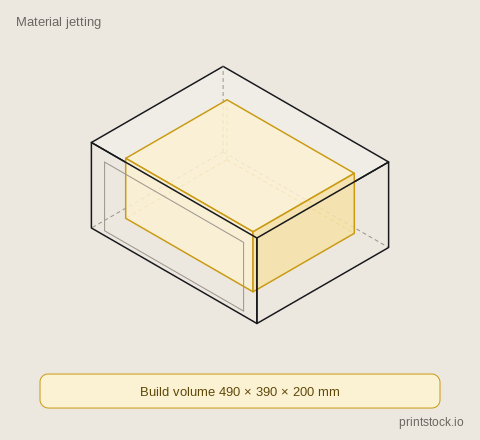
Stratasys's top PolyJet printer: 490 × 390 × 200 mm, up to seven materials at once, layers down to 14 µm, full colour, transparency and flexibility in one part.
How to buy
Stratasys sells this machine through quotes and resellers; the price depends on configuration, software and service.
Taxes, delivery, installation and any import duties are set by the seller when you order; agree them with the maker or its reseller.
Overview
The J850 Prime sits at the top of Stratasys's PolyJet line and is widely regarded as the most capable full-colour material jetting system. It loads up to seven materials at once and mixes them as it prints, so a single part can combine millions of colours with clear and rubber-like regions, at layers down to 14 µm.
That is why designers use it for photoreal consumer product prototypes, medical models with soft tissue and visible structures, and transparent parts such as perfume bottles. A Super High Speed mode at 55 µm trades detail for faster drafts.
It is a 430 kg cabinet on single-phase power, sold on quotation; material cost per part is high, so it is used where realism matters more than strength.
Best for
- Photoreal product prototypes with colour, clear and soft areas
- Anatomical and medical models
- Agencies and studios that need presentation models
Look elsewhere if
- Functional or load-bearing parts
- Tight budgets: materials are expensive
Before you buy
- Request material pricing and typical cost per model.
- Compare with the J850 Pro if you do not need full colour.
- Plan floor space for a 430 kg machine.
Pros and cons
Pros
- Seven materials at once
- Unmatched colour and texture
- 14 µm layers
Cons
- Very expensive to run
- Not for functional parts
- Quote only
Known issues
Last reviewed Nov 15, 2026We have not found serious or recurring problems with this model so far.
How we build this list: we collect independent reviews, owner reports and public discussions on forums and social networks, merge duplicates and group them by cause. Only serious or recurring problems make the list, so a single complaint will not appear here, and a listed problem does not mean every unit is affected.
Specs
Printing
- Type
- Material jetting
- Process
- Material jetting (PolyJet, UV inkjet)
- Made for
- Industrial
- Build volume
- 490 × 390 × 200 mm
- Materials
- Resin
- Layer thickness
- Down to 14 µm; 55 µm in Super High Speed mode
Hardware
- Enclosure
- Yes
Process
- Technology
- PolyJet material jetting with UV curing
Materials
- Simultaneous materials
- Up to seven, mixed into millions of colour, clarity and hardness combinations
Facility
- Power
- 100 to 120 V 13.5 A or 220 to 240 V 7 A, single phase
Software
- Software
- GrabCAD Print; voxel printing
Line
- Range
- J55 Prime, J826 Prime, J850 Pro, J850 Prime, J735, J750
From maker and store specifications, checked Nov 15, 2026. Power, size, network and warranty are in their own blocks below.
Power and setup
Electricity
- Mains input
- Separate 110 V and 220 V versions
- Phases
- Single phase
- Note
- 100 to 120 V at 13.5 A or 220 to 240 V at 7 A
Network and cloud
- Works without internet
- Yes, fully (SD card / USB / LAN)
- Note
- PolyJet printer driven from Stratasys GrabCAD Print; the GrabCAD PolyJet Job Manager slices jobs and streams them to the printer's embedded software.
Space and room
- Size (W × D × H)
- 1,400 × 1,260 × 1,100 mm
- Weight
- 430 kg
For business buyers
Software and firmware
- Slicer / control software
- GrabCAD Print
Questions people ask
How many materials can the J850 Prime use at once?
Up to seven, mixed into millions of combinations.
What is its build size?
490 × 390 × 200 mm.
What is the thinnest layer?
14 µm.