Stratasys H350
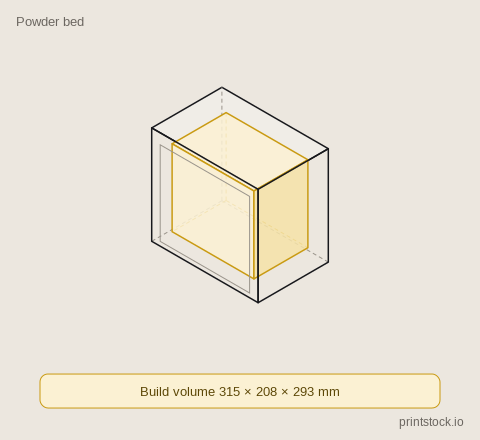
Stratasys's powder bed printer using Selective Absorption Fusion: 315 × 208 × 293 mm (19.2 L), 100 µm layers, full build in 11.6 h, PA11 and PA12.
How to buy
Stratasys sells this machine through quotes and resellers; the price depends on configuration, software and service.
Taxes, delivery, installation and any import duties are set by the seller when you order; agree them with the maker or its reseller.
Overview
The H350 is Stratasys's entry into powder bed fusion and the only machine using its Selective Absorption Fusion process. Like HP's MJF it uses inkjet heads and infrared energy rather than a laser: industrial printheads jet a high-absorption fluid where the part should fuse, and infrared lamps melt that area, layer by layer.
Stratasys aimed it at short-run production with predictable cost per part. It prints a 315 × 208 × 293 mm build in under 12 hours, with resellers citing about 12% nesting density, and its High Yield PA11 is a bio-based nylon from castor oil. A SAF ReLife PA12 material reuses waste PA12 powder, including from other SLS and MJF machines.
It needs three-phase power, a controlled room and extraction. Sold on quotation; aggregator listings start around $150,000.
Best for
- Short-run production of nylon parts
- Shops wanting predictable cost per part
- Users who want to reuse waste PA12 powder
Look elsewhere if
- Prototype-only use
- No three-phase power or climate control
Before you buy
- Plan three-phase power, climate control and extraction.
- Budget HAF fluid and powder handling.
- Compare part cost with MJF and SLS quotes.
Pros and cons
Pros
- Bio-based PA11
- Reuses waste PA12
- Consistent parts
Cons
- Smaller build than rivals
- Quote only
- Facility requirements
Known issues
Last reviewed Nov 15, 2026We have not found serious or recurring problems with this model so far.
How we build this list: we collect independent reviews, owner reports and public discussions on forums and social networks, merge duplicates and group them by cause. Only serious or recurring problems make the list, so a single complaint will not appear here, and a listed problem does not mean every unit is affected.
Specs
Printing
- Type
- Powder bed (SLS, MJF)
- Process
- Selective Absorption Fusion (SAF)
- Made for
- Industrial
- Build volume
- 315 × 208 × 293 mm
- Materials
- PA
- Layer thickness
- 100 µm
- Full build time
- 11.62 h
- Nesting density
- About 12% (reseller figure)
Hardware
- Enclosure
- Yes
Process
- Technology
- Selective Absorption Fusion (SAF): jetted absorbing fluid plus infrared, Big Wave powder deposition
Materials
- Materials
- High Yield PA11, PA12, SAF ReLife PA12 (reused powder), HAF fluid
Facility
- Environment
- 20 to 25 °C, 40 to 55% RH, 300 m³/h extraction
From maker and store specifications, checked Nov 15, 2026. Power, size, network and warranty are in their own blocks below.
Power and setup
Electricity
- Mains input
- 380 to 480 V three-phase
- Circuit the maker asks for
- 16 A
- Peak while heating
- 5,000 W
- Average while printing
- 3,250 W
Network and cloud
- Works without internet
- Yes, fully (SD card / USB / LAN)
- Note
- SAF printer connected to Stratasys GrabCAD Print over the network.
Space and room
- Size (W × D × H)
- 1,900 × 940 × 1,730 mm
- Weight
- 825 kg
- Room temperature
- 20 to 25 °C
- Max humidity
- 55%
For business buyers
What the room needs
- Room 20 to 25 °C, 40 to 55% RH; extraction 300 m³/h
- Powder handling area with depowdering and sieving; operators need PPE for fine nylon powder
Software and firmware
- Slicer / control software
- Stratasys SAF workflow software
Questions people ask
What is SAF?
Selective Absorption Fusion: printheads jet an absorbing fluid onto powder and infrared energy fuses it, without a laser.
What is the H350 build volume?
315 × 208 × 293 mm, 19.2 litres.
What materials does it print?
High Yield PA11, PA12 and SAF ReLife PA12.