Fits all resin printers
$809 as of Nov 11, 2026Check price
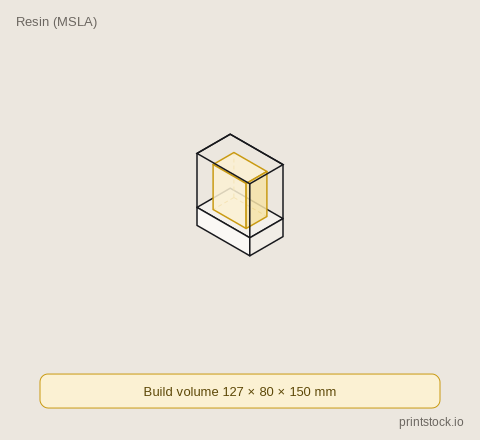
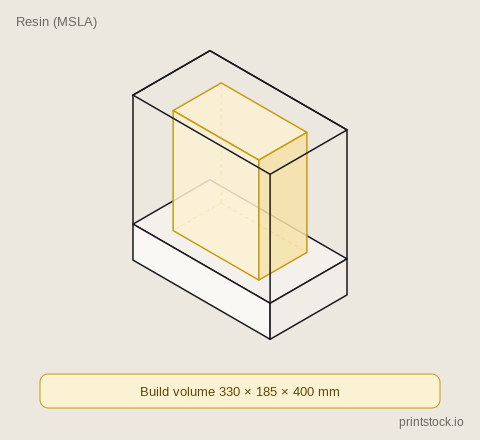
Prusa's resin printer: 5.96-inch monochrome LCD with 0.049 mm XY resolution, 127 × 80 × 150 mm volume, fast tilting tank and 1.4 s layers; pairs with the CW1S wash and cure station.
Taxes, shipping and any import duties are worked out by the store at checkout and depend on your country; ask the store if in doubt.
Store links may be affiliate links: we may earn a commission, and it does not change your price. Affiliate disclosure
The Original Prusa SL1S SPEED, launched in 2021, replaced Prusa's first resin printer, the SL1. Its key change was a monochrome LCD instead of an RGB one: mono screens pass more UV light, so layers cure in about 1.4 seconds and the panel lasts several times longer. Combined with a fast tilting tank that peels each layer in about three seconds, Prusa claims prints up to three times faster than the SL1, with a 25 percent larger print area.
It is built like Prusa's other machines: a heavy aluminum body to minimize vibration, an angled build platform so resin drains instead of pooling, an activated carbon filter, a resin level sensor and a detailed 68-page manual. Tom's Hardware called it speedy, smart and sophisticated, and noted it ships with a 500 g bottle of resin. The matching CW1S station washes, cures, dries and can preheat resin.
The drawbacks are size and price. At 127 × 80 × 150 mm its volume is small by 2026 standards, and its 0.049 mm pixels are coarser than cheap 12K and 16K printers. It remains a choice for professionals who value reliability, repairability and an open ecosystem over raw resolution per dollar.
Reviewers praise high-quality resin prints at lightning speed and a rock-solid, trouble-free ecosystem.
TechRadar praises incredible print quality, reliability and speed.
Collected the same way as known issues: from independent reviews, owner reports and public discussions, merged and grouped.
Popular models have longer lists simply because more people own them and talk about them. Severity and status show how much each problem matters today.
Some owners find the standard tilt speed raises the failure rate and switch to the slow tilt setting for reliability, at the cost of print time.
The resin level sensor complains about small overfills.
There is no auto-refill, so resin is handled by hand.
How we build this list: we collect independent reviews, owner reports and public discussions on forums and social networks, merge duplicates and group them by cause. Only serious or recurring problems make the list, so a single complaint will not appear here, and a listed problem does not mean every unit is affected.
From maker and store specifications, checked Nov 12, 2026. Power, size, network and warranty are in their own blocks below.
| Standard resin, per kg | Cheapest in our catalog: Elegoo ABS-Like Resin V3.0 | $17.99 |
|---|---|---|
| Release film (FEP / nFEP) | Phrozen FEP Film A4 | $10 |
Cheapest compatible items in our catalog, USD prices as last checked. Prices change; see each item for the date.
Official firmware and downloads ↗ We never host firmware files.
Prusa claims up to three times faster than the SL1, with exposures around 1.4 seconds per layer.
Prusa's wash, cure and dry station, which can also preheat resin for the SL1S.
Yes, 405 nm resins work; Prusa provides profiles for many brands in PrusaSlicer.