Modix MAMA-1000
Modix's pellet printer: one cubic metre, Dyze Design Pulsar pellet head up to 3 kg/h and 485 °C, interchangeable filament head, heated MIC6 bed, three-phase power.
How to buy
Modix sells this machine through quotes and resellers; the price depends on configuration, software and service.
Taxes, delivery, installation and any import duties are set by the seller when you order; agree them with the maker or its reseller.
Overview
The MAMA-1000 is where Modix leaves the kit market. It prints a full cubic metre from plastic pellets instead of filament, using a Dyze Design Pulsar head that peaks at 3 kg per hour, with logged prints averaging 1.15 to 1.4 kg per hour. A Griffin Ultra filament head swaps in for finer work.
Pellets are the reason to buy it: Modix quotes about $2 to $8 per kilogram against $20 to $80 for filament, which changes the economics of moulds, furniture and large tooling. Listed pellet grades include PLA, recycled PETG and glass- or carbon-filled PETG. The interlocked enclosure, alarms that pause on pellet or clog problems, and a zoned MIC6 bed are aimed at production.
It needs 400 V three-phase power and compressed air, and Modix quotes it after an application assessment. Larger MAMA-1700 and XL-3000 models stretch the length to 1.7 and 3 metres.
Best for
- Large moulds, patterns and furniture at low material cost
- Production of big parts in recycled or filled PETG
- Shops already using Modix filament printers
Look elsewhere if
- You lack three-phase power and compressed air
- You need fine surface detail: pellet layers are thick
Before you buy
- Confirm 400 V three-phase on a 32 A circuit.
- Plan pellet drying: 4 to 8 hours by material.
- Ask Modix for an application assessment and quote.
Pros and cons
Pros
- Up to 3 kg/h
- Cheap pellet feedstock
- Filament head included
Cons
- Three-phase power
- Quote only
- Coarse layers with pellets
Known issues
Last reviewed Nov 15, 2026We have not found serious or recurring problems with this model so far.
How we build this list: we collect independent reviews, owner reports and public discussions on forums and social networks, merge duplicates and group them by cause. Only serious or recurring problems make the list, so a single complaint will not appear here, and a listed problem does not mean every unit is affected.
Specs
Printing
- Type
- FDM
- Process
- Pellet extrusion
- Made for
- Industrial
- Build volume
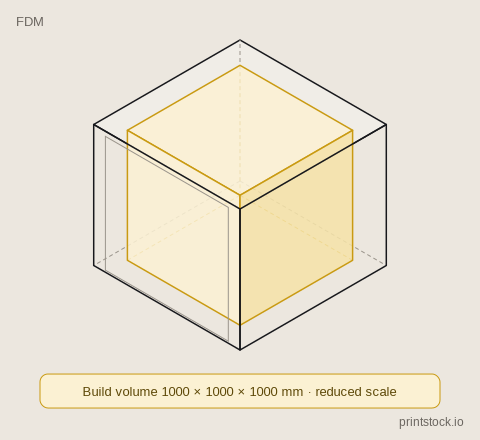
- 1000 × 1000 × 1000 mm
- Multi-color
- No
- Nozzles / toolheads
- 2
- Materials
- PLA, PETG
Extruder and bed
- Extruder
- Direct drive
- Stock nozzle
- 3 mm (1 and 5 mm pellet nozzles; 1.6 mm Griffin Ultra filament head)
- Nozzle / hotend
- Dyze Design Pulsar pellet head
- Max nozzle temp
- 485 °C
- Filament
- 1.75 mm
- Build plate
- MIC6 aluminium tooling plate, zoned heating
- Max bed temp
- 120 °C
- Enclosure
- Yes
Control and sensors
- Screen
- Touchscreen
- Features
- Filament tangle or clog detectionDoor or lid sensor
Files and setup
- Arrives
- Ships assembled
- Variants
- MAMA-1700, MAMA XL-3000
Extrusion
- Pellet head
- Dyze Design Pulsar, up to 3 kg/h peak (1.15 to 1.4 kg/h logged averages)
- Pellet nozzles
- 1, 3 and 5 mm; layers 0.25 to 3 mm; up to 485 °C
- Filament head
- Griffin Ultra, 1.6 mm nozzle, layers 0.1 to 0.8 mm; IDEX optional
Motion
- Motion
- Moving bed in Z, gantry in XY, closed-loop NEMA 23 motors
Facility
- Power and air
- 400 V three-phase, 32 A, plus compressed air
Materials
- Pellet cost
- About $2 to $8 per kg vs $20 to $80 for filament (Modix figures)
From maker and store specifications, checked Nov 15, 2026. Power, size, network and warranty are in their own blocks below.
Power and setup
Electricity
- Mains input
- 380 to 480 V three-phase
- Circuit the maker asks for
- 32 A
- Note
- 480 V sites need an isolation transformer
Network and cloud
- Works without internet
- Yes, fully (SD card / USB / LAN)
- Maker account
- Not needed
- Local control for other software
- Open (documented or open source)
- Slicers from other makers
- Supported
- Note
- Runs open-source RepRapFirmware on a Duet 3 board and is controlled through Duet Web Control from any browser on the local network. Ethernet is standard and Wi-Fi is a removable dongle; Modix needs no cloud account or internet connection, and any slicer that writes G-code works.
Space and room
- Size (W × D × H)
- 1,400 × 1,530 × 2,350 mm
- Weight
- 400 kg
- Gas or air supply
- Compressed air
For business buyers
Software and firmware
- Slicer / control software
- Slicers with RepRapFirmware output
- Firmware
- RepRapFirmware on Duet 3 6HC
- Connectivity
- Ethernet; offline
Questions people ask
How fast does the MAMA-1000 print?
Up to 3 kg per hour peak with pellets; Modix's logged prints average 1.15 to 1.4 kg per hour.
Can it print filament too?
Yes, an interchangeable Griffin Ultra filament head is part of the system.
What power does it need?
400 V three-phase on a 32 A circuit, plus compressed air.
How much cheaper are pellets?
Modix quotes about $2 to $8 per kg for pellets against $20 to $80 per kg for filament.