Markforged PX100
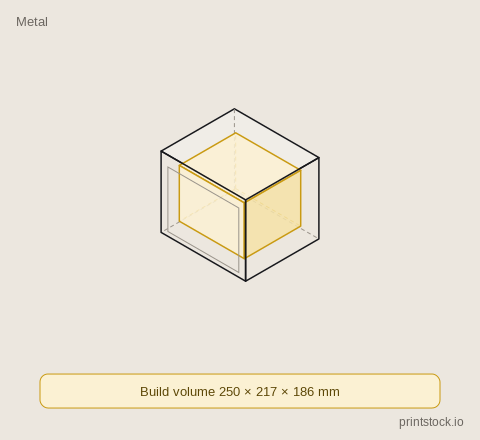
Production metal binder jetting from the Digital Metal line: 250 × 217 × 186 mm build, 70,400 nozzles, 500 to 1,000 cm³/h, sintered steel, titanium, copper and nickel alloys.
How to buy
Markforged sells this machine through quotes and resellers; the price depends on configuration, software and service.
Taxes, delivery, installation and any import duties are set by the seller when you order; agree them with the maker or its reseller.
Overview
The PX100 is Markforged's production metal machine, built on the binder jetting technology it gained by buying Digital Metal. A page-wide printhead deposits binder into thin layers of metal powder; the green parts are then depowdered and sintered in a furnace to full metal.
Binder jetting suits large batches of small, detailed parts: dental and medical components, small industrial parts and consumer hardware, where many parts nest in one build. Typical output is 500 to 1,000 cm³ per hour, far faster than laser powder bed fusion, but parts shrink during sintering and need design rules for it.
This is a full production cell, not a single printer: plan for powder handling, a sintering furnace, inert gas and trained staff. Pricing is on quotation.
Best for
- Batches of small, detailed metal parts
- Production replacing metal injection moulding or machining at low to medium volume
- Dental, medical and consumer hardware makers
Look elsewhere if
- Single prototypes
- Large parts beyond 250 mm
- Shops without a powder-safe room
Before you buy
- Price the full cell: printer, powder handling and furnace.
- Learn sintering shrinkage design rules.
- Plan the room for a 2-tonne machine and metal powder.
Pros and cons
Pros
- High throughput
- Fine detail
- Wide alloy list
Cons
- Full production cell needed
- Sintering shrinkage
- Price on request
Known issues
Last reviewed Nov 15, 2026We have not found serious or recurring problems with this model so far.
How we build this list: we collect independent reviews, owner reports and public discussions on forums and social networks, merge duplicates and group them by cause. Only serious or recurring problems make the list, so a single complaint will not appear here, and a listed problem does not mean every unit is affected.
Specs
Printing
- Type
- Metal
- Process
- Binder jetting
- Made for
- Industrial
- Build volume
- 250 × 217 × 186 mm
- Materials
- Stainless steel, Tool steel, Titanium, Copper, Nickel alloy
- Printhead
- 70,400 nozzles, page-wide
- Productivity
- 500 to 1,000 cm³/h typical
Hardware
- Enclosure
- Yes
Process
- Technology
- Metal binder jetting, then sintering in a furnace
Materials
- Materials
- 316L and 17-4 PH stainless, 4140, H13 and D2 tool steels, Ti-6Al-4V, copper, IN625, IN718, M247
Business
- Ownership
- Nano Dimension owns Markforged; a sale to Stratasys was agreed in 2026
From maker and store specifications, checked Nov 15, 2026. Power, size, network and warranty are in their own blocks below.
Power and setup
Electricity
- Average while printing
- 3,500 W
Network and cloud
- Note
- Build files are created through the Markforged add-in for Autodesk Fusion, which sets up binder-jet jobs for the PX100; Markforged's Eiger is the company's cloud print-management platform.
Space and room
- Size (W × D × H)
- 2,700 × 1,000 × 1,700 mm
- Weight
- 2,000 kg
For business buyers
Software and firmware
- Slicer / control software
- Eiger
Questions people ask
What process does the PX100 use?
Metal binder jetting, followed by sintering.
How big is the build?
250 × 217 × 186 mm, or 70 mm tall in the low build box.
How fast is it?
Typically 500 to 1,000 cm³ per hour.