INTAMSYS FUNMAT HT Enhanced
Entry PEEK printer from INTAMSYS: 260 mm cube, 450 °C all-metal hotend, 160 °C bed and 90 °C heated chamber, single extruder, open 1.75 mm materials.
Where to buy
Prices as of Nov 15, 2026Taxes, shipping and any import duties are worked out by the store at checkout and depend on your country; ask the store if in doubt.
Store links may be affiliate links: we may earn a commission, and it does not change your price. Affiliate disclosure
Overview
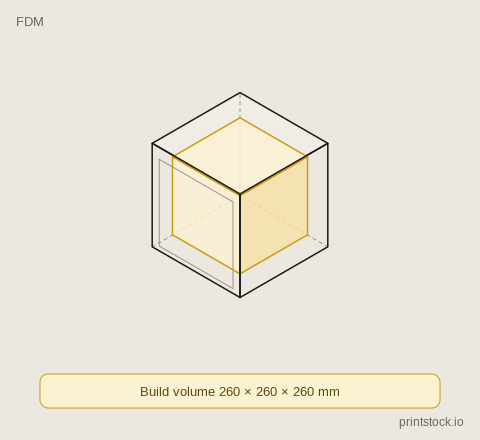
The FUNMAT HT Enhanced is INTAMSYS's entry machine for printing PEEK and PEKK, and for years one of the cheapest printers that can do it properly. Its thermal package is the point: a 450 °C all-metal hotend, a 160 °C glass bed and an actively heated 90 °C chamber, in a 260 mm cube of build space.
A heated chamber is what separates it from consumer printers that list "PEEK capable" on a hot nozzle alone; without it, PEEK cools unevenly and parts warp or stay weak. Even so, 90 °C is the floor for PEEK, not luxury. INTAMSYS itself says the HT is not suited to PEI (ULTEM) or PPSU, which need hotter chambers like the PRO 610HT.
It is a single-extruder machine fed from an SD card, so there is no soluble support and no network printing. Treat it as a tool for PEEK prototypes and application development rather than a production cell.
Best for
- Labs and engineers starting with PEEK and PEKK
- Functional prototypes in high-temperature polymers
- Universities and research groups on a budget
Look elsewhere if
- You need PEI (ULTEM) or PPSU: INTAMSYS says the HT cannot print them
- You want soluble supports or network printing
Before you buy
- Expect a tuning period with PEEK and budget spare material.
- Nozzles are wear parts at these temperatures; order spares.
- Plan a dry box: PEEK and PA must be printed dry.
- Files load by SD card only.
Pros and cons
Pros
- Heated 90 °C chamber at a low price
- 450 °C hotend
- Open materials
Cons
- Single extruder
- No PEI or PPSU
- SD card only
Known issues
Last reviewed Nov 15, 2026Popular models have longer lists simply because more people own them and talk about them. Severity and status show how much each problem matters today.
PEEK has a learning curve
Moderate (affects prints)Workaround availableReviewers new to PEEK report many failed prints before getting good parts, and burned through material while tuning temperatures and cooling. Budget spare material and time for tuning, or use the maker's tested profiles.
Nozzles clog from carbonised material
Moderate (affects prints)Workaround availableAt PEEK temperatures, burnt material builds up inside the nozzle and narrows it until it clogs. INTAMSYS's service guide treats nozzles as wear parts and recommends cleaning and timely replacement; crystallised PEEK is hard to remove once it sets.
How we build this list: we collect independent reviews, owner reports and public discussions on forums and social networks, merge duplicates and group them by cause. Only serious or recurring problems make the list, so a single complaint will not appear here, and a listed problem does not mean every unit is affected.
Specs
Printing
- Type
- FDM
- Process
- FDM (filament)
- Made for
- Professional
- Build volume
- 260 × 260 × 260 mm
- Kinematics
- Cartesian gantry
- Max speed
- 300 mm/s
- Multi-color
- No
- Nozzles / toolheads
- 1
- Materials
- PEEK, PEKK, PA, PA-CF, PC, ABS, PLA
- Layer thickness
- 0.05 to 0.3 mm
- Filament
- 1.75 mm, open materials
- Extruders
- 1
Extruder and bed
- Extruder
- Direct drive
- Stock nozzle
- 0.4 mm (0.4 and 0.6 mm brass, 0.4 mm steel)
- Nozzle / hotend
- Swappable standard and all-metal high-temperature hotends
- Max nozzle temp
- 450 °C
- Filament
- 1.75 mm
- Build plate
- Glass-ceramic plate with PI film
- Max bed temp
- 160 °C
- Bed leveling
- Automatic
- Enclosure
- Yes
- Heated chamber
- Up to 90 °C
Files and setup
- Files the slicer opens
- STL, OBJ
Software
- File transfer
- SD card
From maker and store specifications, checked Nov 15, 2026. Power, size, network and warranty are in their own blocks below.
Power and setup
Electricity
- Mains input
- Separate 110 V and 220 V versions
- Rated power
- 1,200 W
- Note
- 100 to 132 V at 15 A or 200 to 240 V at 7 A
Space and room
- Size (W × D × H)
- 543 × 501 × 645 mm
- Weight
- 63 kg
On a standard power circuit
- US 15 A / 120 V standard circuit: fine, and about 200 W stays free for other things on that circuit while it heats up
- EU/UK 16 A / 230 V standard circuit: fine, and about 1,700 W stays free for other things on that circuit while it heats up
Our calculation from the maker's rated power, keeping a circuit at 80% for long loads.
For business buyers
Software and firmware
- Slicer / control software
- INTAMSUITE NEO (INTAMSYS); profiles for Cura-based workflows
- Connectivity
- SD card
Questions people ask
Can the FUNMAT HT Enhanced print PEEK?
Yes. It combines a 450 °C hotend, a 160 °C bed and a 90 °C heated chamber, which is what PEEK and PEKK need.
Can it print ULTEM (PEI) or PPSU?
INTAMSYS says the FUNMAT HT and the PRO 410 are not capable of printing PEI and PPSU. Use the PRO 610HT with its 300 °C chamber for those.
How big is the build volume?
260 × 260 × 260 mm.
How do you send files to it?
The FUNMAT HT and HT Enhanced load print files from an SD card.
Models proven to print on the INTAMSYS FUNMAT HT Enhanced
Coming soonClosest alternatives by price
Compare all side by side