HP Metal Jet S100
HP's metal binder jetting system for volume production: 430 × 309 × 170 mm build, 1,200 dpi, 63,360 nozzles; parts are sintered after printing.
How to buy
HP sells this machine through quotes and resellers; the price depends on configuration, software and service.
Taxes, delivery, installation and any import duties are set by the seller when you order; agree them with the maker or its reseller.
Overview
HP's Metal Jet S100 applies the company's inkjet know-how to metal. A thin layer of stainless steel powder is spread, and six thermal inkjet heads with 63,360 nozzles jet binder at 1,200 dpi to define each slice. The finished powder box is cured, depowdered and the green parts are sintered in an industrial furnace, the same way metal injection moulded parts are.
It targets volume production of small and medium steel parts, where no supports are needed and many parts can be nested in one build. Automotive suppliers such as Volkswagen and GKN, and Schneider Electric, have used it. A detachable build unit travels between the powder station, printer, curing station and powder removal station, so the printer keeps working.
HP launched it in 2022 and later raised the build height to 170 mm; an S100D entry option cures inside the printer. Sold on quotation.
Best for
- High-volume small stainless steel parts
- Companies moving parts from metal injection moulding
- Automotive and industrial suppliers
Look elsewhere if
- Prototypes or one-offs
- Alloys beyond HP's stainless list
- Shops without sintering furnaces
Before you buy
- Plan a sintering furnace and the process know-how to control shrinkage.
- Ask which configuration (S100, S100P, S100D) fits your volume.
- Check current HP material list.
Pros and cons
Pros
- Production speed
- No supports needed
- Automated station workflow
Cons
- Needs sintering expertise
- Limited materials
- Quote only
Known issues
Last reviewed Nov 15, 2026We have not found serious or recurring problems with this model so far.
How we build this list: we collect independent reviews, owner reports and public discussions on forums and social networks, merge duplicates and group them by cause. Only serious or recurring problems make the list, so a single complaint will not appear here, and a listed problem does not mean every unit is affected.
Specs
Printing
- Type
- Metal
- Process
- Binder jetting
- Made for
- Industrial
- Build volume
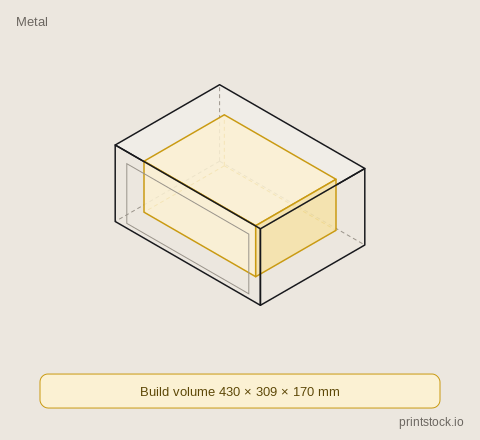
- 430 × 309 × 170 mm
- Materials
- Stainless steel
- Print heads
- 6 HP Thermal Inkjet heads, 63,360 nozzles
- Layer thickness
- 35 to 140 µm
- Resolution
- 1,200 dpi
Hardware
- Enclosure
- Yes
Files and setup
- Variants
- S100P, S100D
Process
- Technology
- Metal binder jetting, then cure, depowder and sinter
- Workflow
- Detachable build unit moves between powder, print, cure and depowder stations
Materials
- Materials
- HP Metal Jet 316L and 17-4PH stainless (MPIF standards)
From maker and store specifications, checked Nov 15, 2026. Power, size, network and warranty are in their own blocks below.
Power and setup
Network and cloud
- Slicers from other makers
- Supported
- Note
- Runs on HP's software: 3D Build Manager and Command Center, the Metal Jet API, Digital Sintering simulation and Process Development with open parameters; Dyndrite's build manager can also create and submit jobs.
Space and room
- Size (W × D × H)
- 2,975 × 1,350 × 2,410 mm
- Weight
- 851 kg
For business buyers
What the room needs
- Separate powder, curing and powder removal stations
- Sintering in an industrial furnace (not included in the printer)
Software and firmware
- Slicer / control software
- HP software; Dyndrite build manager supported
Questions people ask
What is the Metal Jet S100 build size?
430 × 309 × 170 mm effective on the S100 configuration.
Which materials does it print?
HP Metal Jet 316L and 17-4PH stainless steels.
Are parts finished after printing?
No, they are cured, depowdered and sintered in a furnace.