HP Jet Fusion 5600
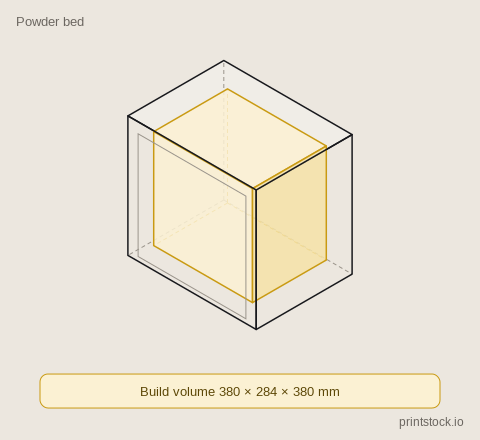
HP's production Multi Jet Fusion printer: 380 × 284 × 380 mm (41 L), up to 3,466 cm³/h, 0.09 mm layers, 1200 dpi, PA11, PA12, PP and TPU.
How to buy
HP sells this machine through quotes and resellers; the price depends on configuration, software and service.
Taxes, delivery, installation and any import duties are set by the seller when you order; agree them with the maker or its reseller.
Overview
The Jet Fusion 5600 is HP's production machine for Multi Jet Fusion, the powder process HP introduced in 2016. Instead of a laser, an inkjet head lays fusing and detailing agents on each layer of nylon powder and infrared lamps fuse it, building a 380 × 284 × 380 mm volume at up to 3,466 cm³ per hour.
Service bureaus run fleets of these for nylon parts in PA11, PA12, polypropylene and TPU, including white and ESD-safe modes. HP sells it with automated powder handling and usage-based service options, aimed at shops making hundreds of parts a week.
It is a big investment: an 880 kg printer, a 4.1 × 3.7 m operating area and three-phase power, sold on quotation. Formlabs, a competitor, puts the printer at around $400,000 and the full ecosystem above $600,000; ask HP's resellers for your configuration.
Best for
- Service bureaus and factories making nylon parts at volume
- Consistent PA11 and PA12 production with HP materials
- Shops wanting usage-based service contracts
Look elsewhere if
- Low volumes: benchtop SLS costs a fraction
- No three-phase power or space for a 4 m operating area
Before you buy
- Plan three-phase power and the full operating area.
- Budget the powder processing station and cooling units.
- Compare usage-based and purchase pricing with HP.
Pros and cons
Pros
- High throughput
- Mature materials
- Big service network
Cons
- Very expensive
- Large footprint
- Three-phase power
Known issues
Last reviewed Nov 15, 2026We have not found serious or recurring problems with this model so far.
How we build this list: we collect independent reviews, owner reports and public discussions on forums and social networks, merge duplicates and group them by cause. Only serious or recurring problems make the list, so a single complaint will not appear here, and a listed problem does not mean every unit is affected.
Specs
Printing
- Type
- Powder bed (SLS, MJF)
- Process
- Multi Jet Fusion (MJF)
- Made for
- Industrial
- Build volume
- 380 × 284 × 380 mm
- Materials
- PA, TPU, PP
- Build speed
- Up to 3,466 cm³/h
- Layer thickness
- 0.09 mm
- Resolution
- 1200 dpi
Hardware
- Enclosure
- Yes
Build
- Effective build volume
- 380 × 284 × 380 mm
Process
- Technology
- HP Multi Jet Fusion (fusing agent and infrared, no laser)
Materials
- Materials
- HP 3D HR PA 11, PA 12, PA 12 S, PA 12 W, PP, TPU and more
Facility
- Operating area
- 4,100 × 3,700 × 2,500 mm
From maker and store specifications, checked Nov 15, 2026. Power, size, network and warranty are in their own blocks below.
Power and setup
Electricity
- Phases
- Three phase
- Rated power
- 12,000 W
- Note
- HP lists 12 kW power consumption; three-phase supply
Network and cloud
- Slicers from other makers
- Supported
- Note
- Gigabit Ethernet; jobs are prepared in HP 3D Build Manager and the fleet is managed with HP 3D Command Center, with the cloud HP 3D Center dashboard as an option. Certified third-party prep includes Autodesk Netfabb and Materialise.
Space and room
- Size (W × D × H)
- 2,210 × 1,268 × 1,804 mm
- Weight
- 880 kg
- Max humidity
- 80%
For business buyers
What the room needs
- Operating area 4,100 × 3,700 × 2,500 mm; printer 880 kg
- Room humidity 40 to 80%
- Powder handling area with depowdering and sieving; operators need PPE for fine nylon powder
Software and firmware
- Slicer / control software
- HP SmartStream 3D Build Manager
Questions people ask
What is the HP 5600 build volume?
380 × 284 × 380 mm.
How fast is it?
Up to 3,466 cm³ per hour, by HP's figure.
Does MJF use a laser?
No. It jets fusing and detailing agents onto the powder and fuses it with infrared energy.