Eplus3D EP-M150 Pro
Compact metal printer for dental, medical and jewellery work: Ø150 × 240 mm, one or two 200 W or 500 W lasers, open materials.
How to buy
Eplus3D sells this machine through quotes and resellers; the price depends on configuration, software and service.
Taxes, delivery, installation and any import duties are set by the seller when you order; agree them with the maker or its reseller.
Overview
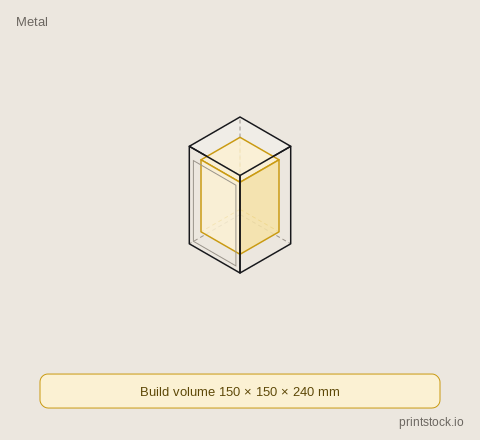
The EP-M150 Pro is Eplus3D's compact laser powder bed fusion machine. It builds in a Ø150 mm round chamber, 240 mm tall, with one or two fibre lasers of 200 W or 500 W, and is aimed at small, precise parts: dental crowns and frameworks, medical implants, jewellery and research.
The small build means less powder to fill the machine, which matters when testing materials or running expensive alloys, and Eplus3D runs it as an open system with titanium, aluminium, nickel alloys, maraging and stainless steels, cobalt chrome and copper. A dental version with an 80 mm tall build and 200 W lasers is sold separately.
Despite the small build it is a 1.5 t machine on three-phase power that needs inert gas. Sold on quotation through distributors.
Best for
- Dental labs printing crowns and frameworks
- Jewellery and small medical parts
- Universities and material research
Look elsewhere if
- Parts wider than 150 mm
- Buyers without three-phase power and inert gas
Before you buy
- Pick single or dual laser and 200 or 500 W for your materials.
- Plan 380 V three-phase and argon or nitrogen.
- Ask the distributor about local service and parameter packages.
Pros and cons
Pros
- Low powder fill for small builds
- Open materials
- Dual-laser option
Cons
- Small round build
- Heavy for its size
- Quote only
Known issues
Last reviewed Nov 15, 2026We have not found serious or recurring problems with this model so far.
How we build this list: we collect independent reviews, owner reports and public discussions on forums and social networks, merge duplicates and group them by cause. Only serious or recurring problems make the list, so a single complaint will not appear here, and a listed problem does not mean every unit is affected.
Specs
Printing
- Type
- Metal
- Process
- Laser powder bed fusion (metal)
- Made for
- Industrial
- Build volume
- 150 × 150 × 240 mm
- Laser output
- 2 × 500 W
- Materials
- Titanium, Aluminium, Nickel alloy, Stainless steel, Cobalt chrome, Copper
- Layer thickness
- 20 to 50 µm (200 W); 20 to 100 µm (500 W)
- Spot and speed
- 60 µm spot, up to 8 m/s
Hardware
- Enclosure
- Yes
Files and setup
- Variants
- Single or dual laser, EP-M150 Dental
Lasers
- Lasers
- Fibre 200 W or 500 W, single or dual
Facility
- Gas
- Argon or nitrogen, oxygen ≤100 ppm
Software
- Software
- EP-Hatch, EP-Control
From maker and store specifications, checked Nov 15, 2026. Power, size, network and warranty are in their own blocks below.
Power and setup
Electricity
- Mains input
- 380 to 480 V three-phase
- Circuit the maker asks for
- 23 A
- Rated power
- 12,000 W
- Note
- Dual laser: 13.5 kW, 28 A
Space and room
- Size (W × D × H)
- 2,120 × 980 × 2,250 mm
- Weight
- 1,500 kg
- Gas or air supply
- Argon or Nitrogen
For business buyers
What the room needs
- Inert gas (argon or nitrogen) and a room set up for fine metal powder: ATEX-rated vacuum, PPE and a metal-fire plan
Software and firmware
- Slicer / control software
- EP-Hatch
Questions people ask
How big is the EP-M150 Pro build?
Ø150 × 240 mm.
What power does it need?
380 V three-phase, about 12 kW (13.5 kW with two lasers).
Is there a dental version?
Yes, the EP-M150 Dental with an 80 mm tall build.