EOS M 290
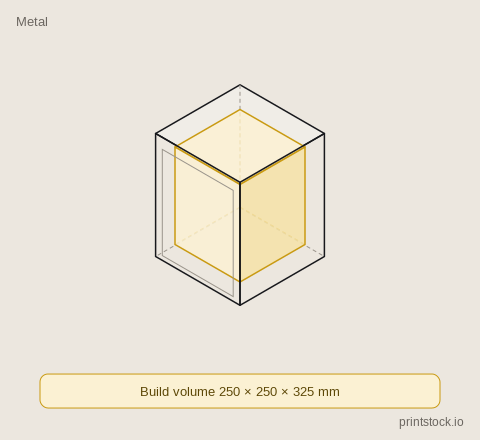
The industry's reference DMLS metal printer: 250 × 250 × 325 mm, one 400 W fibre laser, widest qualified material list; dual-laser M 290-2 option.
How to buy
EOS sells this machine through quotes and resellers; the price depends on configuration, software and service.
Taxes, delivery, installation and any import duties are set by the seller when you order; agree them with the maker or its reseller.
Overview
The EOS M 290 is the machine most metal additive manufacturing is benchmarked against. It melts metal powder with a single 400 W fibre laser over a 250 × 250 mm field, 325 mm tall including the plate, and EOS and its customers have qualified more alloys and processes on it than on any other platform: stainless and tool steels, titanium, aluminium, nickel superalloys and cobalt chrome.
It is used for aerospace brackets, medical implants, dental frameworks and tooling inserts, often where a part must be certified. EOSTATE monitoring watches the laser, powder bed and melt pool for quality records. A dual-laser M 290-2 (2 × 400 W, both covering the full field) launched in late 2024 for more speed with the same parameters.
Planning matters: it needs a 32 A three-phase supply, inert gas at 7 bar, about 1.25 t of floor loading and a room set up for reactive powder. It is sold on quotation.
Best for
- Certified aerospace, medical and dental metal parts
- Shops that want proven, transferable process parameters
- First production LPBF machine for a manufacturer
Look elsewhere if
- Large parts beyond 250 mm
- Buyers without a powder-safe room and inert gas
Before you buy
- Budget for powder, gas, sieving station and post-processing (heat treatment, wire EDM, machining).
- Check floor loading (about 1.25 t) and a 32 A three-phase circuit.
- Ask which parameter sets come with the machine and which cost extra.
Pros and cons
Pros
- Most qualified materials
- Proven, transferable parameters
- Strong monitoring
Cons
- Single laser is slow for big batches
- High running costs
- Quote only
Known issues
Last reviewed Nov 15, 2026We have not found serious or recurring problems with this model so far.
How we build this list: we collect independent reviews, owner reports and public discussions on forums and social networks, merge duplicates and group them by cause. Only serious or recurring problems make the list, so a single complaint will not appear here, and a listed problem does not mean every unit is affected.
Specs
Printing
- Type
- Metal
- Process
- Laser powder bed fusion (metal)
- Made for
- Industrial
- Build volume
- 250 × 250 × 325 mm
- Laser output
- 400 W
- Materials
- Stainless steel, Tool steel, Titanium, Aluminium, Nickel alloy, Cobalt chrome
Hardware
- Enclosure
- Yes
Files and setup
- Variants
- EOS M 290-2
Process
- Technology
- Laser powder bed fusion (EOS calls it DMLS)
Lasers
- Laser
- 1 × 400 W Yb fibre; M 290-2 has 2 × 400 W
- Focus and scan speed
- About 100 µm spot, up to 7 m/s
Facility
- Gas
- Inert gas or compressed air 7 bar, 20 m³/h
Software
- Software
- EOSPRINT, EOSTATE monitoring, EOS Build subscriptions
From maker and store specifications, checked Nov 15, 2026. Power, size, network and warranty are in their own blocks below.
Power and setup
Electricity
- Mains input
- 380 to 480 V three-phase
- Circuit the maker asks for
- 32 A
- Rated power
- 8,500 W
- Average while printing
- 2,400 W
Network and cloud
- Slicers from other makers
- Supported
- Note
- Jobs are prepared in EOS's EOSPRINT, or in Materialise Magics through its EOS build processor; EOSCONNECT links the machine to factory systems.
Space and room
- Size (W × D × H)
- 2,500 × 1,300 × 2,190 mm
- Weight
- 1,250 kg
- Gas or air supply
- Argon or Nitrogen or Compressed air
For business buyers
What the room needs
- Compressed air or inert gas: 7 bar, 20 m³/h
- Inert gas (argon or nitrogen) and a room set up for fine metal powder: ATEX-rated vacuum, PPE and a metal-fire plan
Software and firmware
- Slicer / control software
- EOSPRINT
Questions people ask
What is the EOS M 290 build volume?
250 × 250 × 325 mm, height including the build plate.
What power supply does it need?
32 A at 400 V; up to 8.5 kW, about 2.4 kW typical.
Is there a faster version?
Yes, the EOS M 290-2 with two 400 W lasers over the full field.