$50 as of Nov 11, 2026Check price
Elegoo
Elegoo Saturn 4 Ultra
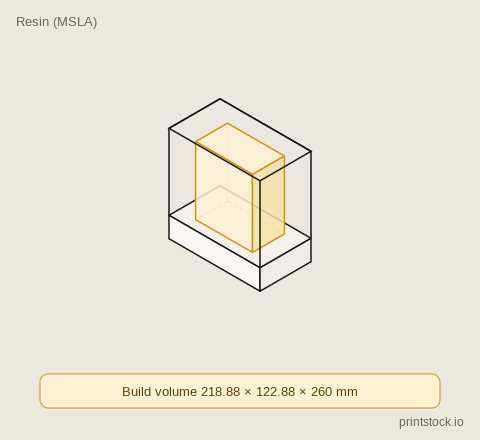
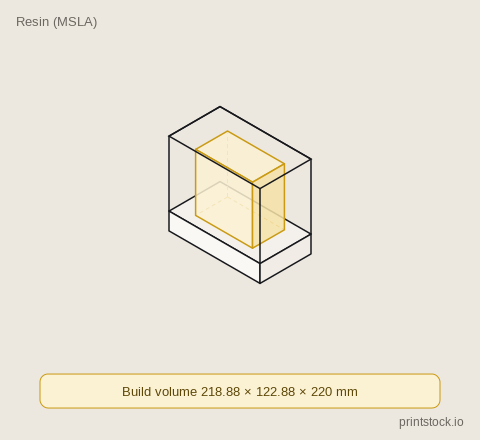
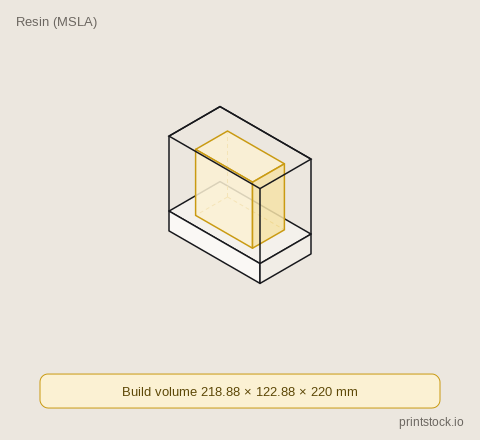
ResinMSLA218.88 × 122.88 × 220 mm
Large-format MSLA resin printer with a 10 in 12K mono LCD (19 × 24 µm), 218.88 × 122.88 × 220 mm volume, tilt-release vat rated up to 150 mm/h, AI camera, Wi-Fi and automatic leveling.
Where to buy
Prices as of Nov 11, 2026Taxes, shipping and any import duties are worked out by the store at checkout and depend on your country; ask the store if in doubt.
Store links may be affiliate links: we may earn a commission, and it does not change your price. Affiliate disclosure
Price history, 90 days
Lowest: $307.45 · Highest: $513.04Overview
The Elegoo Saturn 4 Ultra, released in 2024, brought tilt release to a mainstream large-format resin printer. Instead of lifting the build plate several millimeters after each layer, the vat and screen tilt to peel the cured layer off the film. Peel forces drop, and Elegoo rates it at up to 150 mm/h, several times faster than a classic lift-and-peel Saturn.
The 10 in 12K screen gives a 19 × 24 µm pixel, fine enough for tabletop miniatures, busts and display pieces, and the 220 mm height handles tall models. It adds quality-of-life features that cheaper resin printers lack: automatic leveling, Wi-Fi printing, an AI camera that alerts you to failures and resin-level detection. At our last check it sold for about $307, with bundles around $513.
In January 2025 Elegoo launched the Saturn 4 Ultra 16K, which adds a 14 × 19 µm pixel and a heated vat but has a slightly smaller platform. The 12K remains good value. Owners report the tilt mechanism brings its own quirks: force-sensor errors, knocking from the tilt axis and suction on large flat parts.
Best for
- Tabletop miniatures, busts and display models
- Batch printing many minis on a large plate
- Resin users who want Wi-Fi and a camera on a budget
Look elsewhere if
- You want the finest detail and a heated vat: the Saturn 4 Ultra 16K adds both
- You cannot ventilate a room: resin fumes and handling need a dedicated space
- You want functional engineering parts: an FDM printer suits that better
Before you buy
- Plan for a wash and cure station, gloves, IPA or water-washable resin and ventilation.
- Keep resin above about 20 °C; the 12K has no vat heater, so cold rooms cause failures.
- Orient large flat parts at an angle to reduce suction on the tilt mechanism.
- Update firmware over the air before the first print.
Pros and cons
Pros
- Much faster than lift-and-peel printers
- Large 10 in build plate
- Auto leveling, Wi-Fi and AI camera
- Good value against the 16K version
Cons
- No vat heater (added on the 16K)
- Tilt mechanism adds failure modes
- Large flat parts suffer from suction
Maker's test data
- Print speed
- Up to 150 mm/h, about 5.5 s per layer under general settings, and 2 times faster than the Saturn 3 Ultra, per Elegoo.
Published by the manufacturer from its own tests. PrintStock has not verified these figures; owner reports below may confirm or contradict them.
What owners like
Crisp 12K prints with smart features
Praised by most ownersReviewers praise sharp 12K prints, auto leveling, the tilting vat, speed and the camera at an affordable price.
Works with ordinary resin
Often praisedIt prints fast and crisp with ordinary resin rather than proprietary resins.
Very easy to use
Often praisedOwners call it nearly plug and play, with no calibration fuss.
Collected the same way as known issues: from independent reviews, owner reports and public discussions, merged and grouped.
Known issues
Last reviewed Nov 13, 2026Popular models have longer lists simply because more people own them and talk about them. Severity and status show how much each problem matters today.
LCD dies early
Major (repair or return)Workaround availableDead-pixel blotches appear at 100 to 400 hours as resin pressure on the panel rises; lower leveling thresholds and keep a spare.
Force-sensor and self-test errors
Moderate (affects prints)Workaround availableThe most reported problem is false force-sensor errors during auto leveling and self-test. Cleaning the vat seat, reseating the vat and updating firmware usually clears them.
Suction on large flat prints
Moderate (affects prints)Workaround availableThe tilt peel struggles with large flat cross sections, which can tear parts off supports. Angle parts, add drain holes to hollow models and use the slower print mode for big pieces.
Early hardware faults reported by reviewers
Moderate (affects prints)Still reportedFabbaloo's hands-on review hit several hardware issues before getting good prints, which lowered its beginner score. Check the unit fully during the return window.
Resin leaks into the chassis
Moderate (affects prints)Still reportedThe tilting vat cannot be sealed, so spills reach the electronics and Z motor.
Thick base and raft
Moderate (affects prints)Workaround availableThe spring plate starts exposure before resin flows back; raise rest time after retract.
No vat heater on the 12K
Moderate (affects prints)Workaround availableCold resin causes failed prints and false foreign-matter alerts; an optional heater or warm room helps.
Tilt peel bends parts
Moderate (affects prints)Workaround availableThe angled peel can bend parts and tear supports.
Vat knob strips or seizes
Minor (annoyance)Workaround availableThe vat lock knob strips its thread or seizes with cured resin.
Soft PFA film scratches
Minor (annoyance)Workaround availableWiping scratches the film, and the 60,000-release counter ignores real wear.
OTA can flash the wrong image
Minor (annoyance)Workaround availableMismatched firmware causes boot hangs, and Elegoo publishes no changelog.
How we build this list: we collect independent reviews, owner reports and public discussions on forums and social networks, merge duplicates and group them by cause. Only serious or recurring problems make the list, so a single complaint will not appear here, and a listed problem does not mean every unit is affected.
Specs
Printing
- Type
- Resin
- Build volume
- 218.88 × 122.88 × 220 mm
- Kinematics
- MSLA
- Resolution
- 12K (11520 × 5120), 19 × 24 µm
- LCD
- 10 in 12K monochrome, 11520 × 5120 pixels
- XY resolution
- 19 × 24 µm
- Z accuracy
- 0.02 mm
- Layer thickness
- 0.01 to 0.2 mm
- Speed
- Up to 150 mm/h (fast mode with tilt release)
Hardware
- Build plate
- Laser-engraved quick-release build plate
- Bed leveling
- Automatic
Control and sensors
- Screen
- Touchscreen, 4 in
- Features
- AI print failure detection
Files and setup
- Variants
- Standard, Bundle
Vat
- Release system
- Tilt release: the vat and screen tilt to peel each layer; PFA release film
Light
- Light source
- COB array, 405 nm, with Fresnel collimating lens
Features
- Camera
- AI camera for remote monitoring and failure alerts
- Sensors
- Resin level detection, residue detection
Software
- Slicers
- CHITUBOX, ElegooSlicer (formerly Satellite)
From maker and store specifications, checked Nov 12, 2026. Power, size, network and warranty are in their own blocks below.
Power and setup
Electricity
- Rated power
- 144 W
- Note
- 24 V, 6 A power supply
Network and cloud
- Works without internet
- Yes, fully (SD card / USB / LAN)
- Maker account
- Only for cloud / remote features
- Slicers from other makers
- Supported
- Built-in camera
- Yes
- Note
- Wi-Fi printer that pairs with the Elegoo Matrix app; remote control and print history need an Elegoo account, while some local functions work without logging in. Prints from the included USB drive; other slicers can find it on the same Wi-Fi network.
Space and room
- Size (W × D × H)
- 327 × 329 × 548 mm
- Weight
- 14.5 kg
On a standard power circuit
- US 15 A / 120 V standard circuit: fine, and about 1,250 W stays free for other things on that circuit while it heats up
- EU/UK 16 A / 230 V standard circuit: fine, and about 2,800 W stays free for other things on that circuit while it heats up
Our calculation from the maker's rated power, keeping a circuit at 80% for long loads.
Safety and support
Warranty and repair
- Warranty
- 12 months; main parts; hotend, plates and screens shorter; a longer period applies where local law requires it
- Spare parts store
- Official page ↗
Running costs
| Standard resin, per kg | Cheapest in our catalog: Elegoo ABS-Like Resin V3.0 | $17.99 |
|---|---|---|
| Release film (FEP / nFEP) | Phrozen FEP Film A4 | $10 |
Starter budget: about $325 for the printer at its best listed price, 1 kg of resin.
Cheapest compatible items in our catalog, USD prices as last checked. Prices change; see each item for the date.
Software and firmware
- Slicer / control software
- CHITUBOX, ElegooSlicer (formerly Satellite)
- Firmware
- Over-the-air updates from the printer screen
- Connectivity
- Wi-Fi, USB
Official firmware and downloads ↗ We never host firmware files.
Questions people ask
Saturn 4 Ultra 12K or 16K?
The 16K has a finer 14 × 19 µm pixel and a heated vat that keeps resin at 30 °C, but a slightly smaller 211.68 × 118.37 mm platform. The 12K is cheaper and fine for most miniatures if your room stays warm.
How fast is the Elegoo Saturn 4 Ultra?
Elegoo rates it at up to 150 mm/h in fast mode thanks to tilt release. Real speed depends on resin, layer height and model shape.
What is tilt release?
Instead of raising the build plate to peel each layer, the vat and screen tilt so the film peels away gradually. Peel forces drop, so layers can be printed much faster.
Saturn 4 Ultra or Saturn 4?
The Saturn 4 has the same 12K screen but no tilt release, camera or Wi-Fi, so it is slower and less automated. The Ultra is worth the difference for most buyers.
Models proven to print on the Elegoo Saturn 4 Ultra
Coming soonCompatible accessories
Everything that fits the Elegoo Saturn 4 Ultra
$114.99 as of Nov 11, 2026Check price
$60 as of Nov 11, 2026Check price
$45.99 as of Nov 11, 2026Check price
Closest alternatives by price
Compare all side by side