Carbon M3 Max
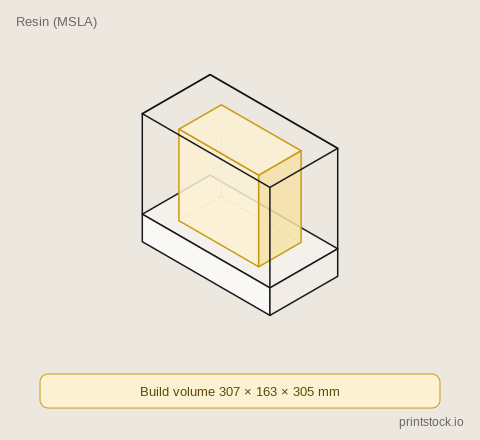
Carbon M3 Max: Digital Light Synthesis printer, 307 × 163 × 305 mm build, accuracy up to ±40 µm, sold on subscription with software and updates included.
How to buy
Carbon sells this machine through quotes and resellers; the price depends on configuration, software and service.
Taxes, delivery, installation and any import duties are set by the seller when you order; agree them with the maker or its reseller.
Overview
The M3 Max is Carbon's current workhorse for production with resins. Carbon's Digital Light Synthesis prints from a continuous liquid interface rather than peeling each layer, which allows fast, isotropic parts, and many materials are dual-cure resins finished in an oven for engineering properties. That is how Carbon made its name with lattice midsoles, helmet liners and dental parts.
The M3 Max doubles the M3's build area with a true 4K light engine at the same pixel size, so it fits larger parts or more small parts per build. Carbon says the new generation cuts part-to-part variation across a build by 30% and improves surface finish.
Carbon sells printers on subscription with software included and regular over-the-air updates; Carbon has quoted entry systems at about $2,100 a month on a 36-month term. Expect to discuss your application before getting a price.
Best for
- Larger production parts or bigger batches than the M3
- Consumer products such as lattices and pads
- Automotive interior and medical production
Look elsewhere if
- You want to own the printer outright
- You print a few prototypes a month
Before you buy
- Ask for the full subscription cost: printer, software, service and minimum term.
- Budget a wash station and oven for dual-cure resins.
- Check which resins suit your part.
Pros and cons
Pros
- Fast, isotropic parts
- Engineering dual-cure resins
- Software updates included
Cons
- Subscription only
- Multi-year commitment
- Extra post-processing equipment
Known issues
Last reviewed Nov 15, 2026We have not found serious or recurring problems with this model so far.
How we build this list: we collect independent reviews, owner reports and public discussions on forums and social networks, merge duplicates and group them by cause. Only serious or recurring problems make the list, so a single complaint will not appear here, and a listed problem does not mean every unit is affected.
Specs
Printing
- Type
- Resin
- Process
- Digital Light Synthesis
- Made for
- Industrial
- Build volume
- 307 × 163 × 305 mm
- Materials
- Resin
- Accuracy
- Up to ±40 µm (maker figure)
Hardware
- Build plate
- Removable machined platform with beveled edges
- Enclosure
- Yes
Control and sensors
- Screen
- Touchscreen
Process
- Technology
- Digital Light Synthesis (DLS), continuous liquid interface
- Consistency
- 30% less cross-build variation than the previous generation (maker figure)
Software
- Software
- Included in subscription, OTA updates about every eight weeks
Business
- Pricing model
- Subscription
Line
- Range
- M2, M3 and M3 Max (189 × 118 to 307 × 163 mm), L1 (400 × 250 × 460 mm)
Materials
- Resins
- Carbon and partner resins: elastomers, rigid, dental, high-temperature
From maker and store specifications, checked Nov 15, 2026. Power, size, network and warranty are in their own blocks below.
Power and setup
Network and cloud
- Works without internet
- No, needs internet
- Maker account
- Required
- Note
- Needs a wired network connection to Carbon's cloud: the printer software is cloud-based and the printer is sold on a subscription with over-the-air updates.
Space and room
- Size (W × D × H)
- 760 × 696 × 1,760 mm
- Weight
- 249 kg
For business buyers
Software and firmware
- Slicer / control software
- Carbon software (cloud), included in subscription
Questions people ask
What is the M3 Max build volume?
307 × 163 × 305 mm.
Can I buy a Carbon printer outright?
Carbon sells on subscription; the software and updates are part of it.
What is DLS?
Digital Light Synthesis: Carbon's continuous resin process, often followed by thermal curing for dual-cure materials.