$21.58 as of Nov 11, 2026Check price
Bambu Lab
Bambu Lab P2S
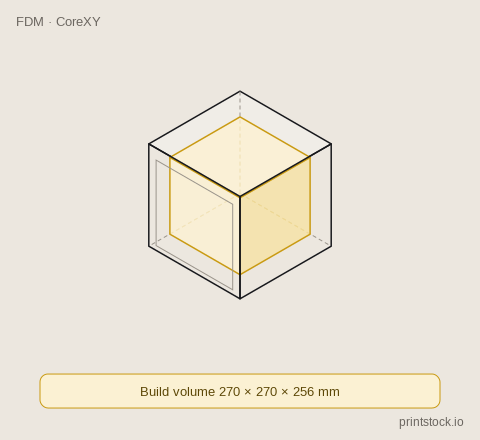
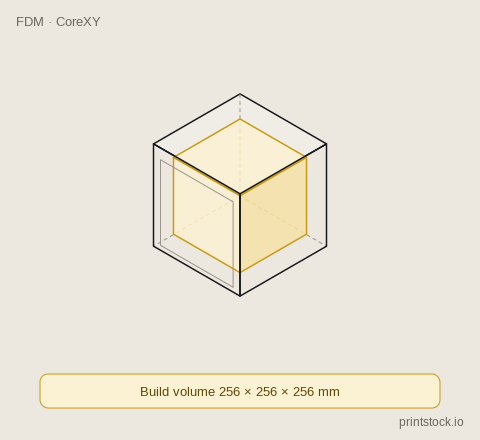
FDMCoreXYEnclosed256 × 256 × 256 mm
Enclosed 256 mm CoreXY printer that replaced the P1S: hardened-steel extrusion path, servo extruder, 5-inch touch screen and an up-to-50 °C chamber for ABS, ASA and fiber-filled filaments.
- Most nozzles of the 38 FDM printers under $500 we list
Where to buy
Prices as of Nov 11, 2026Taxes, shipping and any import duties are worked out by the store at checkout and depend on your country; ask the store if in doubt.
Store links may be affiliate links: we may earn a commission, and it does not change your price. Affiliate disclosure
Price history, 90 days
Lowest: $449 · Highest: $649Overview
The P2S is the second-generation version of the P1S, Bambu Lab's best-selling enclosed printer. It keeps the 256 mm cube build volume and CoreXY motion, and changes most of the parts that matter for daily use: a hardened-steel nozzle and extruder gears, a servo extruder, a one-clip quick-swap hotend, an eddy current sensor for flow calibration and a 5-inch touch screen.
The enclosure and Adaptive Airflow system make it a two-mode machine. For PLA it pulls in cold air; for ABS, ASA, nylon and fiber-filled filaments it keeps the heat in, reaching about 50 °C inside without a chamber heater. That covers most engineering filaments hobbyists use, but not high-temperature materials that need an actively heated chamber.
The P2S Combo adds the AMS 2 Pro, which can dry filament while it sits in the unit. At our last check the P2S was $449 and the Combo $649 at the Bambu Lab US store, so the P2S costs about $100 more than the P1S it replaces. Early units and firmware had teething problems, covered under Known issues.
Best for
- One printer for PLA and PETG plus ABS, ASA and carbon fiber filaments
- Owners who print a lot and want quick nozzle swaps and abrasive-ready hardware
- Multi-color printing with filament drying (P2S Combo with AMS 2 Pro)
Look elsewhere if
- You only print PLA and PETG: the open A1 has the same build volume for less
- You need high-temperature materials that require an actively heated chamber: look at the H2 series
- You want a fully open, cloud-free ecosystem: Bambu restricts third-party software (see Software)
Before you buy
- The Combo bundles the AMS 2 Pro, which dries filament; the base P2S has no AMS. Retailers note that adding an AMS later also needs the filament buffer, so check what is in the box.
- Bambu released several firmware fixes in the first months after launch. Owners on the forum recommend waiting a week or two before installing a new firmware version.
- The printer weighs about 15 kg and stands 478 mm tall; plan for a sturdy table and space above it to open the lid.
- For ABS and ASA, keep the lid closed and use the carbon filter; print in a ventilated room.
Pros and cons
Pros
- Hardened-steel nozzle and gears handle carbon and glass fiber filaments
- One-clip hotend swap in about 30 seconds
- Enclosed chamber reaches about 50 °C for ABS and ASA
- Same 256 mm build volume and footprint class as the P1S
Cons
- Several early firmware releases caused new problems
- No active chamber heater for high-temperature materials
- Costs about $100 more than the P1S
Maker's test data
- Hotend flow
- 40 mm³/s maximum in Bambu Lab's test: Bambu ABS, 250 mm round single-wall model, 280°C.
- Filament change speed
- Up to 60% faster filament changes than before, thanks to a servo-driven extruder.
Published by the manufacturer from its own tests. PrintStock has not verified these figures; owner reports below may confirm or contradict them.
Known issues
Last reviewed Nov 13, 2026Popular models have longer lists simply because more people own them and talk about them. Severity and status show how much each problem matters today.
Extruder overload errors
Moderate (affects prints)Workaround availableSome owners get servo extruder overload errors during printing or loading, often around flow calibration. Firmware updates and adjusted settings resolved it for most; others needed support.
Adaptive Airflow weakens PETG cooling
Moderate (affects prints)Still reportedFirmware treats PETG like a high-temperature material and switches to heating mode, cutting part cooling, with no manual override. Opening the door or a custom profile helps; a fix is pending.
First-layer adhesion failures with PETG on default settings
Minor (annoyance)Workaround availableOwners report PETG failing to stick to the included textured PEI plate with the default Standard profile, even with Bambu's own filament; switching to a slower, higher-quality profile helped.
AI detection false alarms
Minor (annoyance)Workaround availableThe camera can flag dark filament, thin geometry or a hand as a defect and pause overnight prints. Sensitivity can be lowered or detection turned off per job.
Purge wiper and bin misaligned
Minor (annoyance)Workaround availableThe waste bin can shift in shipping and the wiper pad wears, so purge misses the trough or lands on the bed. Bambu has a calibration procedure.
Already fixed: 3 (show)
Firmware updates that introduced new faults
Moderate (affects prints)Fixed in firmwareOwner reports and a third-party issue round-up describe early updates that caused under-extrusion with Bambu filament and, for some users, a bed or hotend that stopped heating. Later releases fixed these, and owners now commonly wait a week or two before updating.
Early-batch quality defects
Moderate (affects prints)Fixed in a hardware revisionSome late-2025 units had a slightly concave bed, a right panel that warped at high heat and a rubbing heatbed cable; newer batches have fixes and affected parts are replaced.
High peak power at bed heat-up
Minor (annoyance)Fixed in firmwareFast bed heating draws a lot of power at once and can overload UPS units or shared circuits; Bambu added a Low-Power Mode that heats more slowly.
How we build this list: we collect independent reviews, owner reports and public discussions on forums and social networks, merge duplicates and group them by cause. Only serious or recurring problems make the list, so a single complaint will not appear here, and a listed problem does not mean every unit is affected.
Specs
Printing
- Type
- FDM
- Build volume
- 256 × 256 × 256 mm
- Kinematics
- CoreXY
- Max speed
- 600 mm/s
- Max acceleration
- 20,000 mm/s²
- Multi-color
- Yes
- Nozzles / toolheads
- 1
- Materials
- PLA, PETG, TPU, PVA, PLA-CF, PETG-CF, ABS, ASA, PA, PC, PET, PPA
- Max toolhead speed
- 600 mm/s
- Max hotend flow
- 40 mm³/s (ABS, 280 °C, manufacturer test)
- Filament diameter
- 1.75 mm
Extruder and bed
- Extruder
- Direct drive
- Stock nozzle
- 0.4 mm (0.2, 0.6 and 0.8 mm)
- Nozzle / hotend
- Quick-swap hotend, hardened steel nozzle
- Max nozzle temp
- 300 °C
- Filament
- 1.75 mm
- Build plate
- Flexible steel plate, textured PEI
- Max bed temp
- 110 °C
- Enclosure
- Yes
Control and sensors
- Screen
- Touchscreen, 5 in
- Features
- Flow calibrationAI print failure detection
Files and setup
- Files the slicer opens
- G-code
- Variants
- P2S, P2S Combo
Bed
- Max bed temperature
- 110 °C
Chamber
- Chamber temperature
- Up to about 50 °C (passive, heat-preservation mode)
- Air filtration
- Activated carbon filter
Features
- Cooling
- Adaptive Airflow: cold-air intake for PLA, heat retention for engineering filaments
- Calibration
- Eddy current sensor for flow dynamics calibration, auto bed leveling
- Failure detection
- Camera with AI failure detection
Physical
- Max power draw
- 1200 W at 220 V; 1000 W at 110 V
- Typical power (PLA)
- About 200 W
From maker and store specifications, checked Nov 12, 2026. Power, size, network and warranty are in their own blocks below.
Power and setup
Electricity
- Rated power
- 1,200 W
- Average while printing
- 200 W
Network and cloud
- Works without internet
- Yes, fully (SD card / USB / LAN)
- Maker account
- Only for cloud / remote features
- Local control for other software
- Limited or behind a special mode
- Slicers from other makers
- Supported
- Built-in camera
- Yes
- Note
- Ships with Bambu's authorization control: full control from third-party software needs LAN-only mode with Developer Mode, which turns off the Handy app and cloud.
Space and room
- Size (W × D × H)
- 392 × 406 × 478 mm
- Weight
- 14.9 kg
On a standard power circuit
- US 15 A / 120 V standard circuit: fine, and about 200 W stays free for other things on that circuit while it heats up
- EU/UK 16 A / 230 V standard circuit: fine, and about 1,700 W stays free for other things on that circuit while it heats up
- A 10-hour run (for example, several figures printed one after another): about 2 kWh. Multiply by your price per kWh for the cost.
Our calculation from the maker's rated power and average power while printing, keeping a circuit at 80% for long loads.
Safety and support
Safety
- Air filtration
- Activated carbon filter
Computer you need
- Runs on
- Windows, macOS (Apple silicon), Linux
Warranty and repair
- Warranty
- 24 months; for consumers in the EU, Switzerland, Norway, Iceland, the US and Canada (US and Canada extended from 12 months in 2026); receipts only from Bambu Lab or authorized resellers
- Repair guides
- Official page ↗
- Open source
- No
Running costs
| PLA filament, per kg | Cheapest in our catalog: Elegoo PLA Basic | $9.34 |
|---|---|---|
| Spare nozzle or hotend | Bambu Hotend - H2/P2S/X2D | $17.99 |
| Spare build plate | Bambu 3D Effect Plate | $11.99 |
Starter budget: about $476 for the printer at its best listed price, 1 kg of PLA and a spare nozzle.
Cheapest compatible items in our catalog, USD prices as last checked. Prices change; see each item for the date.
Software and firmware
- Slicer / control software
- Bambu Studio (official); OrcaSlicer and other slicers via Bambu Connect or LAN Developer Mode
- Firmware
- Closed source, with Bambu's Authorization Control and an optional LAN-only Developer Mode
- Connectivity
- Wi-Fi, Bambu Handy app and cloud, LAN mode
Official firmware and downloads ↗ We never host firmware files.
Questions people ask
Bambu Lab P1S or P2S?
Same 256 mm cube build volume. The P2S adds a hardened-steel nozzle and gears, a servo extruder, a quick-swap hotend, a 5-inch screen and higher rated speed (600 vs 500 mm/s). At our last check the P2S was $449 and the P1S $349 at the Bambu Lab US store.
What does the P2S Combo include?
The P2S plus the AMS 2 Pro for multi-color printing, which also dries filament while it is loaded. It was listed at $649 at our last check.
Can the Bambu Lab P2S print carbon fiber filament?
Yes. The nozzle and extruder gears are hardened steel, which resist the wear abrasive filaments cause, and the enclosure keeps heat in for carbon-filled ABS, ASA and nylon.
How big is the Bambu Lab P2S?
The build volume is 256 × 256 × 256 mm. The machine measures 392 × 406 × 478 mm and weighs about 14.9 kg.
Bambu Lab P2S or X2D?
Both are enclosed with similar build volumes. The X2D is Bambu's higher-end model with a 120 °C bed and a higher price; the P2S is the better value if a 110 °C bed and passive chamber are enough for your materials.
Models proven to print on the Bambu Lab P2S
Coming soonFilaments that fit (87)
Matched by PrintStock from published specs: filament diameter, the materials Bambu Lab lists for this printer. Not a print test.
- PETG
- Anycubic PETG, Bambu Lab PETG Basic, Bambu Lab PETG Matte, Creality Hyper PETG, Elegoo PETG Pro, Elegoo Rapid PETG, eSUN PETG, eSUN PETG-Matte, Overture High Speed PETG, Polymaker PETG, Polymaker PolyLite PETG, Prusament PETG, Spectrum PETG, Spectrum PETG Premium High Speed, SUNLU PETG, SUNLU PETG 2.0
- PLA
- Anycubic PLA+, Anycubic PLA Basic, Anycubic PLA High Speed, Anycubic PLA Silk, Bambu Lab PLA Basic, Bambu Lab PLA Matte, Bambu Lab PLA Silk+, Bambu Lab PLA Translucent, Creality Hyper PLA, Creality Hyper PLA RFID, Elegoo PLA, Elegoo PLA Basic, Elegoo PLA Matte, Elegoo PLA Pro, Elegoo PLA Silk, eSUN PLA+, eSUN PLA Basic, eSUN PLA+HS, eSUN PLA-Matte, eSUN PLA-Silk Rainbow, Overture Easy PLA, Overture Matte PLA Dual Colors, Overture PLA+, Overture Silk PLA Gradient, Polymaker Panchroma PLA, Polymaker Panchroma PLA Matte, Polymaker Panchroma PLA Silk, Polymaker PLA Pro, Polymaker PolyLite PLA, Polymaker PolyLite PLA Pro, Polymaker PolyLite Silk PLA, Polymaker PolyMax PLA, Polymaker PolyTerra PLA, Prusament PLA, Spectrum Huracan PLA, Spectrum PLA, Spectrum PLA Pro, Spectrum Premium PLA High Speed, SUNLU High-Speed PLA, SUNLU PLA+ 2.0, SUNLU Silk PLA+ 2.0
- ABS
- Bambu Lab ABS, Creality Hyper ABS, Elegoo ABS, Polymaker PolyLite ABS, Siraya Tech Fibreheart ABS HT HF, SUNLU ABS
Compatible accessories
Everything that fits the Bambu Lab P2S
$47.99 as of Nov 11, 2026Check price
$39.99 as of Nov 11, 2026Check price
$17.99 as of Nov 11, 2026Check price
$11.99 as of Nov 11, 2026Check price
$23.99 as of Nov 11, 2026Check price
Closest alternatives by price
Compare all side by side